MYD Annual Report 2017 is a recollection of Malaysian Youth Delegation’s highlight moments and our financial report for the period Jan 2017 to Dec 2017.
Once again, we wish to thank our sponsors and partners for their confidence in our work. Let’s make our environment GREAT again.
“Interventions” – it is one of the buzzwords at the UN climate conference. It’s a word the privileged folk in their fancy fur coats at the UN like to use to confuse the ordinary people (joking). But to break it down, it simply means the delivery of a statement or comment given during negotiations. And in this article, I would like to specifically talk about interventions given by constituencies.
The purpose of these interventions are to involve civil Non-Party Actors in the process of negotiations. Negotiations are only carried out by parties and blocs. Often, it’s a more symbolic act than anything else because there are also other avenues for civil society groups to influence negotiations (read, local NGOs stalking their local negotiators around and questioning them). But it serves as an important exercise for the constituencies to conceptualise their positions on the various issues and for negotiators to be reminded that the world does not revolve around their country and its’ national interests.
How interventions at the Conference Of Parties works, is that the various constituencies of the United Nations Framework Convention on Climate Change (UNFCCC) are given the chance to offer two minute interventions during the negotiations on behalf of their constituency. If you run longer than two minutes, the mic would be cut off. A little bit unfair considering how negotiators are allowed to run on for as long as they like and some of them take a while to get to their point.
Few infographics on what constituencies are can be viewed here.
Within each constituency there are certain ‘house rules’ if one can use that term. RINGO for example prefers to remain non-partisan and does not comment on the party positions per se. Their interventions normally calls on the inclusion of more research, transparency and a consideration of data into the process of negotiations. I am unsure why these constituencies follow such rules. It could be because they are afraid of being too critical for fear they do not get called upon in the future to speak. Or perhaps because of this unspoken agreement that everyone should be as nice and as indirect as possible in these negotiation chambers.
Drafting these interventions are led by small groups of RINGO members, of which a couple volunteers (usually the first ones to volunteer) take charge of it and the entire constituency is free to contribute on google docs, as far as they are willing and able to. Every morning after the RINGO coordination meeting concludes at 10am, a small team of drafters meet up to work on as much of the intervention as possible – a process which I found muc satisfaction in. The art of diplomatic and succinct writing is key in this and I had a challenging but engaging time putting those skills to the test. Subsequently the intervention is carried out in the negotiation chamber by one of the drafting RINGO members, whom is decided upon by consensus by the team working on the document. At one point it boiled down to a game of scissors paper stone between me and another lady because both of us had put in just as much effort and were just as interested in talking.
Xiandi giving an intervention on behalf of YOUNGO.
YOUNGO on the other hand, has a slightly different and somewhat more haphazard system of working on interventions. The list of interventions is sent out via email and someone (usually the Focal Point if no one is interested enough) will start up a google doc and people chip in as and when they want to online. The choice of intervention is supposedly carried out by putting the names of all interested people into a hat and getting a random passersby to pick out a name. However for one intervention, one of our fellow delegates who had worked on a substantive amount of the document by herself, was not allowed to speak on behalf of YOUNGO because another Malaysian girl had spoken at another intervention earlier. Therefore representatives of this constituency are not necessarily the ones that drafted the document. A case of equity over equality perhaps.
To be able to give the intervention at the negotiations, is seen as something of a matter of pride, especially to YOUNGOs. Perhaps it is our urge to be recognised and taken seriously despite our youth. Or perhaps the constituency just happens to attract individuals who are more enthusiastic about being in the limelight. There are often many names submitted as speakers (although the number of drafters is considerably smaller). RINGOs too looks forward to delivering interventions as everyone likes their two minute of fame but their preoccupation with this is somewhat less.
Seriously though, if you got to deliver an intervention in the famous Chamber Hall, that would be so cool!
Sometimes individuals wait for hours in the negotiation room for their chance to give their two minute intervention. I heard a senior member of RINGO mention that once a representative had to deliver the intervention at 3am. In our case (the other girl won) the APA closing plenary at which she was to deliver the intervention, got suspended after an hour and only resumed at 7.30 pm. And was then suspended yet again (because parties are unable to arrive at a consensus) and eventually the secretariat decided not to have interventions for that plenary. For the CMP closing plenary, the representatives gave their interventions at 5 am in the morning.
That is the face of a man (Mike) who has gone without sleep, to deliver an intervention. Dedication!
In conclusion, I would say that the system of interventions is important as it highlights the importance of non-party stakeholder interventions in the process of negotiations. However individuals could perhaps be a little less preoccupied with getting their two minutes of fame and focus on delivering a solid, insightful intervention that reflects the views of the constituency as a whole.
COP23 is an easy place to metaphorically and literally get lost at. Especially when you’re a first timer. First there is the issue of two zones which has you clearing security and hopping on the shuttle/ bike/ electric car/ brisk walking multiple times a day to and fro. Add to that the multiple sections per zone and the umpteen rooms and you have a lot of harried looking people running around trying to get to where they are supposed to be.
It is a rather picturesque walk/ cycle between the zones though.
I did not think I would get metaphorically lost as much as I did however. Prior to our departure to COP, we prepared through a mixture of self-study, group study sessions and training series. Feeling so ready, I descend on COP23 on my first day, eager and ready to throw myself in and found myself overwhelmed with the sheer volume of activities and negotiations. And amidst the 25 000 or so people who’ve descended on Bonn from all over the world, you feel like a tiny helpless fish. It took some time and effort, falling sick and getting injured to even begin to have a handle on things and to feel like I had a purpose and could contribute in some way.
By the end of Thursday of the first week, I was starting to feel unwell and the next morning I woke up feverish and nausea. I had successfully managed to work myself up and stress myself out over worrying about not accomplishing anything and not understanding enough. Friday became a break day for me, and I focused on writing one of my articles and going over the goals I had set myself to achieve at the COP. I started to realise the advice given by our seniors in MYD to not be too ambitious and which had fallen on deaf ears at that point actually made alot of sense. So I started to revise those goals. Come Saturday, the much awaited Climate Action Network (CAN) Party happened. It was a full night of partying, fun and letting one’s hair down. About 4 am, someone dropped a beer bottle on my foot which shattered. Let’s say I ended that night somewhat lamely (pun intended). Later that day, after getting a few hours of sleep, I awoke in excrutiating pain and could barely walk. The bottle had dropped right ontop of my middle toe. I was so thankful I had been wearing boots or I would have had to deal with a bloody foot too. I started inquiring into whether my travel insurance covered fractured toes. Thankfully by Monday the pain had subsided somewhat thanks to this awesome cream my host had given me and I knew it wasn’t a fracture.
So by Monday I had already found my footing, as best as one can anyway, with a near fractured toe. I found a negotiational track that had meaning for me: Loss and Damage and the Warsaw International Mechanism. Then I limped to my new home at the Research and Independent Non- Governmental Organisations (RINGO) constituency. I found that I enjoyed interviewing people for our FB page. This slower pace my body was forced to take enabled my mind to slow down too and absorb more.
Lunch sessions with our Malaysian negotiators is crucial to learning and understanding the process of negotiations.
The whispers around the corridor and at the coffee bars said that the Loss and Damage track was not going to be successful and the necessary technical details for the Warsaw International Mechanism would not be discussed sufficiently. However I found this stoked my interest and the divide it was creating between the developing and developed countries was intriguing to observe in the process of negotiations. Negotiators from developing countries were pushing for ironing out how the finances for this element were going to be like while negotiators from developed countries like USA and Australia would deliberately block this.
Drafting interventions was an intensive and tricky exercise in delivering crucial messages concisely and diplomatically. Interventions are an important formalised medium for non-party stakeholders to have a say in the process of negotiations. I worked on four interventions in total, three for the RINGOs and one for the youth constituency called YOUNGO. The interventions were delivered at the opening and closing plenaries of the various tracks. Unfortunately I did not get to deliver any myself in the hall as the other members of the drafting teams that I worked on got the opportunity but I found it to be a very useful learning process and a fun way to meet like-minded people.
Hard at work drafting an intervention!
Meeting people at COP is a good way to stay grounded by sharing your experiences with each other and learning. I found I was not the only one getting lost, which was immensely reassuring and the people with different backgrounds were able to help me understand, at least a little bit, the UNFCCC and its process from the view of the different stakeholders and parties. I took my task of conducting interviews as a way to bring different voices to the table to spread awareness via social media in Malaysia about climate change and the gravity and urgency of the issue. The process of conducting the interviews and meeting people gave me a sense of purpose as well, in transmitting what I knew back home. I managed to conduct 6 interviews in total, of which 2 have been published so far and the other 4 are work in progress.
Meeting people from all around the world! Featuring: Germany, Fiji and Sri Lanka.
Overall, the COP23 experience was a great learning tool both personally and professionally and it felt amazing to be able to contribute in some small way to this huge gargantuan process that is attempting to address climate change.
COP23 is the 23rd Conference of the Parties to the United Nations Framework Convention on Climate Change (UNFCCC). It is the main annual meeting of all nations under the UNFCCC to build and strengthen intergovernmental climate policy.
COP23 will be held from November 6-17, 2017, in Bonn, Germany.
The Conference will comprise sessions of:
the Conference of the Parties (COP 23);
the Conference of the Parties serving as the meeting of the Parties to the Kyoto Protocol (CMP 13);
the Conference of the Parties serving as the meeting of the Parties to the Paris Agreement (CMA 1.2);
the Subsidiary Body for Implementation (SBI 47);
the Subsidiary Body for Scientific and Technological Advice (SBSTA 47);
the Ad Hoc Working Group on the Paris Agreement (APA 1.4).
A Little about COP23
COP23 will be focusing on:
Accelerating the implementation of the Paris Agreement
Catalyzing and supporting climate action happening at a global scale
The special thing about COP23 is that the conference is led by the Presidency of Fiji (Fiji is the host) but hosted off-site in Bonn (where the UNFCCC Secretariat is). So, the host team works closely with the secretariat of UNFCCC, both governments, the State of North Rhine-Westphalia and the city of Bonn in organizing this conference.
COP23 is fused with the Fijian Bula spirit, which means hello or welcome, with a deeper sense of wishing others a blessing of affection and good health. The conference plans on showcasing Fijian and Pacific culture, art and life. The design of the logo was meant to act as a reminder that rising sea levels are affecting not only small island developing states but also coastal cities in many other countries.
One Conference, Two Zones
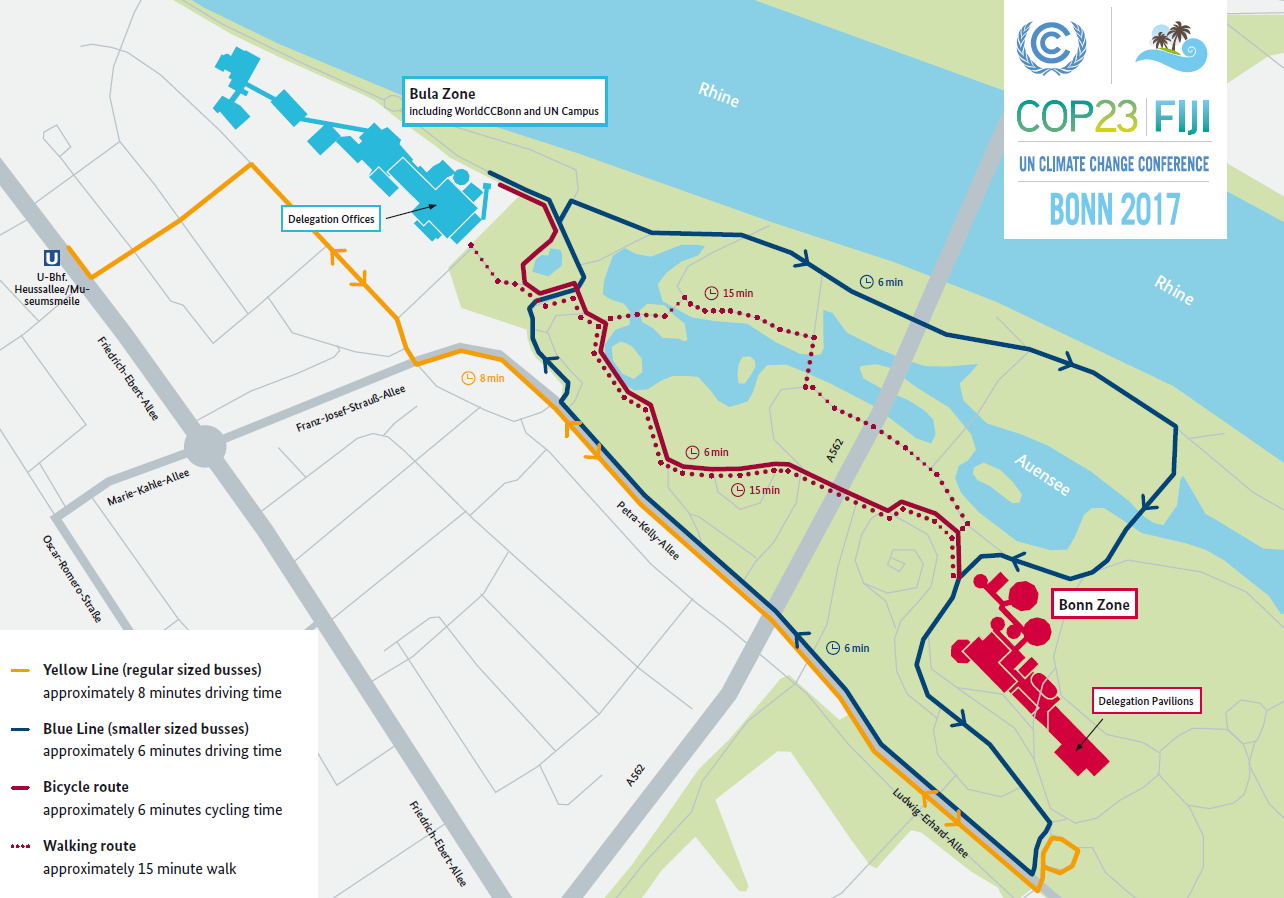
Two zones will be set up for COP23: The Bula Zone and the Bonn Zone. The Bula Zone will act as the formal negotiating zone will the Bonn Zone will act as the climate action zone.
The Bula Zone
The Bula Zone spans from the World Conference Center Bonn to the UN Campus as well as a temporary extension. Plenary halls, meeting rooms, delegation offices, a media and press center as well as catering and other facilities are prepared for a variety of activities.
The Bonn Zone
The Bonn Zone will host global climate action events (including high-level events), side events, media events, exhibits, and pavilion events..
Setup of the Conference
The distance between the two zones is about 1.4km, which is a 15-minute walk or 9-minute drive. Shuttles are provided to commute between the two zones. But, I feel that the most exciting thing about traveling between the two zones is that bicycles are provided for free! Yay!
Preliminary overview map
Here’s a virtual tour of the conference venue:
The presentation of the logistical preparation can be find HERE as well.
Sustainable Aspect of the Conference
The conference aims to be climate neutral through a series of action plans, hoping to offset the unavoidable emissions (like flights). Actions include virtual participation, paper reduction, European Eco-Management, and Audit Scheme (EMAS) verification, vegetarian catering and etc.
The SEA Games will take place from Aug 19 to 30 while the ASEAN Para Games will be held from Sept 17 to 23. The Games will coincide with the celebration of Malaysia’s National Day as well as Malaysia Day.
Green Games Initiative
Few months back, the Malaysian Sea Games Organising Committee (Masoc) launched the Green Games Initiative in conjunction with World Environment Day. The chief operating officer of Masoc, Shaiful Zahrin Subhan pledged to commit to deliver the event in an environmentally-responsible wayand to promote environmental protection. Besides, he also mentioned that the green initiatives will be implemented in collaboration with key partners which hope to inspire all stakeholders including venue owners, vendors and the public to continue their sustainable practices beyond the Games. [The Star]
This is how i felt during that time. So POWER, So AMBITIOUS, So MUCH WIN
They even came out with a framework on how to go “green” during the Games and publish on the website. In the website, it also stated that the events present broad opportunities to promote environmental awareness and sustainability practices to be shared and applied across different layers of society. OK LAH, SAY UNTIL LIKE DAT, CANNOT GIVE APPLAUSE ALSO CANNOT LIAO
As usual, my skeptical mindset started to tickle me. No matter how great is the plan sound like, it will fail if no proper implementation is given. Thus, Emily and i have decided to bought the opening ceremony ticket and head to the Bukit Jalil National Stadium to check whether they put words in their mouth.
For this “audit”, I am using the key green initiatives that clustered by The Star as a reference, which comprises of
Waste management
Transportation management
Outreach and Engagement
Other matter – Land Management
Disclaimer:
I am not focusing on energy management in this article as i have no access to any information regarding this, thus i will not provide any comment on this … yet
The content below are based on my findings and view.
Waste Management
People came all the way to Stadium Bukit Jalil to check on their favorite athletes and firework while i was there to check on the recycling bin and also the waste management system. #ironic #truestory
I know this is how you think of me now
As promised by the organiser, recycling bin for non plastics (the one in orange) can be spotted along side with non recyclable bin and food waste bin. Consider them as one set and each set was placed a few pillar away only. To stated the obvious, the bins are placed to encourage waste separation and to recover recyclable material. The food waste will also be processed into compost on site. Updates: I only spotted the recycle bin for plastics (the one in blue) during my 2nd visit to the venue.
The pictures above were taken around 5.30 pm. While waiting for Emily and her friends to buy some snacks at the food truck (it was quite a long wait), i was standing nearby the bins while stalking people on how they throw their rubbish. As you might expected, Malaysians in general (please bear with me for those who are not) still lack of awareness in waste segregation, or maybe we simply don’t care. Once they see a bin that look like trash bin, they will just open the lid and throw the rubbish in.
The picture below were taken after the opening ceremony (around 10.30 pm). As you can see, the waste were not segregated and some of them were overflowed with rubbish too. Same thing happened to the food waste bin. I wonder how will the organiser separate the food waste for on-site composting with the packaging still intact. Moreover, these kind of situation happened to almost all of the bins that i passed by. Till the end, human mentality is still the hardest to change.
Apart from these, do you notice anything fishyin the photo?
.
.
.
.
.
PLASTIC BAGS (LOTS OF THEM)
As mentioned in the beginning, the Chief Operation Officer, Shaiful Zahrin Subhan said that
“the green initiatives will be implemented in collaboration with key partners which hope to inspire all stakeholders including venue owners, vendors and the public to continue their sustainable practices beyond the Games”
But i noticed all of the food trucks are still using plastic bags, which defied the purpose of the green initiative.
Besides, one of the plan is using compostable/recycleable food packaging which i believed they were provided/supplied by SCGM Berhad, a thermoform food packaging manufacturer and also the silver sponsor for SEA Games. I am not going to say anything on the so called “eco-friendly” products here as the main point now is the usage of unnecessary plastic bags even though proper packaging is used.
I am wondering whether the target of reducing waste going to landfills by 30% is still achievable or not if plastic bags are still being used throughout the whole SEA Games.
I think more waste management awareness need to be done especially on the vendor side in order to really inspire everyone to continue their sustainable practices. Maybe we can ask Dato Seri Vida for some help. #Sayangx3 #wanmotaim #joke
Transportation Management
I would say the organiser did put great effort in transportation management.
On 10 August, our Ministry Youth and Sport release a statement to encourage everyone to take public transport to avoid delay. (I only found out about this after the opening ceremony!). Since Bukit Jalil LRT is just next to the stadium, coming here by public transport is so easy.
The best thing about using public transport now is getting 50% discount on all Rapid rail services. In conjunction with the opening ceremony, all public transport also extended their operation until 1am.
I heard discount!
We reached Bukit Jalil LRT station around 5pm and the station already crowded with people. A special thanks to the policemen that guarding at the exit while maintaining the order of the queue. The station was reinvigorated and look much sporty now.
People mountain people sea
After exit the station, signage and directory also can be spotted easily.
The organiser also partner withoBikewhich provide free bike-sharing services (for the first 1 hour) to and from LRT/MRT stations for the public. We attempted 2 times to ride around the venue but failed due to sudden down pour and the pathway are always crowded with people.
Everyone was rushing to the LRT station right after the event ended. The organiser already knew this is definitely going to happen and i could see they were already well prepared for this.
I (organiser) got you bro
Barricades were setup and policemen were stationed outside of the station. Once the train has arrived, then only they will allow a certain number of people to enter the station. This can ensure everyone safety. I dont think anyone will wish anyone to fall on the railway track as a result of “sardin-ing” right, unless you are a psychopath.
For this initiative, there is no doubt that it has already achieved the target of having at least 30% of volunteers and spectators to travel by public transport
Extra comment: As there were a lot of people waiting for the LRT (easily reach 40,000), the queue was utterly long. Even after we walk around the stadium for 1 hour to check on the waste management, the queue is just exactly the same as before. Bored of waiting, we decided to check on the price of taking Grab to KL Sentral. What happened in the next second stunned us. The price is RM49 due to surge rate. Albeit there are RM5 off x 10 rides in conjunction with SEA Games, the charges is still sky high.
Then we tried to check the price to go to the second nearest LRT station – Sri Petaling but there was no one want to fetch us despite plenty of drivers indicated on the map. Maybe our trip is not profitable for him/her kut. So, we ended up walking to Sri Petaling LRT station instead. It was a nice and windy 15 mins walk.
While the event is promoting the usage of public transport, i hope Grab can give us flat rate.
Outreach and Engagement
Aside from traditional media approach, the organiser also fully utilized the power of social media. They create a Facebook album specifically for public transport guidance. Do you know what lagi #ohsem? In the afternoon of the opening ceremony itself, a video was uploaded on Facebook that featured our Minister of Youth of Sport, Y.B. Brig. Gen. Khairy Jamaluddin on encouraging people to take public transport. #winliao
Based on the Star, there will be 1,000 volunteers from local universities trained as “green ambassadors” who will be responsible for advocating waste separation and collecting waste data. Indeed i saw quite a few of them throughout the event. As the name “green ambassadors”, they were wearing green shirts as well. After the event finish, they can be spotted easily as they walked around the venue to collect litter. But i am not sure what will they do with them after this.
So far i yet to notice any booth that educate waste separation nor do i know how are the data being collected. I will update here if i found answers during my next visit to the stadium, which will be on 24th September.
Moreover, the message of promoting the green initiatives/environmental awareness should be brought up publicly and proudly by the emcee throughout the event in order to gain a greater outreach. The message also can be shown on the 2 huge LED screen inside the stadium or even projected on the new facade of the newly reinvigorated stadium. I think it will be super awesome!
Last but not least, i would suggest the organiser to fully utilize the empty wall of the toilets by placing signs that promote and encourage sustainable practices.
Other matter – Land Management
Albeit land management related initiative is not stated in the framework, i think our government (at least the organiser) did a brilliant job in this. Instead of following the trend of building new stadiums (plural) for grand international sport event, they chose to reinvigorate them.
A new look in 2017 for one of the world’s biggest stadiums
Building new stadiums (plural) require to buy and develop a large piece of land which most of the time forest is the best candidate as it hits all the requirement needed.
In other words, deforestation has to be done in the name of development. Forest is one of the major carbon sink (reservoir) which continuously remove/store carbon. By destroying the forest, it will lead to the now carbon sinks becoming carbon sources in a foreseeable future. And the final product …
CLIMATE CHANGE! #perubahanIklim
Aside from environmental issue, spending billions to build new stadium for a 1 month event (including Para Games) is not a wise investment. A good example is the Olympic venues. Most of them go unused after the games and become white elephant – total waste of space and money. Photos of run down stadiums can be viewed HERE.
For this Games, only one new velodrome was built in Nilai (costing MYR 80 million ) to host track cycling events as there is no proper venue previously. For more information about the redevelopment of KL Sport City, you can refer to HERE. I believe by reinvigorating the venues instead of building new one, the carbon footprint can be reduced. [Example]
“In line with KL2017 mission to leave a meaningful legacy, we will support efforts to rehabilitate certain forest areas.” – Khairy Jamaluddin, Minister of Youth and Sports (KBS)
After the Games, 5,249 trees will be replanted in destroyed or degraded forests to support forest conservation and reduce carbon footprint of the games (layman term: offset). The total number of 5,249 are based on the total number of gold, silver and bronze medals offered in the SEA Games and Para Games. The “One Medal One Tree!” initiative will see every medalist receiving a seedling which will be planted at the Tropical Rainforest Living Collection Banun in Gerik, northern Perak. Landskap Malaysia is the official partner in implementing this initiative.
People see shades, i see unlimited power supply from solar.
In the near future, i hope that solar panels will be installed along the roof of the walkway as well as the stadiums to optimize the environmental footprint.
Summary
Despite there are #kantoi moments, the organiser did tried their best in adopting green initiatives for the Games. Not forgetting this is the first ever SEA Games that has such brilliant initiatives. OK LAH, GIVE YOU A LIKE #Negaraku #LetMakeOurEarthGreatAgain
This training series was somewhat unique as we had a highly motivated youth from Singapore to share her experience and knowledge in the field of climate change.
Nor Lastrina Hamid, is the co-founder of both Singapore Youth for Climate Action (SYCA), which is a platform for young Singaporeans to act in solidarity towards the fight for climate change and Lepak in SG, a calendar listing for environmental events.
The event was held at University of Nottingham’s Teaching Centre in Kuala Lumpur on 7 July and it was a three hour session filled with understanding Lastrina’s and Singapore’s perspective on climate policy and action.
Lastrina chose to sit with the audience and do the sharing
Moving to the sharing session, Lastrina explained in detail on her roles in SYCA and COP21 and 22. She showed great ingenuity by describing her experiences in her spell at Paris and Marrakech. While delineating on Singapore government’s efforts towards bringing increased awareness to the public, she explained on the government providing funds and scholarships to those who were taking part in climate related movements and activities.
The food was good, so was the sharing session?
With respect to climate accountability and tracking the climate progress matter of the government, Lastrina encouraged more youth participation in negotiations and reaching out to the public by disseminating the information and awareness for localised action. SYCA bridges the gap between the government and the community, similar to MYD for Malaysia.
Presenting the Token of Appreciation (The mug is starting to become a part of gift culture)
By concluding, and as Lastrina had highlighted, the supportive Singaporean government underlined the strength of youth and paves way to steer the country towards a sustainable future which is something countries around the world can learn from.
Overall, from the Singaporean example, I had learnt that the governments across the globe can contribute much more towards encouraging youth and public on issues that need more action on a global scale. Singapore commits not only to training and building capacity for developing countries but also involves itself in assisting other parties of the Paris Agreement and International Institutions.
The MYD Squad ? (Not in full team yet)
MYD is beholden to Lastrina for contributing to the training series by sharing her experiences at the local and international stages for climate action and justice. The discussion was quite insightful and broadened our perspective of climate negotiations. With three months to COP23, the journey to Bonn is in full swing.