COP23 is the 23rd Conference of the Parties to the United Nations Framework Convention on Climate Change (UNFCCC). It is the main annual meeting of all nations under the UNFCCC to build and strengthen intergovernmental climate policy.
COP23 will be held from November 6-17, 2017, in Bonn, Germany.
The Conference will comprise sessions of:
the Conference of the Parties (COP 23);
the Conference of the Parties serving as the meeting of the Parties to the Kyoto Protocol (CMP 13);
the Conference of the Parties serving as the meeting of the Parties to the Paris Agreement (CMA 1.2);
the Subsidiary Body for Implementation (SBI 47);
the Subsidiary Body for Scientific and Technological Advice (SBSTA 47);
the Ad Hoc Working Group on the Paris Agreement (APA 1.4).
A Little about COP23
COP23 will be focusing on:
Accelerating the implementation of the Paris Agreement
Catalyzing and supporting climate action happening at a global scale
The special thing about COP23 is that the conference is led by the Presidency of Fiji (Fiji is the host) but hosted off-site in Bonn (where the UNFCCC Secretariat is). So, the host team works closely with the secretariat of UNFCCC, both governments, the State of North Rhine-Westphalia and the city of Bonn in organizing this conference.
COP23 is fused with the Fijian Bula spirit, which means hello or welcome, with a deeper sense of wishing others a blessing of affection and good health. The conference plans on showcasing Fijian and Pacific culture, art and life. The design of the logo was meant to act as a reminder that rising sea levels are affecting not only small island developing states but also coastal cities in many other countries.
One Conference, Two Zones
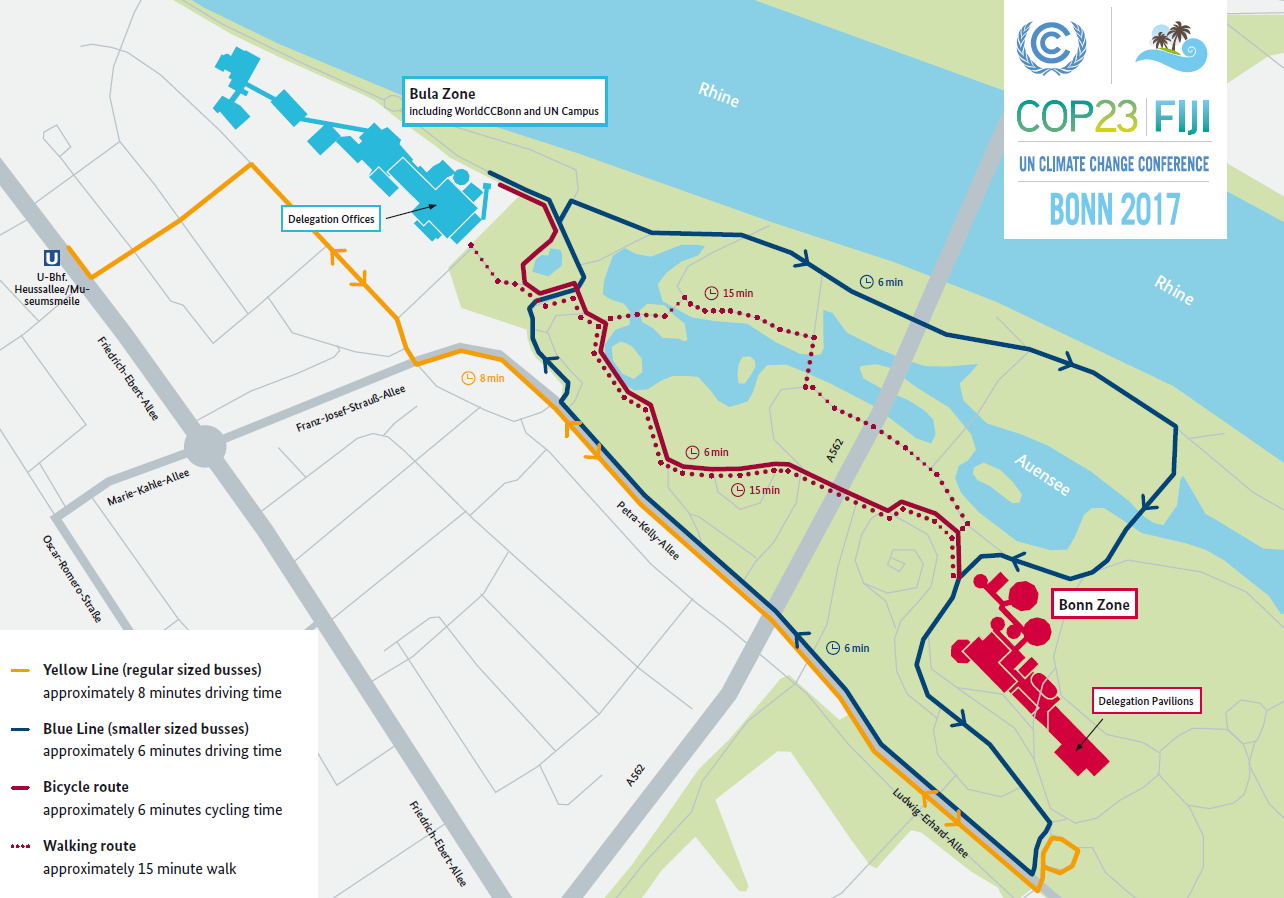
Two zones will be set up for COP23: The Bula Zone and the Bonn Zone. The Bula Zone will act as the formal negotiating zone will the Bonn Zone will act as the climate action zone.
The Bula Zone
The Bula Zone spans from the World Conference Center Bonn to the UN Campus as well as a temporary extension. Plenary halls, meeting rooms, delegation offices, a media and press center as well as catering and other facilities are prepared for a variety of activities.
The Bonn Zone
The Bonn Zone will host global climate action events (including high-level events), side events, media events, exhibits, and pavilion events..
Setup of the Conference
The distance between the two zones is about 1.4km, which is a 15-minute walk or 9-minute drive. Shuttles are provided to commute between the two zones. But, I feel that the most exciting thing about traveling between the two zones is that bicycles are provided for free! Yay!
Preliminary overview map
Here’s a virtual tour of the conference venue:
The presentation of the logistical preparation can be find HERE as well.
Sustainable Aspect of the Conference
The conference aims to be climate neutral through a series of action plans, hoping to offset the unavoidable emissions (like flights). Actions include virtual participation, paper reduction, European Eco-Management, and Audit Scheme (EMAS) verification, vegetarian catering and etc.
The SEA Games will take place from Aug 19 to 30 while the ASEAN Para Games will be held from Sept 17 to 23. The Games will coincide with the celebration of Malaysia’s National Day as well as Malaysia Day.
Green Games Initiative
Few months back, the Malaysian Sea Games Organising Committee (Masoc) launched the Green Games Initiative in conjunction with World Environment Day. The chief operating officer of Masoc, Shaiful Zahrin Subhan pledged to commit to deliver the event in an environmentally-responsible wayand to promote environmental protection. Besides, he also mentioned that the green initiatives will be implemented in collaboration with key partners which hope to inspire all stakeholders including venue owners, vendors and the public to continue their sustainable practices beyond the Games. [The Star]
This is how i felt during that time. So POWER, So AMBITIOUS, So MUCH WIN
They even came out with a framework on how to go “green” during the Games and publish on the website. In the website, it also stated that the events present broad opportunities to promote environmental awareness and sustainability practices to be shared and applied across different layers of society. OK LAH, SAY UNTIL LIKE DAT, CANNOT GIVE APPLAUSE ALSO CANNOT LIAO
As usual, my skeptical mindset started to tickle me. No matter how great is the plan sound like, it will fail if no proper implementation is given. Thus, Emily and i have decided to bought the opening ceremony ticket and head to the Bukit Jalil National Stadium to check whether they put words in their mouth.
For this “audit”, I am using the key green initiatives that clustered by The Star as a reference, which comprises of
Waste management
Transportation management
Outreach and Engagement
Other matter – Land Management
Disclaimer:
I am not focusing on energy management in this article as i have no access to any information regarding this, thus i will not provide any comment on this … yet
The content below are based on my findings and view.
Waste Management
People came all the way to Stadium Bukit Jalil to check on their favorite athletes and firework while i was there to check on the recycling bin and also the waste management system. #ironic #truestory
I know this is how you think of me now
As promised by the organiser, recycling bin for non plastics (the one in orange) can be spotted along side with non recyclable bin and food waste bin. Consider them as one set and each set was placed a few pillar away only. To stated the obvious, the bins are placed to encourage waste separation and to recover recyclable material. The food waste will also be processed into compost on site. Updates: I only spotted the recycle bin for plastics (the one in blue) during my 2nd visit to the venue.
The pictures above were taken around 5.30 pm. While waiting for Emily and her friends to buy some snacks at the food truck (it was quite a long wait), i was standing nearby the bins while stalking people on how they throw their rubbish. As you might expected, Malaysians in general (please bear with me for those who are not) still lack of awareness in waste segregation, or maybe we simply don’t care. Once they see a bin that look like trash bin, they will just open the lid and throw the rubbish in.
The picture below were taken after the opening ceremony (around 10.30 pm). As you can see, the waste were not segregated and some of them were overflowed with rubbish too. Same thing happened to the food waste bin. I wonder how will the organiser separate the food waste for on-site composting with the packaging still intact. Moreover, these kind of situation happened to almost all of the bins that i passed by. Till the end, human mentality is still the hardest to change.
Apart from these, do you notice anything fishyin the photo?
.
.
.
.
.
PLASTIC BAGS (LOTS OF THEM)
As mentioned in the beginning, the Chief Operation Officer, Shaiful Zahrin Subhan said that
“the green initiatives will be implemented in collaboration with key partners which hope to inspire all stakeholders including venue owners, vendors and the public to continue their sustainable practices beyond the Games”
But i noticed all of the food trucks are still using plastic bags, which defied the purpose of the green initiative.
Besides, one of the plan is using compostable/recycleable food packaging which i believed they were provided/supplied by SCGM Berhad, a thermoform food packaging manufacturer and also the silver sponsor for SEA Games. I am not going to say anything on the so called “eco-friendly” products here as the main point now is the usage of unnecessary plastic bags even though proper packaging is used.
I am wondering whether the target of reducing waste going to landfills by 30% is still achievable or not if plastic bags are still being used throughout the whole SEA Games.
I think more waste management awareness need to be done especially on the vendor side in order to really inspire everyone to continue their sustainable practices. Maybe we can ask Dato Seri Vida for some help. #Sayangx3 #wanmotaim #joke
Transportation Management
I would say the organiser did put great effort in transportation management.
On 10 August, our Ministry Youth and Sport release a statement to encourage everyone to take public transport to avoid delay. (I only found out about this after the opening ceremony!). Since Bukit Jalil LRT is just next to the stadium, coming here by public transport is so easy.
The best thing about using public transport now is getting 50% discount on all Rapid rail services. In conjunction with the opening ceremony, all public transport also extended their operation until 1am.
I heard discount!
We reached Bukit Jalil LRT station around 5pm and the station already crowded with people. A special thanks to the policemen that guarding at the exit while maintaining the order of the queue. The station was reinvigorated and look much sporty now.
People mountain people sea
After exit the station, signage and directory also can be spotted easily.
The organiser also partner withoBikewhich provide free bike-sharing services (for the first 1 hour) to and from LRT/MRT stations for the public. We attempted 2 times to ride around the venue but failed due to sudden down pour and the pathway are always crowded with people.
Everyone was rushing to the LRT station right after the event ended. The organiser already knew this is definitely going to happen and i could see they were already well prepared for this.
I (organiser) got you bro
Barricades were setup and policemen were stationed outside of the station. Once the train has arrived, then only they will allow a certain number of people to enter the station. This can ensure everyone safety. I dont think anyone will wish anyone to fall on the railway track as a result of “sardin-ing” right, unless you are a psychopath.
For this initiative, there is no doubt that it has already achieved the target of having at least 30% of volunteers and spectators to travel by public transport
Extra comment: As there were a lot of people waiting for the LRT (easily reach 40,000), the queue was utterly long. Even after we walk around the stadium for 1 hour to check on the waste management, the queue is just exactly the same as before. Bored of waiting, we decided to check on the price of taking Grab to KL Sentral. What happened in the next second stunned us. The price is RM49 due to surge rate. Albeit there are RM5 off x 10 rides in conjunction with SEA Games, the charges is still sky high.
Then we tried to check the price to go to the second nearest LRT station – Sri Petaling but there was no one want to fetch us despite plenty of drivers indicated on the map. Maybe our trip is not profitable for him/her kut. So, we ended up walking to Sri Petaling LRT station instead. It was a nice and windy 15 mins walk.
While the event is promoting the usage of public transport, i hope Grab can give us flat rate.
Outreach and Engagement
Aside from traditional media approach, the organiser also fully utilized the power of social media. They create a Facebook album specifically for public transport guidance. Do you know what lagi #ohsem? In the afternoon of the opening ceremony itself, a video was uploaded on Facebook that featured our Minister of Youth of Sport, Y.B. Brig. Gen. Khairy Jamaluddin on encouraging people to take public transport. #winliao
Based on the Star, there will be 1,000 volunteers from local universities trained as “green ambassadors” who will be responsible for advocating waste separation and collecting waste data. Indeed i saw quite a few of them throughout the event. As the name “green ambassadors”, they were wearing green shirts as well. After the event finish, they can be spotted easily as they walked around the venue to collect litter. But i am not sure what will they do with them after this.
So far i yet to notice any booth that educate waste separation nor do i know how are the data being collected. I will update here if i found answers during my next visit to the stadium, which will be on 24th September.
Moreover, the message of promoting the green initiatives/environmental awareness should be brought up publicly and proudly by the emcee throughout the event in order to gain a greater outreach. The message also can be shown on the 2 huge LED screen inside the stadium or even projected on the new facade of the newly reinvigorated stadium. I think it will be super awesome!
Last but not least, i would suggest the organiser to fully utilize the empty wall of the toilets by placing signs that promote and encourage sustainable practices.
Other matter – Land Management
Albeit land management related initiative is not stated in the framework, i think our government (at least the organiser) did a brilliant job in this. Instead of following the trend of building new stadiums (plural) for grand international sport event, they chose to reinvigorate them.
A new look in 2017 for one of the world’s biggest stadiums
Building new stadiums (plural) require to buy and develop a large piece of land which most of the time forest is the best candidate as it hits all the requirement needed.
In other words, deforestation has to be done in the name of development. Forest is one of the major carbon sink (reservoir) which continuously remove/store carbon. By destroying the forest, it will lead to the now carbon sinks becoming carbon sources in a foreseeable future. And the final product …
CLIMATE CHANGE! #perubahanIklim
Aside from environmental issue, spending billions to build new stadium for a 1 month event (including Para Games) is not a wise investment. A good example is the Olympic venues. Most of them go unused after the games and become white elephant – total waste of space and money. Photos of run down stadiums can be viewed HERE.
For this Games, only one new velodrome was built in Nilai (costing MYR 80 million ) to host track cycling events as there is no proper venue previously. For more information about the redevelopment of KL Sport City, you can refer to HERE. I believe by reinvigorating the venues instead of building new one, the carbon footprint can be reduced. [Example]
“In line with KL2017 mission to leave a meaningful legacy, we will support efforts to rehabilitate certain forest areas.” – Khairy Jamaluddin, Minister of Youth and Sports (KBS)
After the Games, 5,249 trees will be replanted in destroyed or degraded forests to support forest conservation and reduce carbon footprint of the games (layman term: offset). The total number of 5,249 are based on the total number of gold, silver and bronze medals offered in the SEA Games and Para Games. The “One Medal One Tree!” initiative will see every medalist receiving a seedling which will be planted at the Tropical Rainforest Living Collection Banun in Gerik, northern Perak. Landskap Malaysia is the official partner in implementing this initiative.
People see shades, i see unlimited power supply from solar.
In the near future, i hope that solar panels will be installed along the roof of the walkway as well as the stadiums to optimize the environmental footprint.
Summary
Despite there are #kantoi moments, the organiser did tried their best in adopting green initiatives for the Games. Not forgetting this is the first ever SEA Games that has such brilliant initiatives. OK LAH, GIVE YOU A LIKE #Negaraku #LetMakeOurEarthGreatAgain
This training series was somewhat unique as we had a highly motivated youth from Singapore to share her experience and knowledge in the field of climate change.
Nor Lastrina Hamid, is the co-founder of both Singapore Youth for Climate Action (SYCA), which is a platform for young Singaporeans to act in solidarity towards the fight for climate change and Lepak in SG, a calendar listing for environmental events.
The event was held at University of Nottingham’s Teaching Centre in Kuala Lumpur on 7 July and it was a three hour session filled with understanding Lastrina’s and Singapore’s perspective on climate policy and action.
Lastrina chose to sit with the audience and do the sharing
Moving to the sharing session, Lastrina explained in detail on her roles in SYCA and COP21 and 22. She showed great ingenuity by describing her experiences in her spell at Paris and Marrakech. While delineating on Singapore government’s efforts towards bringing increased awareness to the public, she explained on the government providing funds and scholarships to those who were taking part in climate related movements and activities.
The food was good, so was the sharing session?
With respect to climate accountability and tracking the climate progress matter of the government, Lastrina encouraged more youth participation in negotiations and reaching out to the public by disseminating the information and awareness for localised action. SYCA bridges the gap between the government and the community, similar to MYD for Malaysia.
Presenting the Token of Appreciation (The mug is starting to become a part of gift culture)
By concluding, and as Lastrina had highlighted, the supportive Singaporean government underlined the strength of youth and paves way to steer the country towards a sustainable future which is something countries around the world can learn from.
Overall, from the Singaporean example, I had learnt that the governments across the globe can contribute much more towards encouraging youth and public on issues that need more action on a global scale. Singapore commits not only to training and building capacity for developing countries but also involves itself in assisting other parties of the Paris Agreement and International Institutions.
The MYD Squad ? (Not in full team yet)
MYD is beholden to Lastrina for contributing to the training series by sharing her experiences at the local and international stages for climate action and justice. The discussion was quite insightful and broadened our perspective of climate negotiations. With three months to COP23, the journey to Bonn is in full swing.
Bonn Intersessional Negotiations – An interview with Nasha Lee
By Jasmin Irisha Jim Ilham, MYD 2016
Nasha Lee
Please introduce yourself and your background.
I have a bachelor’s degree from the University of Malaya in Environmental Engineering and started my career as an environmental consultant in a global sustainability consultancy. In 2014, I was offered a Commonwealth Shared Scholarship to read a Master’s degree in Environmental Change and Management at the University of Oxford. Upon my return, I joined an intergovernmental organization, and am now working on climate change and energy issues in Malaysia.
You were recently at the Bonn Intersessional in May 2017 as part of the Malaysian Delegation. Which tracks were you following?
I was in Bonn for the Bonn Climate Change Conference (Bonn Intersessional) which went on from the 8th to the 18th of May 2017. The meeting comprised of the 46th sessions of the Subsidiary Body of Implementation (SBI 46), the Subsidiary Body for Scientific and Technological Advice (SBSTA 46) and the third part of the first session of the Ad Hoc Working Group on the Paris Agreement (APA 1-3). The Malaysian delegation to the Bonn Intersessional consisted of fourteen people.
While in Bonn, I was tracking the agenda items on capacity building, technology, the Nairobi Work Programme, and public registries on the Nationally Determined Contributions (NDCs) and Adaptation Communications. I also participated in the in-session workshop to develop possible elements of the gender action plan under the UN Framework Convention on Climate Change (UNFCCC).
This year, Malaysia was one of the countries invited to present the results from our Biennial Update Report in a process called the facilitative sharing of views. The Biennial Update Report is a report submitted by developing countries to the UNFCCC which contains the country’s greenhouse gas emissions reduction plans and progress. In the facilitative sharing of views process, countries have to explain and defend their climate plans which are open to public questions from all countries. I was also following closely on this.
Any progress on the tracks that you followed?
For capacity building issues, we discussed about the fourth review of the implementation of capacity-building framework for economies in transition, and on the implementation of the framework for capacity building in developing countries. There were quite a few informal consultations whereby the co-facilitators had already prepared the draft conclusions and decision text. However, at the end, parties were unable to agree on the text proposed. Thus, the discussions will be restarted at COP 23. The outcome of this agenda item reflects the nature of the negotiations process at the UNFCCC, whereby decision-making is by consensus, and getting more than a hundred countries to be on the same page is often a complex and lengthy process.
I also followed the agenda items on the modalities and procedures for the operation and use of public registries for Nationally Determined Contributions (NDC) and adaptation communications. These two agenda items had significant progress with countries agreeing to common elements of the registries, emphasizing on the user-friendliness, public accessibility, security and searchability of the web-based registries.
There were two agenda items under technology: the Technology Framework and the scope and modalities for the periodic assessment of the Technology Mechanism. During the consultations on the technology framework, parties discussed about the possible principles and structure of the technology framework, and the functions of the technology mechanism, among others. Possible headings of the Technology Framework were agreed upon, and the item will be further discussed in COP23. For the agenda item on the periodic assessment of the Technology Mechanism, parties gave their views on how the process should be: cost-effective, results oriented, aligned with the technology framework, and inclusive of stakeholders.
As for the Gender Action Plan, the in-session workshop was held to develop possible elements of a gender action plan to support the implementation of gender-related decisions and mandates under the UNFCCC. Parties and NGOs provided views on key result areas and possible activities of the gender action plan.
In Paris almost two years ago, a landmark agreement was agreed upon by almost 200 nations to cut global emissions in the effort to limit climate impacts. However, many of the details on rules, accountability, transparency and governance were left for future negotiations. Put simply, there were questions left unanswered on who should do what, by when, and with what kind of financial support. Drafting these details, collectively known as the “Paris Rulebook” was the top agenda item in Bonn, and people attended the negotiations with the expectation that the Paris Rulebook will be discussed and there will be a draft negotiating text. Discussions focused on the global stocktake, on how reporting can be made more transparent, on how climate finance will be mobilized.
The overall progress for the Bonn talks were incremental. Discussions on the “Paris Rulebook” captured the different views of parties in informal notes, but there was no consensus making yet. If the expectation before the Bonn talks was that a draft text will be prepared, this would mean that we did not achieve what was expected. But progress, no matter how incremental, is still important.
You mentioned on the Global Stocktake. Any updates on that?
In Paris, parties agreed that they will come together for a global stocktake in 2023 and every five years following that to measure collective progress. A similar process, called the “facilitative dialogue” was also agreed to be undertaken in 2018 to measure progress and inform the next round of national determined contributions (NDCs) which are due in 2020. . During this intersessional, the Facilitative Dialogue was discussed, but concrete guidelines and rules as to how the facilitative dialogue will be carried out has not yet been agreed upon.
Is there anything for Malaysia to prepare for COP23? What is there to expect?
Under each topic for the “Paris Rulebook”, parties are invited to submit their views during ahead of COP23, with the aim of setting out options for the draft text of the rulebook. That will be the immediate actions for Malaysia.
What are the differences between the Intersessional and COP?
The intersessional talks take place in Bonn every year, midway between the annual COPs. While the COP is at the ministerial level, the intersessionals are the working level, the backbone supporting the UNFCCC. The intersessional talks move negotiations forward, ahead of the larger COP meetings which take place at the end of the year. In my opinion, the intersessionals are not being given as much attention compared to the COP, but they have very significant contributions in terms of getting down to business.
The Malaysian Delegation to the Bonn Intersessional 2017
Was there anything interesting that happened during the Intersessional?
As the US took a step back in the negotiations this year while the Trump administration contemplated a decision on whether the US should withdraw from the Paris Agreement, there seemed to be an interesting geopolitical shift where other developing countries were starting to become climate leaders. In Bonn, we saw other countries like China and India stepping up and reinforcing their commitment to the climate change agenda. In their Facilitative Sharing of Views, India shared how their renewable energy is growing so quickly that it is on track to be about 8 years early in reaching its 2030 goals to have 40% of the nations installed electricity supplied by clear energy. China also gave statements that reaffirmed its commitments towards the Paris agreement. The news that Trump administration might pull the US out from the Paris Agreement (which was confirmed to be true after Bonn) did not affect the negotiations at all, but negotiators we all the more determined to move ahead.
To me, the key message that came out from Bonn is that the world is committed to climate action, whether or not the US remains in the Paris Agreement.
What are your views on Malaysia’s progress?
Malaysia has shown lots of progress in last few years on climate change. We have embarked on efforts to move towards a low-carbon pathway, increased the deployment of renewable energy through incentives, and have implemented various programmes in reducing energy demand and increasing energy efficiency. Our technical skills, including that of calculating and reporting greenhouse gas emissions have increased dramatically. Our capacity in implementing climate change activities have also improved.
However, we still need to put concerted effort in making sure that our economy is being decarbonized, that renewables play a larger role, and that we design things to be more energy efficient. Energy is the biggest sectoral contributor to GHG in Malaysia, accounting for about 76% of our GHG emissions. The best way for us to be on track to achieve our Paris Agreement target is to look at the energy sector. There is much to be done in reducing emissions from electricity, transport and buildings in Malaysia, which should be our priority areas.
Additionally, Malaysia’s focus thus far has been on mitigating greenhouse gas emissions- we have had little work done on adapting to the effects of climate change, which is still necessary.
Some would argue there is not really a need for Malaysia to carry out adaptation plans just yet.
It is true that Malaysia has not been suffering from the worst impacts of natural disasters yet, but we are still vulnerable to extreme weather events like flooding and droughts. Having a plan in place to adapt to climate change would mean that we would be better prepared to face any current and future impacts of climate change towards health, ecosystems and water resources.
Do you have any advice for MYD and Youth interested in climate change and negotiations?
I believe that it is important to keep the dialogue on climate change going between youth, decision makers from the government and NGOs. Youths are often able to bring new and innovative solutions to difficult issues, and being able to see things from a new perspective and learn from other stakeholders who are passionate in the same issue is always good. Most importantly, always remind yourself of the reason you became interested in climate change in the first place, and use it to keep yourself motivated and accountable!
What’s next for you?
I still see myself going on the climate change and environmental path in the future, as this is something that I can relate to very much. I hope that I can to be of much greater service to Malaysia one day and to contribute much more in the future.
Feel free to add any final comments.
It’s great to see MYD playing such an important role in bringing young people together to learn, discuss and act on climate change issues. Keep up the good work!
With only a few more months left for COP23, MYD organised it second training series on 21st May, which focus on how to put the FUN in fundraising
2 climate experts from Paris were invited to help us better understand what crowdfunding is all about and the strategies involve in it, but our venue is what made this whole training series even more special.
We held it in Taman Rimba Kiara, where an Earth Day event and a protest to stop the diminishing of this park were held consecutively.
When Art meets Activism
Many other booths relating to the ‘green’ topic too were set up, including us as well. We get to enjoy ourselves with Zumba in the morning (Sorry guys, i am too busy dancing, no time to take picture), then petition signing and also get to witness the protestants chanting “Save Taman Rimba!”.
People mountain people sea
A successful crowdfunding campaign uses the theory of communication circles to determine if the crowdfunding is successful or not. So, when your close friends and family starts talking about your campaign, their friends would eventually help you raise funds too if they agree with your campaign’s idea itself, and that is when you know your campaign has been a success!
Besides that, we get to be the first trial group for the 2 Parisians to test out their ‘game’ involving us to plan our own crowdfunding campaign (on any topic) on that spot and to present it after 30 minutes, to determine if it will help us gain better insights regarding crowdfunding on that topic.
Anne and Tienot are the founder of Wānanga Trek and we are happy to be able to invite them to be our trainers
With that, different ideas, strategies and also rewards idea ( for the sponsors) were given feedback from the 2 Parisians and it had proved how much creativity the MYD’s members had in them in terms of crowdfunding as ideas such as giving ‘seed’ as a reward for the sponsor to reduce carbon emission, or even setting hotel booths to collect leftovers to reduce food wastage, were the discussed ideas on that day itself.
Our team, were thinking of publishing a photo book regarding the MYD- Making You Donate, idea as a reward for sponsoring us to COP23, to help publicize and educate Malaysians about climate change policies during UNFCCC itself.
Why so serious !
To end the day, MYD along with its partners, #PowerShiftMsia and Kem Solusi, held a BIG-PIE( Peer Integration Exchange) meeting effectively using the fishbowl method where we, as MYD Members get to witness it too! *hence the term BIG*
As the fishbowl method involves a circle within a circle, where only the interior circle was able to talk and voiced out their opinion and the exterior circle is the observant and could only be voicing out only upon tapping the interior participant’s’ shoulder, this method was beneficial as the meeting was held in the park itself, and minimal disruption would be beneficial.
As part of the MYD member, I believe that the next coming months would involve an increment in knowledge absorbed and also life skills learned, as we will be organizing our own training series the next time round!
THE Malaysian Youth Delegation (MYD), a group of young passionate Malaysians who represent the local youth climate movement at international climate conferences, expresses its deepest disappointment in the United States’ decision to withdraw from the United Nations Framework Convention on Climate Change (UNFCCC) Paris Agreement.
We would like to express our gratitude to the editor as well as The Star for including our statement in the newspaper. We appreciate your willingness to publish a candid response. Ultimately, we are also grateful to The Star for allowing the voice of the youth to be heard.