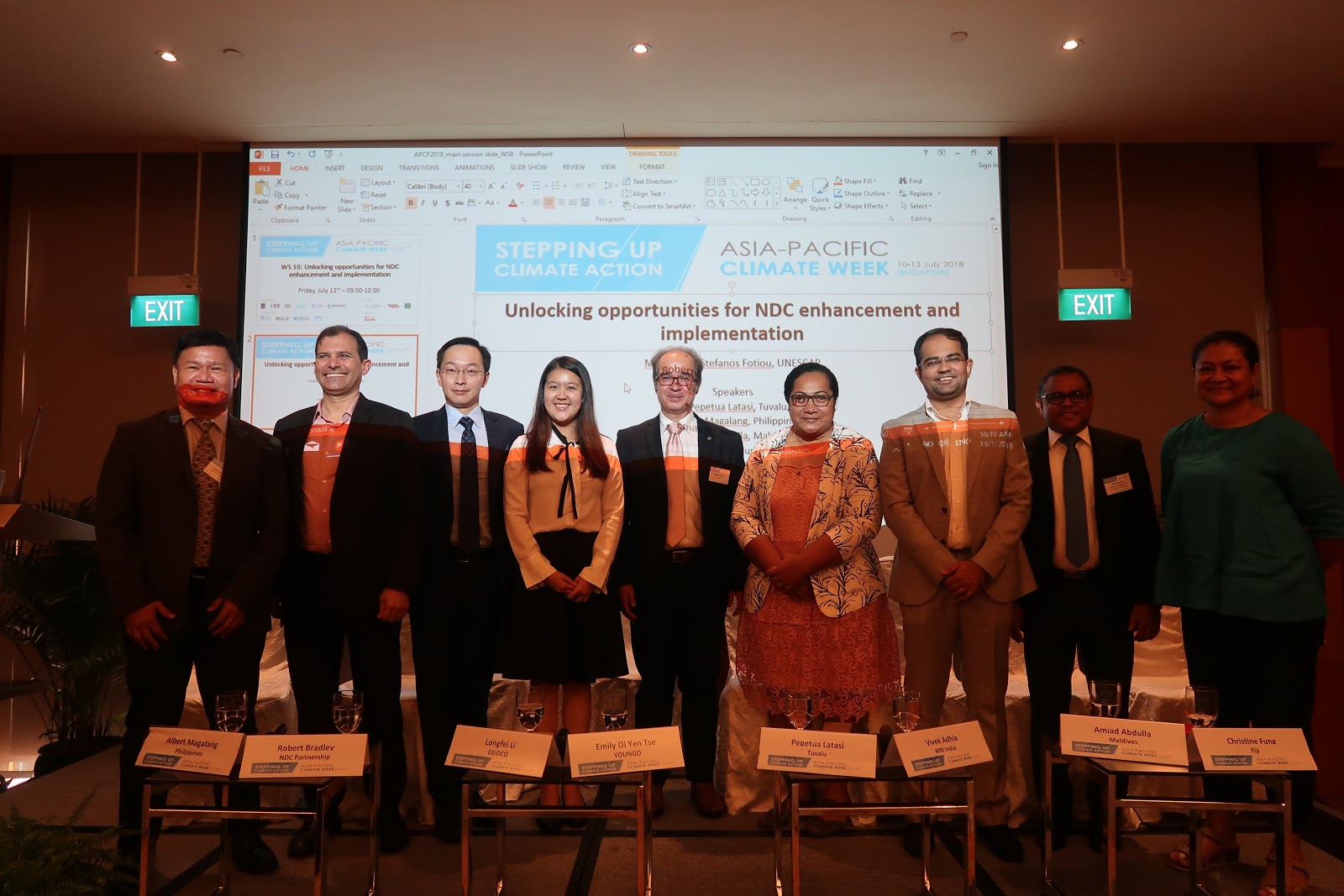
It was a struggle at first. To attend, or not to attend. But when the YOUNGO speaking opportunity was secured, I knew it was a sign. I had been quite detached from the climate negotiations conversation and I guessed it was time I immersed myself once again, even for a short few days.
Pre-work of preparing for my session, “Unlocking opportunities for NDC enhancement and implementation’ was rather limited. All of it was done in a rushing manner as I was drowned with work. Yet, while drafting the key points with assistance from other members, I was pleased that my knowledge in both MYD and my full time job have been able to contribute nicely. The most exciting part was that a subject matter expert of this area had agreed to share his thoughts and inputs on top of mine and it was all done in the nick of time.
Looking at the panelist profile, I felt small. Sitting with these people working on NDC implementation on a national and inter-governmental level, I asked myself, what can I bring to the floor? YOUNGO (insert link), the official youth constituency of UNFCCC had entrusted me to represent the youths. How do I strive to establish the balance between not being the typical “hoo-ha-youths-who-only-know-to-make-noise” and being able to deliver my pressing message?
In the morning, after saying goodbye to our host, Cheryl from Singapore Youth Climate Action (SYCA), I travelled with Hanis to Resorts World Sentosa, the conference site for my 9am session. As if weeks of sleep deprivation wasn’t enough to torture me, the purple line on the MRT decided to freak me out at the final moment – with just 3 stops to the designated station, it broke down and delayed our journey for more than 10 minutes.
Time was ticking. With no time to spare, we rushed for a cab and went straight to the conference site. A rush of relief went through us both. We reached just on time, at 9am sharp. Not knowing if the other MYD members would make it on time to set up and live stream the session (as they too were stuck on the purple line). We ran through the corridors and met the session moderator, Mr. Stefanos Fotiou, Director of United Nations Economic and Social Commission for Asia and the Pacific (UNESCAP), who was kind enough to brief me through with patience and reminded me “not to worry”. Of course, a big thanks goes out to Hanis for being my luggage guardian at this crucial moment. Another blessed moment was Melissa Low’s presence, a research fellow at NUS Energy Studies Institute who showed up at the session and calmed me down with providing me guidance on what to speak about. In chaotic times as such, you see kindness in people.
When all the courtesy introductions to the panelist were done, I sat down as the fourth speaker from the left. When the first speaker, Mr. Albert Magalang, Head at Climate Change Office, Philippines started his take on NDC implementation, my heart was thumping at the speed of light. All of my pre-drafted speech was all over the place in my mind. I was screaming for help from the inside but I knew that I still had to look cool and collected. Soon, it would be my turn.
Mr Stefanos took an unexpected and refreshing approach while cueing me in. He asked the floor “How many of you in this room were born at the end of the 60s or beginning of the 70s?” Few hands were raised, including Mr Stefanos himself, exposing their age (oops). He then turned to me and said, “Emily, for us who have raised our hands, we have completely failed to deliver a better planet to your generation.” He then asked what should youths be doing to deliver a better planet to the next generation and also our roles in NDC implementation. Amused by his introduction, it cracked me up a little and prompted me to share my thoughts.
I started off with one of my favourite framing sentences: “While our future is being negotiated, we, the youths need to be part of the process”. I shared that youth participation is in fact, another form of capacity building to nurture talents and to ensure succession and a just transition. I proudly slipped in the Malaysian government as a good example in allowing MYD to engage with them and learn from the national delegation in COP, hoping this could urge other nations’ participants in the room to mobilise their government to do the same. NDC implementation is a long term strategy and thus, sustainability in ensuring the talent pipeline to continue the work is vital.
The second point I raised was on adaptation. It was one of the strongest messages from my heart, yet, I felt a sense of intimidation to share my message with the crowd. Gathering all my guts, there it went – I said it. I shared my sentiment on how the whole conversation in climate negotiations have been very mitigation-centric. It channels out to affect how corporate, cities, and even financing opportunities lean towards being mitigation-focused. We should now have more tools and mechanisms to enhance adaptation projects’ environmental and social impact assessment and the respective ROI to let investors see the value of it. I witnessed a few nodding heads from the floor and even from the panelists, which was a very assuring response for me, as this was my first time voicing my views out in a public forum as such.
After I spoke, other panelists also voiced their thoughts on adaptation. When the session ended, a lady from FAO came and thanked me for raising up adaptation matters. It was a humbling experience to hear from everyone. I hope I did my part to raise the youths voice, especially on our concern about adaptation. Mr. Stefanos concluded my part fittingly with “If the youths talks about it, it is a signal that it is not in a very optimistic situation. And therefore we should pay more attention and look more into it.”
Dear world, it is time for a paradigm shift within the climate circle.
The Asia Pacific Climate Week (APCW) 2018 opened with a strong pro-business and private sector sentiment. A number of heavy weights sat on the opening panel: Patricia Espinosa, Luke Daunivalu, Masagos Zulkifli, President Michal Kurtyka, Bambang Susantono. Steve Chao moderated the session. The importance of a business and private finance solution to climate change was well highlighted by the presence of such individuals.
The rhetoric among the speakers on the panel and also subsequent ones, stressed highly on the need for private finance, investments and the engagement and evolution of the business industry. The need for increased ambition by these sectors and more finance poured into addressing climate change was emphasized upon.
Singapore’s Environment Minister Masagos Zulkifli was the first of the panel. He started with an appeal to emotion and enhanced action by narrating the disasters that have been happening in the region including the ongoing flood in Japan that has claimed almost 200 lives as of then. Then, he stressed the importance of trade and the need to keep global systems open and made the age old call for urgency and the spurring of global climate action.
He highlighted innovation and collaboration as two important thrusts towards achieving a low carbon future. Certainly the image of Singapore is also based on this. Then he announced that Singapore plans to implement a carbon tax starting at 5 dollars for every tonne of greenhouse gas emitted.
“No exception!” he exclaimed.
He also reinforced that the integrity of the Paris Agreement needs to be preserved, which was somewhat ironic given that a petrochemical company was one of the platinum sponsors of this APCW.
Following him was the Executive Director of the UNFCCC, Patricia Espinosa. She brought up the need for carbon forums to be more inclusive of input from different groups of people. She also called for more action on climate change using a personal story to evoke emotion in the people. She narrated her visit to Tuvalu. At a visit to a primary school she had been ‘deeply moved’ by how the children were aware of and had to deal with the floods. It would be great if more high ranking individuals were ‘deeply moved’ by such sights so that they would persuade governments and important businesses to increase ambition.
She listed a number of things that should be done: All levels of government need to be involved. The PA work program needed to be finalised, firm commitments should be made by countries to increase climate ambition by 2020, proper financing should be provided by developed countries and they should honour their promises. She also highlighted the inadequacy of current finances,
“the global community is talking in millions and billions, but it should be trillions.”
She compared financing climate change with current finances to walking into a category 5 hurricane protected only by an umbrella. Ms Espinosa presented climate change as an unprecedented opportunity instead of an unprecedented challenge. All in all it is a dire picture, our current rate of addressing climate change.
Luke Daunivalu followed after Ms Espinosa. He stressed the importance of climate leadership at all levels: government, grassroots and the private sector. One key point he mentioned that I found particularly interesting was how he stressed on leadership that is feasible and heard by the international community. Presumably he is referring to his own. What I took away from his implications is that it is important for leadership to be mindful and inclusive of counter agendas but also one that is inspirational and significant enough to make a difference in the international community. He reiterated the importance of the Talanoa dialogue and how we need to share our stories and followed up by saying that we need to move beyond rhetoric, towards action.
Subsequently the next President designate of COP24, President Michal Kurtyka of Poland took the podium. He reinforced the messages of the previous panelists, picking up on Masagos’ idea of innovation and innovative leadership. He then praised the EU’s goal of a 40% reduction of carbon emissions. Another ironic statement, considering earlier on, Poland had protested against being assigned a portion of the intended distribution. Specifically, it had been assigned a 7% reduction in overall emissions, a percentage somewhat proportionate to its contribution to the EU’s total emissions. Given that Poland is organising the upcoming COP, it would have been a good show of faith if the president could have committed to actions that move it away from being a coal powered nation and announced policies to encourage renewable energy. As of now, more than 90% of Poland’s electricity comes from lignite and coal.
Bambang Susantono from the Asian Development Bank (ADB) wrapped up the panel. He outlined measures the ADB was undertaking with respects to climate change such as how it has been supporting the Asian Carbon Forum. One of the ADB’s seven operational strategies is also tackling climate change. He mentioned how the Asia Pacific is home to more than 60% of the population and emits 40% of total output of green house gases. Seven of the top 10 vulnerable countries are also located in the region. He issued a warning that climate change will reverse the benefits of economic development in the region. He moved on to the progress ADB has made in mobilising finance for addressing climate change and how they are working with countries to help them transform Nationally Determined Contributions into climate investment plans.
Strategies to Reach Scale: Adaptation and Climate Resilient Initiatives in Coastal Zones
The coast is a battle zone. Coastal communities all over have to fight to survive against rising sea levels, worsening typhoons, depleting fish stocks and ocean acidification. That makes them one of the more vulnerable communities to climate change. At the recent Asia Pacific Climate Week that took place in July in Singapore, coastal zone climate initiatives got its own discussion session. A panel sat down to talk about “Strategies to Reach Scale: Adaptation and Climate Resilient Initiatives in Coastal Zones”.
The panel featuredYoussef Nassef, Director of Adaptation, UNFCCC; Singapore Red Cross secretary-general Benjamin Williams, Andi Eka Salva, Ms Rima Al-Azar Senior Natural Resources Officer from the Climate and Environment Division of the FAO,Stefanos Fotiou, Director for Environment and Development at UNESCAP and the UNFCCC High-level Champion Tomasz Chruszczow.
Community led adaptation and mitigation measures are important in coastal zones. This is for a variety of reasons such as:
They can respond flexibly to disasters,
Their knowledge of local issues is advantageous in such situations,
They can be more efficient than a government or an international NGO in many instances and
Their solutions can be very unique and suited to their context.
The panel was asked to share some innovative models from communities in coastal zones that have managed to achieve a large impact. While they did not quite manage to share on these (perhaps a reflection of the general lack of attention on ground up initiatives) they each spoke of coastal adaptation and mitigation measures in their own contexts.
Benjamin Williams talked about the Redcross’ Vulnerability and Capacity Assessment (VCA). The tool aims to enable local priorities to be identified and appropriate action taken to reduce disaster risk.
Mr Williams also stressed on the importance of finance in adapting coastal communities for climate change resilience as well as in disaster risk responses. The financing model needs to improve to take an integrated approach to addressing climate change issues by involving all relevant partners, across geographic and type boundaries.
Andi Eka Salva talked about a variety of conditions needed for effective adaptation and mitigation in coastal communities. These included early warning systems, timeliness in response and building literacy among communities regarding such measures. This is so that they will be prepared to aid and respond to such problems. For example, teaching farmers how to collect data.
He also emphasised on the importance of youth involvement in scaling up coastal climate change adaptation and mitigation measures. Forest fire and tsunami response education should be adapted into suitable mediums for children. In order to engage with the younger generation, he stated that there is a need to adapt to using their language and technology. In line with the principle of intergenerational equity, this is an area that should be given more focus in general. There is a lack of involvement and consideration of the future generations in climate change adaptation and mitigation strategies.
Stefanos Fotiou referenced the 1991 publication by John Clarke as a good guidebook on integrated coastal management. The guidebook puts out 17 different activities that can be taken in coastal zones. He also noted that participation is an important factor for the Small Island Developing States.
Ms Rima Al-Azar focused in on the context: that 3.1 billion people around the world live within 10km of the coast. Coastal zones also have large implications for countries given that 84% of NDCs and INDCs mention aquaculture and fisheries as important.
She made a distinction between scaling up vs scaling out: up has not been as successful and that we are still at the pilot stage of scaling out. Better vertical and horizontal coordination and integration management is needed to address this. And this needs to be paired with a greater awareness about this issue.
Youssef Nassef also highlighted that coastal zones are important areas of focus for the Warsaw International Mechanism (WIM) for loss and damage. This Mechanism addresses climate induced loss and damage. These could be extreme events or slow onset events.
He reiterated that developing countries in particular are vulnerable to the adverse effects of climate change. There should be more contingent measures such as insurance and innovative finance. It must be noted however, that insurance is a controversial solution. This stems from the international negotiations where developed countries were careful to address the issue of loss and damage as one that does not provide a basis for any liability or compensation. Therefore insurance was brought up as the alternative.
However many CSOs highlight the unfairness of expecting poor, vulnerable communities in developing countries to bear the costs of climate change disasters when they have disproportionately smaller greenhouse gas emissions.
EnviroNewsNigeria: Tomasz Chruszczow, Special Envoy for Climate Change from Poland
Tomasz Chruszczow spoke on how adaptation measures need to be integrated into general development planning in the countries. There is potential here for synergy between the Sustainable Development Goals and climate change when making national infrastructure, education and development plans. He highlighted an obstacle to adaptation which was that it is difficult to measure and there is no standardised system for this.
Day 2 of SB48-2: Negotiations in APA, SBI and SBSTA moving into informal consultations and informal informals
As the Bangkok climate negotiations kicked off yesterday, it became clear very quickly that parties, for the next week, will be saying the same thing. From the opening ceremony, to the plenaries, to the contact groups as well as the informal consultations, almost all chairs, facilitators and parties started their interventions with similar themes; we’re running out of time, we should not waste any more time now, and we must leave Bangkok with a draft text to bring to COP24.
Parties are so eager to get straight to work, that they proposed and agreed to forgo the opening plenary interventions from parties as well as CSOs. While it is clear to see why parties chose this course of impromptu action, several Youth CSO representatives did not appreciate the decision to cut out one of only two opportunities for CSOs to speak at this SB session.
While parties continue to reiterate the need to move fast with negotiations in Bangkok, CSOs are calling for parties not just to move swiftly but also to produce a strong and robust draft text for each facet of the Paris Agreement Work Programme (PAWP). The hope and expectation is to head into COP24 with draft texts that will be ready to be negotiated on in Katowice, Poland.
What does it mean to have draft negotiating texts coming out of Bangkok?
Currently, agenda items relating to the PAWP are being negotiated on the basis of informal notes and tools which have been drafted by the respective facilitators of each agenda item. These informal notes and tools contain inputs from parties from the past several sessions, dating back to SB44 in May 2016. The task ahead of parties in Bangkok is to distill the inputs and streamline the options with clearer and meaty text.
With stronger and more focused text coming out of Bangkok, the hope is that it will facilitate a good session of high level negotiations at COP24, with the ultimate goal of completing the PAWP by the December 2018 deadline.
What are the potential risks in Bangkok?
While it is promising and encouraging that parties see the urgency and feel the pressure, they also run the risk of pushing out draft texts that are weak. On the other hand, should parties take their time to negotiate, or come across stumbling blocks, they run the risk of ending the Bangkok session with incomplete draft texts.
Either option is unacceptable. And parties have no other choice than to work in overdrive. The current situation was perfectly captured in the opening address by COP23 President and Fiji Prime Minister, Frank Bainimarama, who said, “In three months’ time we will be in Katowice, and frankly, we are not ready. I don’t think that statement should surprise anyone in this room.”
Although discouraging, the COP23 President’s words were necessary. He told it like it is. The situation is dire now. Parties have left it all to the last minute and need to find as much common ground as possible over the next four days if we are to get any closer to implementing the Paris Agreement in 2020.
MYD is currently tracking the negotiations on the Paris Agreement Work Programme
United Nations Conference Center in Bangkok Pic: UNFCCC
UNFCCC climate negotiations resumed today in Bangkok, kicking off with opening plenaries for SBSTA 48-2, SBI 48-2 and APA 1-6. But why are we in Bangkok?
In a typical year, intersessional negotiations are held in Bonn between COPs. These additional sessions allow for negotiations to take place in the subsidiary bodies, namely SBSTA, SBI and APA. This year a second intersessional conference has been organized in Bangkok due to the urgent nature of having to complete the Paris Agreement Work Programme (PA) by the end of 2018.
Since parties adopted the Paris Agreement in 2015, they have been working on drafting guidelines to implement and operationalize the PA, beginning in 2020. With that deadline approaching quickly, parties are feeling the pressure to deliver texts to be negotiated and agreed on at COP24 in Katowice this December.
While this session in Bangkok is the result of the inability of parties to come to a definitive negotiation text at the last intersessional in May, the parties have also displayed the willingness and motivation to complete the PAWP on time.
10 MYD members are in Bangkok, tracking the negotiations at SB48-2
So what needs to be done in Bangkok?
As negotiations in SBSTA, SBI and APA get underway today, parties will only be discussing agenda items relating to the PAWP. This is so that there can be a strict focus on the most pressing issues that are holding back its completion. The absence of side events and UNFCCC-sanctioned actions at this session further stresses the importance of making complete and strong progress on the negotiations on the PAWP.
Finance is proving to be one of the crucial issues that will be negotiated here, specifically in SBI agenda item 15, relating to Article 9.5, which calls for developed countries to provide adequate information on a roadmap of potential financial contributions, as well as SBSTA agenda item 13, relating to Article 9.7, the modalities for the accounting of financial contributions provided and mobilized. There is the expectation that the African group will continue to ask for more robust text on Art. 9.5, something they have been adamant about since COP23 last year.
Finance is going to be key as it is most commonly seen as a factor in building trust. With higher financial flows, or even commitments to providing more quantitative and qualitative information on potential funds in the future, it would go a long way in galvanizing parties from both developing and developed nations to push for higher ambitions.
NDC enhancement will also be negotiated this week, with features and the accounting of NDCs, yet to be agreed on. Along with that, there is a question mark on the general timeline of NDC periods. Agreeing on these common timeframes around the submission and reporting of NDCs over a short interval of five years is crucial to opening up transparency on the collective contributions of all parties and will better push for stronger ambition in each iteration of NDCs.
The one thing I’ve noticed today, however, is the lack of follow through in the themes from COP23 specifically global stocktake (GST) and the Talanoa Dialogue. A lack of emphasis on GST may be a result of good and timely negotiations in May, however, the Talanoa Dialogue is more important than ever. The process, which involves collecting stories from parties, CSOs, and non-party stakeholders, is meant to build understanding and boost ambition for stronger climate action. It is still underway and should last until COP24 where it should see some sort of political input. If not, this all will be have been for nothing.
Lastly, where does Loss & Damage sit within this Bangkok session? All parties are scrambling to complete the PAWP in time and it feels as if L&D is being left behind. It’s been reiterated by many that the PAWP should be inclusive and an all-round package. No one stream should take precedence over the other. With L&D being tied to the WIM, it will be interesting to see how it fits into the PAWP.
All I can hope for, as we begin the week, is that parties do not waste time and start serious work in completing the PAWP in time to facilitate good negotiations and a decision in COP24. If not, we run the risk of accepting very loose and weak text should we run out of time at the end of this week. And that would just be doing a disservice to the Paris Agreement and its adoption three years ago.
Written by Mike Campton Peer reviewed by Daniel Teoh
Image courtesy of TODAYOnline: The view of causeway bridge (Johore-Singapore)
Asia Pacific Climate Week 2018 (APCW) was held at Resorts World Sentosa, Singapore and Johore observes the start of the weekend on Friday whereas Singapore starts its weekend on Saturday.
Before the event started, all the members of Malaysia Youth Delegation who participated in APCW had a meeting for coordination and task purposes. When it came to accommodation, I decided to stay with my parents in Johore Bahru and make daily trips.
Day 1
I felt the first day of the event was more into business, financial dealings and promotion – nothing more, nothing less. One thing that I liked about the first day of the event was the inconvenient truth and realistic view for climate finance stated by UN, businesses and government representatives. The balance of adaptation and mitigation should be the priority for funding the projects. People need to understand market demand and supply.
The day ended for me after I headed back to Johore Bahru with full confidence and belief that the second day would not let me down. I was excited to go back early as I boarded the MRT at 8.30 pm and reached Queen St. around 9.30 pm. I also got to the bus on time and reached home around 12.00 am.
Day 2
The second day was more fascinating – the event was attended by national negotiators and United Nations representatives. I interviewed and spoke to them regarding what was on my mind regarding climate finance. At the same time, this conference helped me understand further on the United Nation’s role in every sector.
Mr. Stefanos Fotiou from United Nations, Economic and Social Commission of Asia Pacific (UNESCAP) said:
“Our role (United Nations) is to facilitate, not to mandate or to dictate the country to follow the agreement. NDC (National Determined Contributions) are determined nationally, and the nations need to coordinate.”
Amjad Abdullah, National Lead Negotiator for Maldives said:
“I’ve been there in the process back in United Nations, the UN’s role is to facilitate, not to dictate, and most of the agreements are voluntary based.”
Back to the interviews, the first approach was with Mr. Clifford Polycarp from Global Climate Fund who advised on seeking an opportunity behind ASEAN Banking Integration Framework 2020 for climate finance. I met with Mr. Yossef Zahar from Institute for Global Environment Strategies (collaboration with UNFCCC Secretariat) and Mr. Adam Cotter from The Official Monetary and Financial Institutions Forum (OMFIF) regarding blockchain technologies as a catalyst of green credit in the green finance context and Climate Related Financial Disclosure (CRFD).
A fruitful discussion was held with them and I was filled with excitement for such discussions to succeed in other sectors. However, I do hope that all of the connections have a better focus or balance between mitigation and adaption programs and investment.
With the second day drawing to a close, at the end of the conference, the representing MYD members at the event carried out a daily reflection and repositioning of tasks for the final day. Singapore Youth Climate Action (SYCA) and the MYD members mingled over dinner and got to know one another.
Day 3
As I reached the event for the last day, Emily Oi Yen Tse from the Malaysian Youth Delegation and Youth Non-Governmental Organization of Climate Change (YOUNGO), was there to speak on a session that focused more on the National Determined Contributions (NDC) – Mr. Stefanos Fotiou and Emily stressed the importance of youth in combating climate change.
Mr. Stefanos asked: – “How many of you in this room were born at the end of the 60s or beginning of the 70s?” Sadly, the response showed that most of the participants in the room had raised their hand. He then said,
“For us who have raised our hands, we have completely failed to deliver a better planet to your generation.”
Emily then said: –
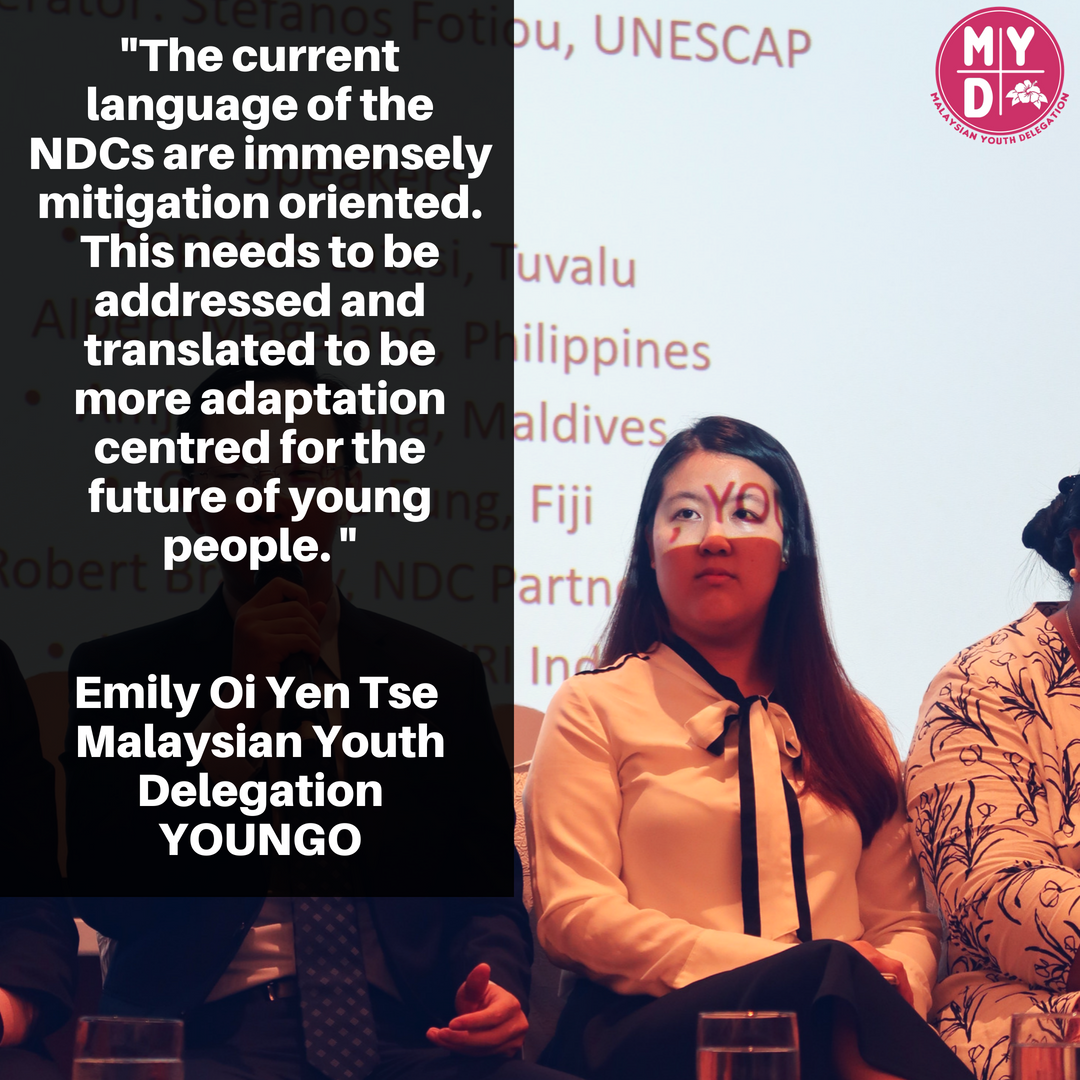
“The current language of NDC’s are immensely mitigation oriented. This need to be addressed and translated to be more adaptation centered for the future of young people.”
The final session ended with the Talanoa Dialogue on Green Financing with it’s main focus on the aspirations and what we are looking forward to at the 24th Conference of Parties (COP 24) in Katowice, Poland and the end phase of Paris Agreement. One of the panelists was our very own Nur Syahirah Khanum, an MYD member and representative of YOUNGO.
The topic got interesting after Steve Chao from Al Jazeera opened the session and the momentum of the session rose when the earliest carbon trader (1990), Frank Joshua and Dirk Forrester talked about carbon exchange and climate finance in the financing language. The heated session ended with Syahirah emphasizing her point regarding youth participation in climate change, especially in the climate finance context.
Syahirah Khanum said: –
“We (the youth) are here, and we are dedicated to make the Earth a better place.”
I caught up with Frank Joshua after the session and interviewed him regarding carbon exchange, the future of carbon exchange in the Asia Pacific region and the relation to the next financial crisis and how it would affect the carbon market. Deadly question for him indeed, yet, he did not break a sweat.
All of the MYD members gathered after the conference ended, had dinner and a short discussion at the Harbourfront Point Food Court before we left the island. It was the same routine going back to Johore Bahru – I would gladly remember this event seeing as my goals and objectives had been fulfilled.
Urgency of South-South and Triangular Cooperation to Combat Climate Change
Image courtesy of An Sionnach Fionn: Climate Change Deniers and Sceptics in Ireland
Asia Pacific Climate Week 2018 (APCW) happened in Singapore on the 11-13th of July 2018. The focus of this conference was on Business to Business (B2B), Business to Government (B2G), and Government to Government (G2G) – these were to enhance the green finance and effective implementation on Paris Agreement as we enter the second half of the year prior to 24th Conference of Parties (COP 24) in Poland.
For those who don’t know much about the focus in the Paris Climate Agreement, 195 countries signed a pact called the Paris Climate Agreement (Also known as Paris Accord) to combat greenhouse gas emissions, mitigation, adaptation and finance starting from 2020. The agreement was adopted by consensus on 12 December 2015. The Paris Agreement’s long-term goal is to keep the increase in global average temperature to well below 2 °C above pre-industrial levels and to limit the increase to 1.5 °C – this substantially can reduce risk and climate change.
Most of the public sector, private sector and government officials came to the conference with optimism and expected to contribute more for adaptation and mitigation purposes. It was an opportunity to share best practices and technological cooperation at the regional level and allowed engagement with interested stakeholder. This information is vital as we try to make Paris Climate Agreement goals successful by developing sustainably and giving a green comprehensive structure as a whole.
United Nations Framework Convention on Climate Change (UNFCCC) Executive Secretary, Patricia Espinosa stressed on to complete the implementation of the Paris Climate Agreement and dramatically accelerate climate ambition before 2020; she also added that this ambition should be reflected in the next round of National Determined Contributions (NDC).
“Climate Change is about more than just the weather or economy, of course. Climate Change is connected to almost every significant challenge humanity faces.”[1]
She mentioned, all of us need to cooperate at all levels on which focusing on more integrated and coherent approaches to meet outlines in Sustainable Development Goals. The businesses can play a complementary role as same as what North-South cooperation respectively.
For me, the beauty of this year APCW event was the introduction of high level technologies that came in, especially blockchain technology. I believe that this is one of the game changer to enhance more on climate change action in 21st century business canvas. A part of climate change as one of the focus in business sector, green blockchain technology has introduced a promising mechanism in the midst of technology efficiency. As optimistic as it may sound, I believe that on cooperation with full confidence to integrate adaption and mitigation at this level looks promising.
Government has to make a realistic stand on their own National Determined Contributions (NDC) before 2020 heads up on Paris Agreement’s goals.I suggest a committee on green finance to be set up and filled in with every sectors including non-governmental organizations (NGO), youth participation, government officials and business organization to create a short plan for climate exchange, and to create a realistic approach upon “Climate Integrated Framework” in Malaysia context.
[1] UNFCCC Executive Secretary, Patricia Espinosa (2018), Workshop South-South and Tech Cooperation, Asia Pacific Climate Week 2018, Singapore
A realistic view on climate finance and carbon exchange
Climate change and climate exchange in the world of finance. Picture edited from 88.5 WFDD and An Sionnach Fionn
The main topics focused on during the Asia Pacific Climate Week 2018 in Singapore were Climate Finance and Carbon/Emission Trading. Most delegates and even the speakers noticed that the conference was set on mitigation rather than adaptation in the climate change context.
For those who aren’t familiar with these two terms; mitigation focuses on an action to reduce the intensity of climate change, generally through reducing Greenhouse Gas (GHG) emissions. Mitigation measures are long-term actions to reduce GHG emissions, and are not an immediate cure for climate change (IPCC, 2007), with even climate exchange leaning towards mitigation.
Meanwhile, adaptation is an action to help individuals, communities, organizations and natural systems to deal with the consequences of climate change that cannot be avoided. It involves taking practical actions to manage risks from climate impacts, protect communities and strengthen the resilience of the economy. Adaptation can take shape as a gradual transformation with many small steps over time, or as a major transformation with rapid change.
Green finance involves financing national, regional and international entities for climate change mitigation and adaptation projects, as well as programs. Under Green Finance, a framework known as the Kyoto Mechanism, involved legally under the Kyoto Protocol, has established an outcome concerning the introduction of three market-based mechanisms; joint implementation, clean development mechanism and international emissions trading.
International Emissions Trading goes through six entities;
Carbon Emission/Greenhouse Gas (GHG) emissions as a product for exchange.
Carbon Credit: a permit which allows a country or organization to produce a certain amount of carbon emissions of which can be traded if the full allowance is not used.
Carbon Pricing: charges those who emit carbon dioxide (CO2) as part of their emissions or an amount that must be paid for the right to emit one tonne of CO2 into the atmosphere.
Green Bond: represents debt obligations — therefore, is a form of long term borrowing to fund green projects (in layman’s terms). Just like normal bonds, it allow investors to earn interest and to receive their principal back at maturity. Types of green bonds include the securities bond, “use of proceeds” bond, revenue bond, project bond, covered bond, loans and other debt instruments.
Carbon/Emission Trading: alsoknown as cap and trade;
The cap on greenhouse gas emissions is a limit backed by science. Companies pay penalties if they exceed the cap, which gets stricter over time.
The trade part is a market for companies to buy and sell allowances that permit them to a certain amount of emissions. Trading gives companies a strong incentive to save money by cutting emissions.
6. Carbon Exchange: a facility where brokers and traders are able to buy and sell carbon emissions, green bonds and other financial instruments. Stock exchanges may also provide facilities for the issue and redemption of such securities, instruments and capital events including the payment of income and dividends.
Three mechanisms introduced by the government for the industrial platform and social economics;
Carbon Tax: a fee imposed on the burning of carbon-based fuels (coal, oil, gas). Carbon tax is a monetary policy to reduce and eliminate the use of fossil fuels, which as a byproduct of its combustion continues to destabilize and destroy our climate.
Green Subsidies: a subsidy that contributes to reducing damage on the climate and environmental programs or by increasing the purchasing power for more green programs e.g. subsidies for public transportation.
Prior to the Asia Pacific Climate Week, I felt that the argument surrounding the event was baseless, while some points proved to be crucial. The involvement of a rating agency to assign ratings on the bonds and the market (especially the countries) was a good initiative – a precise move as it gave an advantage to the countries and companies to highlight their contributions towards combating climate change.
Although most of the climate warriors did not see this through, as it gravitates towards adaptation such as controlling livestock, adopting a vegan lifestyle in order to reduce meat consumption (because cows emit higher levels of methane), I believe that as a financier, my fellow finance colleagues worldwide have a right to take part in this process too.
The 2008 Global Financial Market was a catastrophic event to us all. At the same time, this event brought about a huge impact on carbon exchange, where the carbon exchange experienced a recession and decline, largely similar to the situation in the New York Stock Exchange.
In the midst of hardship, the monetary policy and public policy related to finance and climate change has evolved from time to time. As such, it has posed as a challenge for carbon exchange to rise from the abyss up until the last two years. The market itself has found its holy light again seeing as the market has started to be more active as of this year.
Frank Joshua from the Carbon Asset Group stated that;
Today’s market is getting stable despite it already being the year 2018 where the year should display a financial crisis according to the economic cycle, but yet again we are faced with a strong start over the past two years with most of the company seeing the value behind carbon exchange as compared to the year 2008.
Despite the carbon pricing in any carbon exchange beginning to increase rapidly, it does give confidence for the future climate change private budget in terms of loads of return earning investment. Financiers will start to see the value behind the new market that could benefit them as well as the social economical purposes.
I assume that the market will crash six years from now but by that period of time, the stock exchange worldwide would have recovered, thus allowing carbon exchange a fast recovery for the near future.
At the end of the day, carbon exchange and climate finance are not just for mitigation purposes. It helps to boost our circular economy and transform our social economics into more of a green coherent site while changing the pseudo-market into a more sustainable and yielding market.
“Indigenous Peoples (IPs) are on the frontline to suffer! Meanwhile, they’ve been inherited from the wisdom of thousand years in combating threat of climate change, too.” claimed Prof. Dr. Chien-Te Fan, Professor for National Tsing-Hua University and Director for Institute of Law for Science and Technology. The third seminar in Taiwan enlightened us with Indigenous People’s traditional knowledge and climate change – Taiwan’s perspective.
Prof. Dr. Chien-Te Fan, Professor for National Tsing-Hua University and Director for Institute of Law for Science and Technology
Indigenous peoples (IPs), defined by Indigenous Survival International are “distinct cultural communities with unique land and other rights based on historical use and occupancy… whose cultures, economies and identities are inextricably tied to their traditional lands and resources”.
Taiwan’s IPs are considered as part of Austronesian peoples. They share similar experience like symbiosis with nature. Council of IPs of Taiwan stated that there are currently 530,000 IPs which accounts for 2% of the whole population in Taiwan, but only 16 are officially recognised as indigenous tribes. Among the known IPs in taiwan are the Yami people, native to the outlying Orchid Island are skillful fishermen and relies on fishing for survival. Apart from that, when facing water shortage, a farmer suggested drought resistance farming where IPs normally practices seeds barter in fall season. The Amis tribe (Chinese: 阿美族; pinyin: āměi-zú; also Ami or Pangcah) also known as urban aborigines has been recently recognised for finding the way out under extreme weather conditions.
It is evident that IPs may contribute enormously in adapting with the climate change threat though their systemic living experience – cheaper and durable. Through the IP basic law, article 4, government shall guarantee equal status and development of self-governance of IP and implement IPs autonomy in accordance to their will. Taiwan are moving ahead by providing preservation of rights and cultural aboriginal heritage. IPs through (1) Status Act for Indigenous Peoples, (2) Organisation Act of the council of Indigenous Peoples, Organisational Act of Indigenous Peoples Cultural Development Center, (3) Council of Aboriginal Peoples, (4) Act for the Establishment of the Indigenous Peoples Cultural Foundation, (5) Protection Act for the traditional intellectual creations of Indigenous Peoples, (6) Indigenous Peoples Employment Rights Protection Art, and (7) The Indigenous Peoples Basic Law.
Henceforth, IPs in Taiwan may look forward as the laws helps safeguard their cultural rights, knowledge systems and practices and intellectual creations. In contempt of consensus among tribes for intellectual collection still has yet come to any group agreement. For instance, in Taitung county, only Tao tribe has submitted their application. Pastor Sakinu Tepiq (戴明雄) of the Paiwan tribe mentioned that rituals and artifacts among Paiwan people are still in discussion as there are differences to be understand. Equivalently, a cultural worker Dahai (達亥) of the Bunun tribe said that their polyphonic choral speaking issue is yet to be determined as it is similar with Malastapang ritual that praises hunters’ achievements.
It is fascinating to learn how diverse the world can be with the presence of IPs. Considering their potential of knowledge with the earth, we need to recognise them officially so the knowledge won’t extinct. Government plays an essential role to have adopt language shift and cultural assimilation so the IPs will not feel left out in the process.
Written by Liyana binti Yamin
Edited by Varun
The Indo-Pacific and Southeast Asia Seminar on Climate Change was hosted by the Ministry of Foreign Affairs (MoFA), Taiwan and coordinated by National Tsing Hua University. Malaysia Youth Delegation (MYD) was honoured to be invited and hosted by the generosity of the Taipei Economic and Cultural Office in Malaysia.