by admin | Nov 27, 2015 | #PowerShiftMsia, Blog, MYD2015
Personal development tracking
The event COY 11 Tokyo is being held at National Olympics Memorial Youth Center. Even though the event is taking place in Japan, there is no language barrier between the participants. Most of us understand English and we try to communicate with each other regarding the issue on climate change. I managed to improve on my networking skills. I am grateful to meet like-minded people especially youth from East Asia as there are many common problems we are facing. Here are some of the problems we discussed: haze, poor air quality, sea level rise, ecosystem disruption. I feel that it is very important to not be SHY in front of people. Keep in mind “Be Brave to Speak Out Our Opinions”.
 Highlight
One of the highlights of the day is our guest speaker, Mr. Tareshi. He is from Tuvalu and married to a Japanese wife. It is an eye opener to know the presence of Tuvalu country. It is a small country with a population of 11,000. It is located near to the east side of Australia. People living in Tuvalu basically depend on the local resources for living. Each household must own a canoe for fishing. It is heart wrenching to know that the Tuvalu is getting more floods and droughts as the years come by. They were hit by a cyclone last year and it was the second time being affected by a huge wave. Local communities, especially the youth are taking actions to voice up their concern. The Prime Minister of Tuvalu and respective delegations will be attending COP21. The fear for losing livelihood for the future generation has forced local communities to find a new HOME. The speaker highlighted that should you become a leader for the climate movement, please help to protect Tuvalu.
Learnt
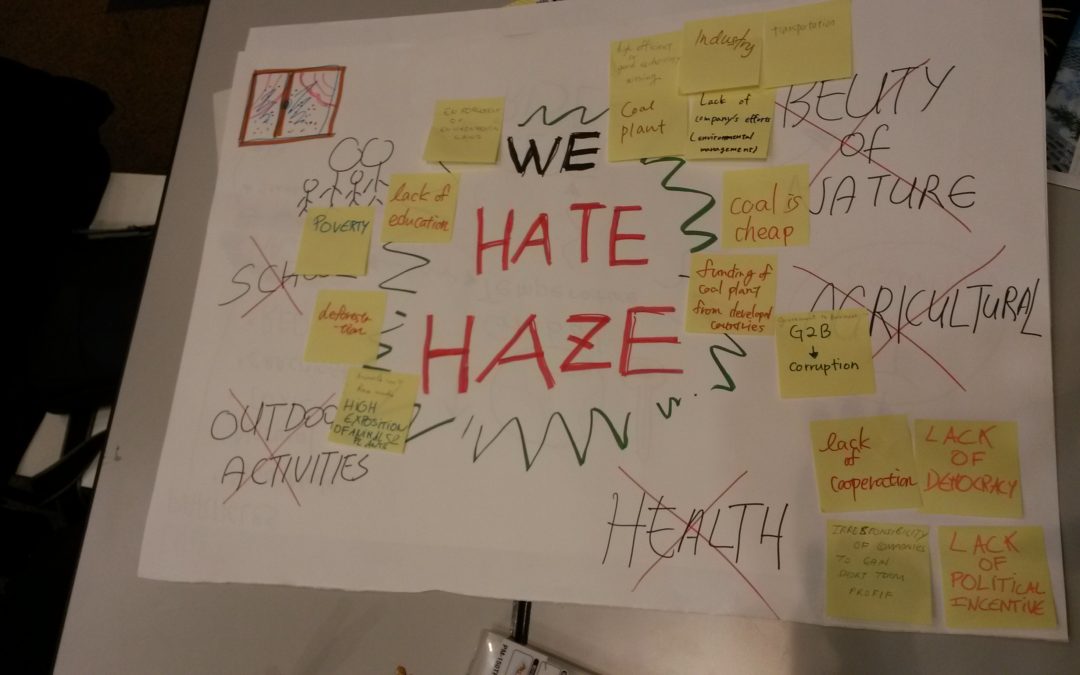
- Youth of East Asia Action Agenda (YEAAA): The participants selected five topics that are concerned with the impact of climate change.
- Poverty: A lot of consequences of climate change lead to poverty.
- Haze: East Asia such as Malaysia and China are facing this issue. The consequences of global warming worsen the haze situation.
- Destruction of Ecosystem: Lost of species.
- Rise of Sea Level: Islands are most vulnerable.
- Economy: The countries which suffer from climate change face poverty, lack of food security, etc.
- Guest speaker from Tuvalu : Learnt about how an island such as Tuvalu is struggling for the survival of their people.
- CLIMATE: Make it work!. Watched the documentary flim from a COP simulation in Paris to rethink climate negotiations. Carolin shared her experience on how 200 students in her university mimicking the process of Conference of Parties. The negotiation process is tough at the beginning. It is time consuming, tiring, complicated and tough process. It is a remarkable achievement to finally getting everyone to agree on the text and reaching an agreement.
- All COYs’ Round Table Session – Meeting with COY from Brazil, France, Indonesia and Canada through Google Hangout. It was great to know youth from other parts of country are concern about climate change issue.
- Goal – Yes. I am achieving my first goal to meet East Asia youth who might be the leaders of tomorrow.
by admin | Nov 26, 2015 | #PowerShiftMsia, Blog, MYD2015, UNFCCC, YOUNGO
Date: Thursday, 26th November 2015
Time: 22:13
Author: Loh Rachel, 18 (Selangor, Malaysia)
Current location: Yoyogi Olympics Memorial Youth Center (Tokyo, Japan)
First things first, hello! I’m Loh Rachel from the Malaysian Youth Delegation (MYD15) and am currently attending the Conference of Youths on Climate Change (COY11) in Tokyo! Feel free to ask me about COY11, MYD or anything at all through my social media networks.
So, I mustered a little courage today and spoke up during the roundtable discussion where we connected (via Skype) with all the COY conferences across the world in Brazil, India, Canada and France, to name a few. I was definitely nervous represent the youth voices of COY 11 Tokyo, but I am so glad I did! I always seem to have a problem voicing out my opinions to a large audience, afraid of their judgements, but I have learnt that we all deserve a voice and if you don’t speak up when necessary- you. Will. Regret. It.

Me speaking to youths at COY 11 in 8 countries across the globe!
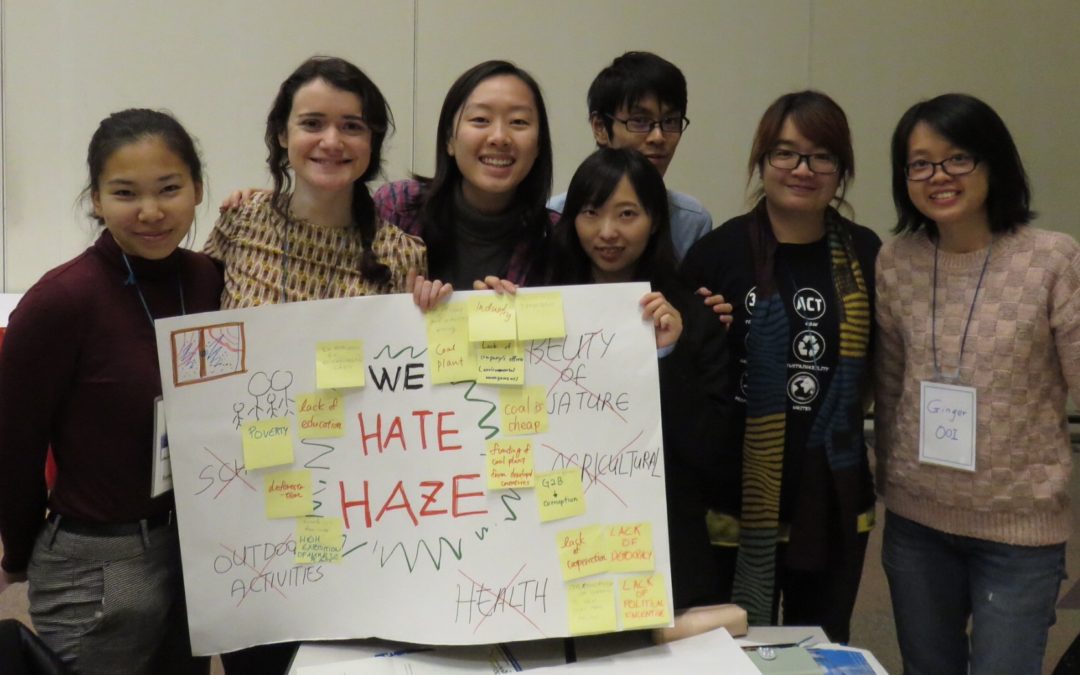
One of the best parts of my day was producing part one my group’s discussion during the “Youth of East Asia Action Agenda” (YEAAA) session. We collectively decided on the topic of Haze in East Asia, while others concluded on various topics such as conservation of biodiversity, poverty, the rise in sea levels, etc. My group was positively charged with energy. From tackling the causes of the haze to delving deep into the consequences and its relevance to climate change, we achieved A LOT during that session. Wooohoooo, go productivity! We’re ready for part two where we will talk about solutions and the logistics of incorporating this pertinent issue in our COY11 Tokyo manifesto.

Team “WE HATE HAZE” with their poster.
Second best part of the day was when the MYD group consisting of Ginger, Sze Ming and me going out for a stroll to the Meiji Shrine! We witnessed the mesmerising beauty of the fall colours merging with the traditional Japanese architecture. It was so beautiful that we decided to walk there every morning.

The Malaysian Youth Delegation (#MYD15) at the Meiji Shrine!
So, aside from learning a few Japanese phrases (e.g. Mataashita : see you tomorrow), I’ve learnt more about the negotiation process in COP21 through a film called “Make It Work” by Theatre de l’air, where students from various universities around the world experienced a COP simulation and ended up negotiating as representatives of entities (e.g. Soil) instead of the usual format (i.e. Countries). The documentary provided a wonderful insight to the harsh reality of the negotiating process in COP.
Lastly, my goal for attending COY11 is to establish a network with like minded people who are passionate about climate change and the environment, learn more about climate change and how youths can or should be involved, and make sure our voices are heard by world leaders in time for COP21. And today, though I didn’t achieve the first goal as I believe it takes time to foster strong bonds of friendship, I believe I will achieve it in the long run. As for the latter, I strongly believe we as youths achieved that today and I hope we can continue to keep this energy as we proceed with the next two days!
Domo arigatou once again to Air Asia for sponsoring our flights! I’ll be posting daily updates, so please stay tuned. 🙂

by admin | Nov 26, 2015 | Blog, MYD2015
Greetings to all, Ginger Ooi here from Malaysian Youth Delegation (MYD). If you are curious about MYD, don’t miss out the chance to know more about us. MYD is sending 3 youths to attend Conference of Youth (COY11) in Japan. Thanks to our sponsor, Air Asia for providing youths in Malaysia to have a greater exposure to the world.
 I am one of the lucky ones to be selected. It is a golden opportunity to meet with youth from East Asia and know what problems they face in their own countries and together urge world leaders to act against climate change.
This is the first year COY is happening outside of the organising country. Tokyo has been selected to host COY in East Asia. It is time to reach the local community about climate change instead of flying all the way to Paris. This is my first time travelling to a four season country.
I am excited and eager but worried as well as the temperature is between 2-18 degree Celcius. Oh gosh, I will look fatter in appearance due to the many layers I will be wearing…I like it though! Stay tuned with MYD.
My apologies for the late posting. Limited WiFi access
by admin | Nov 24, 2015 | Blog, MYD2015, UNFCCC
Hello people,
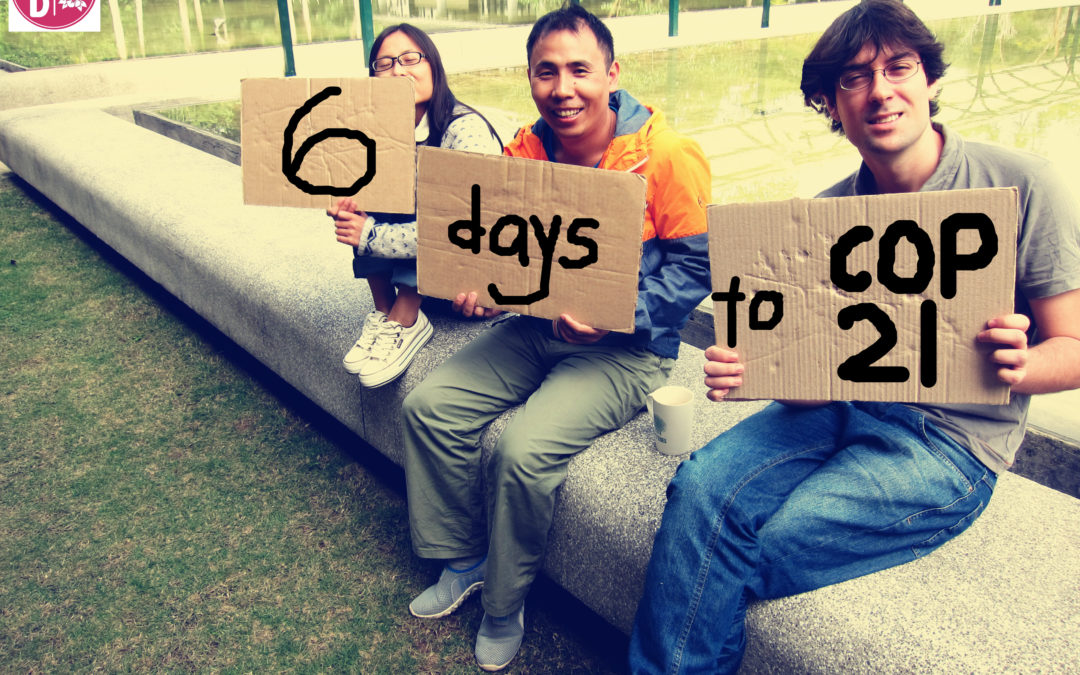
With 6 days to go before the COP21 takes place in Paris,
let’s do some serious talk on climate adaptation and mitigation
with Roxanne Low from Malaysian Youth Delegation.

The terms “adaptation” and “mitigation” are two important terms that are fundamental in the climate change debate. The IPCC defined adaptation as adjustment in natural or human systems in response to actual or expected climatic stimuli or their effects, which moderate harm or exploits beneficial opportunities. Similarly, Mitchell and Tanner (2006) defined adaptation as an understanding of how individuals, groups and natural systems can prepare for and respond to changes in climate or their environment. According to them, it is crucial to reducing vulnerability to climate change. While mitigation tackles the causes of climate change, adaptation tackles the effects of the phenomenon. The potential to adjust in order to minimize negative impact and maximize any benefits from changes in climate is known as adaptive capacity. A successful adaptation can reduce vulnerability by building on and strengthening existing coping strategies.
In general the more mitigation there is, the less will be the impacts to which we will have to adjust, and the less the risks for which we will have to try and prepare. Conversely, the greater the degree of preparatory adaptation, the less may be the impacts associated with any given degree of climate change. For people today, already feeling the impacts of past inaction in reducing greenhouse gas emissions, adaptation is not altogether passive, rather it is an active adjustment in response to new stimuli. However, our present age has proactive options (mitigation), and must also plan to live with the consequences (adaptation) of global warming.
The idea that less mitigation means greater climatic change and consequently requiring more adaptation is the basis for the urgency surrounding reductions in greenhouse gases. Climate mitigation and adaptation should not be seen as alternatives to each other, as they are not discrete activities but rather a combined set of actions in an overall strategy to reduce greenhouse gas emissions. Climate mitigation is any action taken to permanently eliminate or reduce the long-term risk and hazards of climate change to human life, property. The International Panel on Climate Change (IPCC) defines mitigation as: “An anthropogenic intervention to reduce the sources or enhance the sinks of greenhouse gases.” Climate Mitigation and Adaptation
Climate adaptation refers to the ability of a system to adjust to climate change (including climate variability and extremes) to moderate potential damage, to take advantage of opportunities, or to cope with the consequences. The IPCC defines adaptation as the, “adjustment in natural or human systems to a new or changing environment. Adaptation to climate change refers to adjustment in natural or human systems in response to actual or expected climatic stimuli or their effects, which moderates harm or exploits beneficial opportunities. Various types of adaptation can be distinguished, including anticipatory and reactive adaptation, private and public adaptation, and autonomous and planned adaptation.”
This is quite a serious post,
truly reflecting how seriously climate change can affect us.
Do look foward to COP21, people,
as it’s our responsibility in addressing this serious issues.
by admin | Nov 23, 2015 | Blog, MYD2015
Warmest Greetings !
In our previous post, we had insights from Mr. Richard =)
In this post, we will hear what our fellow MYD has to say on Malaysia’s stand on climate change.

Thomas – MYD15
Here, let me happily share with you some insights from Elyas Eric:
Malaysia is a developing country that’s on the brink of becoming a high-income nation. If we manage to hit our economic target by the year 2020, we will be standing on the same league as other high income countries such as Singapore. However, as we are transforming Malaysia to become a high income nation, we face substantial challenges: marrying economic development and environmental protection. Therefore, in this context, Malaysia can offer a new perspective in taking actions against climate change.
As peaceful as it is in Malaysia, we are vulnerable to climate change. According to the Intergovernmental Panel on Climate Change (IPCC) assessments, the past records of Malaysia climate show similar trend that has been encountered globally(Bindoff et al., 2007; Trenberth et al., 2007). Malaysia’s temperature had increased 0.18 0C per decade for over 40 years since 1951 (MOSTE, 2000). Since 1986, the average annual rise in sea level at a southern coastal site in the Peninsular Malaysia increase by approximately 1.25mm (UTM, 2007).
As a developing nation, Malaysia faces similar challenges that other developing countries are experiencing. Malaysia has overpassed the great divide in climate change negotiations: we have entered the 21st century as one of the richest countries in SEA. During COP15 in 2009, Malaysia, with support from developed countries, proposed to reduce its carbon emission to 40 per cent by the year 2020 compared with its 2005 levels, and in the same year, the National Climate Change Policy was introduced to ensure climate-resilient development and serves as a framework to mobilise and guide Government agencies, industry and communities as well as other relevant stakeholders in addressing the challenges of climate change in a concerted and holistic manner.
In pursuant to the proposal in Copenhagen, the National Corporate Greenhouse Gas (GHG) Reporting Programme for Malaysia (known as MYCarbon), was launched on 3rd December 2013. When it comes to negotiation, we were promised many great things, and although we didn’t get the funds or technology we were promised at Copenhagen, we stuck to the pledge we made there. In the Tenth Malaysia Plan, 2011-2015, as a result of mitigation measures, we have cut the emissions intensity of our GDP by 33% of the 40% proposed in the past five year. The Eleventh Malaysia Plan, 2016-2020, will focus on climate resilient development that incorporates climate change and environmental considerations into policy and development planning, evaluation and implementation.
Listed in Non Annex I as a developing country, Malaysia has no quantitative commitments under the Kyoto Protocol at present but instead, acts as one of the observer countries. However, together with all other countries, Malaysia is already committed under the UNFCCC to combat climate change by formulating, implementing, publishing and regularly updating national and regional programmes containing measures to mitigate climate change. Under the UNFCC, Malaysia is addressing anthropogenic emissions by sources and removals by sinks of all greenhouse gases.
Malaysia aims not only to graduate into the high income category by 2020, but also to shift to a new period of a low carbon economy. We are determined to get there not through rapacious consumption, but sustainable development. Asian leaders must argue for strong and effective action on climate change. Though, it is difficult to adapt to the new climate threat, and reduce greenhouse gas emissions, while still pursuing economic development, nothing is impossible if everybody plays their roles.

by admin | Nov 22, 2015 | MYD2015, UNFCCC
Hello people,
With eight more days before COP21,
I had a chance to get some precious insights from Mr.Richard Corlett
about the coming COP21 and Malaysia…..
Mr. Richard is the Lead Author for the Asia chapter of the Working Group 2
contribution to the Fifth Assessment Report of the Intergovernmental Panel on Climate Change (IPCC).
Enjoy the read, people.

Richard T Corlett, November 22th 2015
Every climate conference is billed as the “Last chance to save the world!”, but they never are. A single meeting is not enough to save the world, and a single failure – like COP-15 in Copenhagen – is not necessarily a disaster. However, success at COP-21 in Paris really is crucial, not just because every delay makes future solutions more difficult, but because for the first time – and possibly the last – all the major players are in agreement on what needs doing. Things could still go very, very wrong in Paris, but they could also, potentially, go very, very right. Most countries have submitted ‘INDCs’ setting out what they intend to do and, while some of these are too vague or too conditional to be useful, the major players – China, the USA and the EU – have all promised substantial cuts in greenhouse gas emissions, as have many of the other significant emitters.
COP-21 is supposed to agree on cuts that will keep global warming below the dangerous threshold of 2oC. If you add up all the INDCs we won’t achieve this, even if every country keeps to its promises, with 2.7-3.0oC more likely. Moreover, the 2oC target is already too high to save coral reefs and prevent a substantial rise in sea-level, as well as a lot of other less predictable, but no less unwanted, consequences. However, even 3oC is a great deal better than the 4-6oC warming that will occur if we do nothing. Moreover, the major players have agreed on the need to review the targets every 5 years. I think this is as good as we could realistically expect from Paris.
The INDCs – Intended Nationally Determined Contributions – are voluntary and, despite calls to make the Paris agreement legally enforceable, there is no practical way to do this. Will the USA invade Canada if it continues to exploit its huge tar sand deposits? No, it won’t. So, even if world leaders reach an agreement in Paris, the ‘enforcement’ will have to come from each country’s own citizens. Only Americans can hold the next US president to an agreement that Obama signs and only Indians can make sure that India meets its targets. As global economic power shifts to Asia it will be Asians – particularly Asian youth – who must ensure that Asia does not repeat the environmental mistakes of the industrial revolution in Europe, or indeed, the more recent industrialization of China. Apart from China, the key Asian players are India, which cannot follow China’s coal-fueled road to development, and Indonesia, with massive carbon stores in forests and peat, and even more in coal, which must not end up in the atmosphere.
Malaysia is one of the very few middle-income countries that has not submitted an INDC, and joins a sad list that includes some tiny oil states (e.g. Brunei), as well as countries too poor (Nepal, Nicaragua), isolated (North Korea), or unstable (Libya, Yemen, South Sudan) to make a meaningful commitment. The absence of a clear, international commitment to reduce emissions makes it harder for Malaysians to hold their government to account, but Malaysia’s currently substantial emissions from industry and deforestation, and its ambitions for first-world status, make it essential that they do so. It is not too late for Malaysia to submit an INDC to the UN and, assuming the 5-year review period is agreed in Paris, the government needs to plan for 2020. Obvious emission-reduction targets are zero deforestation, particularly in Malaysian Borneo, and protection of the vast areas of logged and degraded forests so that they absorb carbon as they recover. For urban areas and industry, energy efficiency is a priority, plus a rapid increase in the proportion of electricity from renewable sources. These actions all have co-benefits for biodiversity and for people, so it is not just about carbon. Raising awareness is also important, but it needs to be linked to hard scientific information. Malaysians need to understand the risks they face, from warming and the less predictable changes in rainfall patterns, and how global cuts in emissions will reduce these risks. It is time for Malaysia to join the rest of the world in stopping climate change.

