![Divestment]()
by admin | Aug 19, 2016 | Knowledge, MYD2016


NGOs who took part in Global Divestment Day. Image was taken from: http://newsroom.unfccc.int/unfccc-newsroom/13-14-february-is-global-divestment-day/
One of the biggest hurdles in combatting climate change is to reduce our dependency on fossil fuels and other pollutants. However, there are individuals who still stand to profit from the industry. The only way to fix that is when the industry is no longer profitable or the business is no longer operational. A way to lead to that is by way divestment.
What is divestment?
Divestment is the opposite of investment. It is where you take out your money, in the form of stocks or bonds from a company so that you cease control or stop getting profit from it. Corporations are beholden to the wish of their shareholders. Thus, if there no longer any interest to pursue the business, operations can calm to a halt or at least, have less capital to operate.
Where has divestment been used effectively?
- South Africa
The apartheid regime was a dark part of South Africa’s history. It was a system where black and white citizens could not mix with only the white population receiving quality infrastructure and amnesties. Its impact on income inequality and racism can be felt even today.
At its peak, a majority of the world’s nations has imposed sanctions and divested from the country. Companies were supposed to invest in the country pulled out, amid pressures from nation states. The divestment was done in support of the growing anti-apartheid movement, led by notable leaders like Nelson Mandela and Desmond Tutu. It was the non-violent alternative to Mandela’s violent tactics that landed him in jail prior.
Recently, Desmond Tutu visited the University of California, Los Angeles to thank the university for pulling out investments from the country, which led other organisations to do the same. The regime then caved in from the economic incentive.
2. Israel
In opposition to the Zionist regime and the apartheid-like treatment done by the Israeli government on the people of Palestine, sympathisers ran the Boycott, Divestment and Sanction (BDS) movement. The movement was a non-violent alternative to boycotting products from the state of Israel to deprive them of revenue. Even if the impact is questionable, at least they know their money wouldn’t land in the hands of the Israeli military.
While economically, Israel still stands strong, the movement has gained traction in the European Union. This has led them to ban items from Israeli-occupied lands that were exported as Israeli goods. Due to this, multiple companies have decided not to invest or at least pulled out their money from companies based in the occupied territories.
How does this apply to the fossil fuel industry?
Desmond Tutu has called for the same tactics used in South Africa to be used in the fossil fuel industry. He urged companies to pull out the biggest industry players, making them unable to expand operations and stuck with their current situation. It is only when they decide to move on to other sources of energy than the world’s richest should be able to invest in them, without guilt.
Written by: Terence Aaron Anthony
Edited by: Choy Moon Moon
![Loss and Damage]()
by admin | Aug 17, 2016 | Knowledge, MYD2016
Loss and Damage associated with climate change impacts was first discussed and initiated at the COP16 held in Cancun in 2010, as part of the Cancun Adaptation Framework. This issue which specifically focus on the context of developing countries are more vulnerable to adverse effects of climate change, including extreme events and slow onset events were then formally addressed by the establishment of Warsaw International Mechanism for Loss and Damage associated with climate change impacts at the COP19. The initial objective of the mechanism is to promote the implementation of approaches to address loss and damage in a comprehensive, integrated and coherent manner. (Decision 2/CP 19)

Loss and damage of vulnerable cities due to climate change. Image was taken from: Millennium Post http://www.millenniumpost.in/NewsContent.aspx?NID=199956
The main functions of the mechanism include enhancing knowledge and understanding of comprehensive risk management, strengthening dialogue and coordination among relevant stakeholders, enhancing actions and support through the means of finance, technology and capacity-building to address loss and damage associated with the impacts of climate change.
The administration of the mechanism has been placed under the Executive Committee of the Warsaw International Mechanism for Loss and Damage. A total of 20 members, 10 each respectively from Annex I Parties and non-Annex I Parties forms the committee, governed by an agreement made at the COP20.
The Executive Committee wasted no time working on the initial two-year work plan that encompasses the following action area:
- Action Area 1: Enhance understanding of factors based on geography, socioeconomic status and livelihoods etc.
- Action Area 2: Enhance the understanding of comprehensive risk management approaches
- Action Area 3: Enhance knowledge of risks of slow onset events and their impacts
- Action Area 4: Enhance data on non-economic losses
- Action Area 5: Enhance the understanding of the capacity and coordination needs with regard to responding to loss and damage
- Action Area 6: Enhance the understanding and expertise of impacts of climate change
- Action Area 7: Encourage comprehensive risk management by the diffusion of information related to financial instruments and tools that address the risks
- Action Area 8: Complement, draw upon the work of the involve
- Action Area 9: Develop a five-year rolling work plan for consideration at the COP22
At the COP21, Loss and Damage is defined as a stand-alone issue rather than being a subcategory under Adaptation, largely due to the reality that there are significant impacts from climate change that could not possibly be adapted. It is also clearly stated in Paris Agreement that Warsaw International Mechanism of Loss and Damage associated with climate change impacts has been decided to be extended from being expired in 2016. The decision has been widely recognised as a necessary move which explicitly differentiate adaptation to climate change and contending with the associated losses and damages.
Following the decision coined at the COP21, the latest list of nominated committee members was updated on 24 May 2016. The Executive Committee has thus put on high hope continue its effort in averting, minimising and addressing loss and damage issues associated with climate change adaptations.
Written by: Diong Siong Loong (Kelvin)
Edited by: Choy Moon Moon
References:
- UNFCCC, ‘Warsaw International Mechanism for Loss and Damage associated with Climate Change Impacts‘ Web
- K Mogelgaard & H McGray, ‘When Adaptation Is Not Enough: Paris Agreement Recognises “Loss and Damage“‘ [2015] WRI Resources
![What Is Climate Technology Transfer?]()
by admin | Aug 12, 2016 | MYD2016
Technology transfer is, according to the Intergovernmental Panel on Climate Change (IPCC) a broad set of processes covering the flows of know-how, experience and equipment for mitigating and adapting to climate change among different stakeholders such as governments, private sector entities, financial institutions, non-governmental organizations (NGOs), and research/education institutions.
Its framework was established at COP 7, as part of the Marrakesh Accords for meaningful and effective actions to enhance the implementation of Article 4.5 of the United Nations Framework Convention on Climate Change (UNFCCC. Article 4.5 requires developed countries to “take all practicable steps to promote, facilitate and finance, as appropriate, the transfer of, or access to environmentally sound technologies and know-how to other Parties, particularly developing country parties to enable them to implement the provisions of the Convention.”)

The Climate Technology Centre and Network (CTCN) was formed to minimise the costs and risks for the transfer of climate change mitigation technology to the developing countries. Image was taken from: http://inhabitat.com/
The rationale was that the design and spread of more energy-efficient technologies that reduce or eliminate climate change inducing emissions is a recognised solution to climate change. This is because the international community must keep the average global temperature rise to below 2°C compared to pre-industrial levels to mitigate the most severe impacts of global warming. Thus, the growth in global greenhouse gas emissions must be stopped by 2020 at the latest for a start.
At the COP13 in Bali, four sub-themes were added to the framework as part of the mechanisms for technology transfer theme.
- The first is Innovative financing, that aims to improve financial access for the development and transfer of technology from a wide variety of sources, public and private.
- Secondly, identifying ways and means to enhance international cooperation with relevant conventions and intergovernmental processes involved in the development and transfer of technology.
- Thirdly, identifying actions to promote the endogenous development of technology through the provision of financial resources and joint research and development.
- Finally, promoting collaborative research and development on technologies.
There is a particular focus on encompassing developing countries in this endeavour because it is predicted that by 2020, nearly two-thirds of the world’s emissions will be produced from them. Thus, climate technologies are directed to ensure accessibility in all parts of the world. After all, falling emissions in Europe but escalating emissions would have a counter-intuitive effect on the goal of maintaining the average global temperature. The European Union for its part has kept this mind, particularly in regards to programmes such as the Kenya Climate Innovation Centre in Kenya. It was aimed to promote home-grown green technologies throughout the East African region. It offers support to climate-focused technology ventures to boost agricultural productivity and agro-processing, to which the governments of the UK and Denmark are partners in this World Bank initiative. Other initiatives include the Renewable Energy and Adapting to Climate Technologies Window (REACT) in Africa and Vocational Training Centre for Renewable Energies and Industrial Maintenance in Cape Verde.
These tend to be economically beneficial to the private sector as well, but whether they are sufficient to leap in progress as is required given the race against time is left to be seen. However, the march against climate change continues.
Written by: Nachatira Thuraichamy
Edited by: Choy Moon Moon
![What Is Climate Adaptation?]()
by admin | Aug 10, 2016 | Knowledge, MYD2016

Climate adaptation. Image was taken from: http://thinkprogress.org/climate/2011/11/22/374301/tv-media-ignore-ipcc-extreme-weather-report/
As climate change now becomes a topic more prominent than ever, it is also a time to question what we can do about it. There are two main courses of action which are commonly discussed upon and undertaken – mitigation and adaptation. Whilst mitigation attempts to address the root causes (i.e. why are temperatures rising), adaptation seeks to lower the risks of climate change consequences (i.e. better water systems for dry seasons). Both of these measures are critical especially for our present time, but according to the IPCC’s latest report, climate change and its impacts will continue for centuries even if mitigation measures are taken immediately. Therefore, we need to start finding ways to adapt to a future of climate uncertainty.
Around the world, adaptation measures often involve infrastructural or policy changes that aid in reducing the vulnerability of people towards climate change consequences, making communities more resilient towards such changes. Malaysia, as a developing country, is highly vulnerable to climate change as its effects are not only environmental and will also lead to socioeconomic effects.
To better illustrate what climate adaptation means for Malaysia, here is an example. Among other climate consequences for Malaysia, one that we are exceptionally familiar with is flooding. Expected increase in intensity and frequency of flooding will mean that communities, rural and urban alike, will have to be better equipped in via infrastructure, education, improvement in policies etc. Increased flooding as a result of climate change can also bring detrimental effects to our economy, as agriculture takes up 12% of our annual GDP. An example of an adaptation method Malaysia can adopt will be to enable farmers with better equipment or better yielding crops in order to sustain their livelihoods and also our national economy. It can also mean providing rural communities who are reliant on climate for crops better education so that they can contribute to other facets of the economy. Now, these so-called “climate adaptation methods” sound similar to development programs, and they do in fact overlap. However, adaptation to climate change for a developing country like Malaysia involves measures targeted specifically at climate change consequences such as building sea defences at coastal areas prone to sea level rise like Tanjung Piai in Johor.
As mentioned above, climate adaptation, more often than not, entails anthropocentric perspectives – measures targeted at reducing the vulnerability of humans. Whilst that aspect is crucial, it is perhaps wise that we do not forsake ecological vulnerability to climate change, such as global warming’s threats to pristine biodiversity. Such is particularly relevant for Malaysia as our tropical rainforests are not only carbon sinks which can neutralise effects of climate change, but they are so because of the biodiversity which exists within it. So, adapting to climate change for Malaysia may very well also include conserving and protecting our pristine rainforests in order to dampen climatic consequences. However, climate change adaptation for biological and environmental threats are, as of date, not explored in depth.
Whilst climate change may not seem like a tangible occurrence to many, it is crucial that policy-makers and every individual to understand the necessity of climate adaptation as inseparable from sustainable development in the near future.
Written by: Nicole Lim Pei Pey
Edited by: Choy Moon Moon
![What Is Climate Adaptation?]()
by admin | Aug 7, 2016 | Knowledge, MYD2016
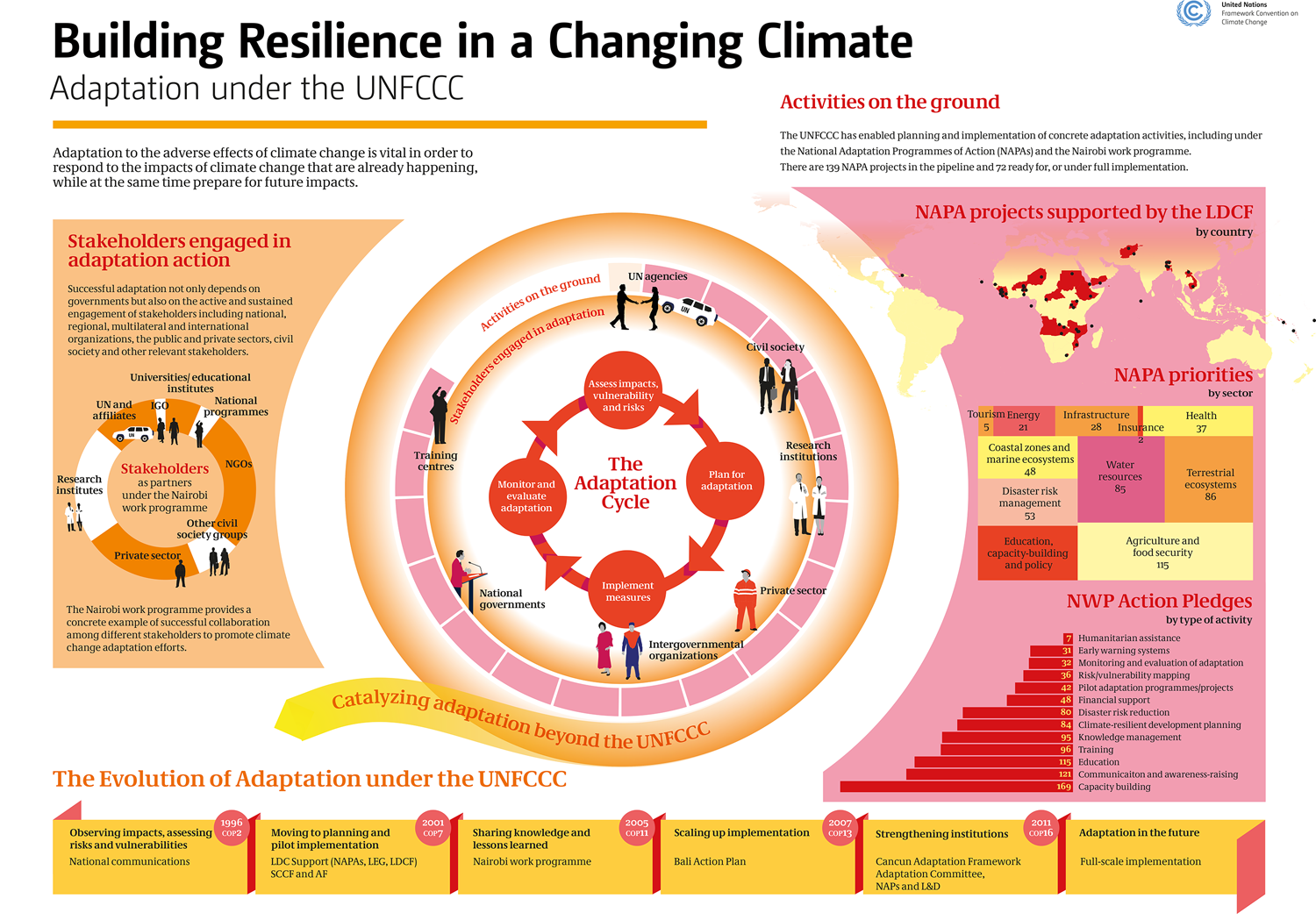
Climate adaptation is considered a response to the effects of climate change that seeks to reduce the vulnerability of various social and biological systems thus offsetting the changes. The UNFCCC defines it as actions taken to help communities and ecosystems cope with changing climate condition. It is a process by which strategies to moderate, cope with and take advantage of the consequences of climatic events are enhanced, developed, and implemented. Even if emissions are stabilised, the effects of climate change will last much longer and adaptation is required to respond to the impacts of climate change that is already happening, while at the same time prepare for future impacts.

Climate Adaption under the UNFCCC. Image was taken from: http://unfccc.int/timeline/
Adaptation is especially important in developing countries since those countries are predicted to suffer the most severe consequences of climate change. The adaptive capacity is also unevenly distributed across different regions and populations and developing countries are generally the ones that are least capable of doing so. Adaptive capacity is closely linked to social and economic development (IPCC, 2007). The economic costs of adaptation to climate change are likely to cost billions of dollars annually for the next several decades and the degree of adaptation correlates to the situational focus on environmental issues. The challenge grows with the magnitude and the rate of climate change. A team of science policy experts claim that adapting to climate change would be a more effective means of dealing with global warming than reducing greenhouse gas emissions. The IPCC working group II suggested that mitigation and adaptation should be complementary components of a response strategy to global warming. The report mentioned that adaptation, sustainable development, and enhancement of equity can be mutually reinforcing.
There are several principles that need to be considered when designing the adaptation policy:
- Effect of climate change varies with regions and demographics;
- Climate change poses both risks and opportunities;
- Adaptation comes with a cost;
- The response has varying effectivenes;
- The systemic nature of climate change complicates the adaptation; and,
- Maladaptation can result in negative effects that are as serious as the climate-induced effects that are being avoided.
As mentioned, enhanced adaptive capacity can reduce vulnerability to climate change. These activities are essentially equivalent to activities that promote sustainable development such as reducing poverty, improving education, improve access to basic resources, lowering inequality and wealth gaps and building infrastructure. Another adaptation method is through agricultural production as changes in rainfall patterns have a direct impact on crops. The strategies include drought tolerant crops, investing in irrigation and rainwater storage. Other initiatives like weather control, geo-engineering and damning of glacial lakes Strengthening the resilience and adaptive capacity of more vulnerable regions must go hand in hand with efforts to raise awareness and integrate measures into national policies and strategies.
Written by: Khoo Nee Zhen
Edited by: Choy Moon Moon
![Common but Differentiated Responsibilities]()
by admin | Aug 5, 2016 | Knowledge, MYD2016
The adoption of the principle i.e. Common but Differentiated Responsibilities (CBDR) in the United Nations Framework Convention on Climate Change (UNFCCC) entails that while all States are pursuing a common goal, they hold different obligations depending on their socio-economic situation, as well as their present and historical contribution to the environmental problem at stake. The principle provides an overarching harmonisation in terms of sharing the burden and responsibility to safeguard global environmental problems for common resources equally, whilst recognising and acknowledging that there are wide differences with regards to the economic development among the States. Accordingly, these differences between the States act as an indication to determine their respective contributions, as well as their capabilities and abilities in addressing environmental problems.

A simple depiction of the principle of Common but Differentiated Responsibilities. Image was taken from: The GWPF
The principle became prominent in the 1990s especially when States started to share the same sentiment whereby they should develop a legal framework on climate change, in order to address the rapid hike of the greenhouse gases (GHGs) emissions which were not previously included in the ozone layer protection regime during the 1980s. The Intergovernmental Panel on Climate Change (IPCC) was soon established by the World Meteorological Organisation (WMO) and the United Nations Environment Program (UNEP) to provide scientific assessment and the implications of policies made by the decision makers in terms of adaptation and mitigation.1
Initially, the principle was not unanimously accepted by the developed countries, in particular, the United States where it conditioned its participation of such regulatory regime on the involvement of developing countries as well. It became evident that a “north-south” divide2 was exhibited with regards to the perception of climate change between the developed and developing countries due to their dissimilar and often diverging underlying domestic interests – the former emphasised on the environmental issues by drawing a connection to the scientific findings, whilst the latter shown concerned about their future development and economic status.
In spite of that, the principle of CBDR came into force when the UNFCCC was adopted in 1992. It led to a compromise in relation to the positions of safeguarding global environmental issues between the developed and developing countries with the aim of bringing about the establishment of environmental governance to be as inclusive, and as effective as possible. On account of recognising the States’ present and historical relation between their development, as well as their contribution towards the degradation of global environment, it was established that since the developed countries had entered the industrialisation era sooner and had the opportunity to develop for a longer period, they now need to undertake a more significant share of responsibility. Without neglecting various climate change affected groups, namely small island states, areas which are more susceptible to drought and natural disaster, least developed countries, low-lying coastal region etc., the principle also seeks to take their specific needs and concerns into consideration when it comes to determining their responsibility in addressing environmental problems.
Considering that Malaysia is a part of the Like-Minded Group of Developing Countries (LMDCs), this principle allows them to hold a less stringent obligation. In addition to that, developed countries are required to provide international assistance to the developing countries i.e. transfer of technology and financial resources etc. in helping them to achieve their sustainable development responsibility, whilst playing the lead role in combating climate change in accordance with Article 3(1) of the UNFCCC.3
Written by: Choy Moon Moon
References:
- IPCC, ‘History’ https://www.ipcc.ch/organization/organization_history.shtml accessed 17 July 2016
- D A Mejía, The Evolution of the Climate Change Regime: Beyond a North-South Divide? [2010] ICIP 18-20
- UNFCCC 1992, NY