In conjunction to the upcoming COP23 in Bonn, Germany, this training series aims to educate both the public and the MYD members about:
1. Malaysia’s stance on climate change issues at UNFCCC negotiations and how NDCs are determined by Malaysia
2. Conflict between international policies and Malaysian policies as well as the weaknesses in Malaysia’s climate change policies
3. How Malaysian stakeholders influence policies and the impact of climate change on our economic/ social/ environmental development.
Event: MYD 2017 Training Series #7- Understanding Malaysia’s Climate Change Policies and NDCs
Date: 24/10/17
Time: 6.30 p.m – 9:00 p.m.
Venue: The University of Nottingham Teaching Centre, Level 2, Chulan Tower, No 3 Jalan Conlay, 50450 Kuala Lumpur, Malaysia
MYD Training Details:
Trainer Profile:
Ms Lakshmi Lavanya Rama Iyer is a professional qualified lawyer that also has a Msc in Sustainability (Climate Change) in University of Leeds, UK.
Her experience include working with the Malaysian Government on a UNDP funded project to prepare Malaysia’s climate change report called the Second National Communication to the United Nations Framework Convention on Climate Change (UNFCCC).
Besides that, she also works at the UN in Geneva and is currently practicing law in Malaysia, being WWF-MY’s representative in several working groups of the Third National Communication process.
Registration
#MYD Training Series – Training on UNFCCC negotiations and media work with various climate experts, government bodies and civil society leaders. Each sessions will run for min 2 hours and will be broadcast/record and available on YouTube for future reference. For more info about the TS, please click here: http://powershiftmalaysia.org.my/myd-2017-road-map/
October 11th marks Ada Lovelace day, an international celebration day of the achievements of women in science, technology, engineering and maths (STEM). Ada Lovelace was born in 1815 and was a famous mathematician and computer programmer. In fact, she was known as the founder of computer programming as she could create an algorithm for mechanical computers at that time. This is something foreign in the 19th century as there were very few women who partook in such a field. She has become the symbol of many women to follow their dreams and have the determination to break the social norms of the society.
In conjunction with Ada Lovelace day, The University of Nottingham Malaysia Campus held a gender equality network and our MYD member, Lhavanya Dharmalingam was one of the speakers. Lhavanya took the stage to talk about how great minds such as Ada Lovelace, Da Vinci, and Rabindranath Tagore are individuals who had multiple interests and passions; developing and contributing ideas that led to cultural, economic and social progress. Now that was the hurdle to progress in the past – breaking the social norm. However, today there is another hurdle to overcome – the climate change. The threat it poses which she described as “looming over us right this moment like a big fire-breathing dragon.”
Climate change has caused so much destruction for the past few decades; the increasing sea levels, severe drought, crop failures, coral deaths and the list goes on. All these have and will lead billions of people around the world to be trapped in serious social and economic problems. Lhavanya told the floor how MYD is helping to combat climate change by attending conferences in the Conference Of Youth (COP) held annually. The significant role of MYD is to act as a mediator between the government and the public . It is the MYD’s responsibility to translate all the climate policy jargons into the layman’s terms for the public to digest and be updated in the global and local climate movement.
She took the opportunity to enlighten the floor with Malaysia’s efforts as a leading nation in climate change during the Paris Agreement and the following COPs. She added how the Malaysian government has decent environmental initiatives and good stance at COP conferences. She gave an example of how Malaysia has pledged to reduce greenhouse gas emissions intensity by 35% with an additional 10% on the condition of foreign aids by translating what Article 4, Section 3 of the Paris Agreement means for Malaysia. She emphasised the importance of a climate policy communicator coupled with the media that forms an integral role to play in the climate change policy progress. She added that the media is in a unique position to disseminate information to large audience.
In addition, she pointed out how feminism movement is directly involved in this global issue. The movement feels responsible to address the issue as the poor and vulnerable will be the most affected. In this group women make up most of the number. This is due to the fact that in developing regions most farmers are women. As a result, they will be the first to experience the effects of climate change. In addition, she reminded the audience that in rural economies, the job of gathering food and water often falls on the females’ shoulders. Being involved directly in getting food and water for the family, women will definitely be the first to face the impact of climate change.
Besides that, Lhavanya mentioned an eco-feminist movement that focuses on climate change issues and other environmental problems led by Dr. Vandana Shiva, an activist from a diverse skillset coming from a Nuclear Physics background but is currently pursuing the field of environmental policy and agricultural science. “Climate change can and should be approached from various facets and angles for a holistic approach,” she added. She ended the speech by urging us to take the opportunities given to further diversify ourselves to be better qualified and to fill the gaps in the society, partaking in global issues such as climate change. Of course, all for the good of mankind.
Have you seen or experienced around 175 enthusiastic people on climate change in one arena to watch a movie on Climate Change?
It may not be too prevalent, but thanks to #PowerShiftMsia, the screening of Al Gore’s sequel movie on climate change “An Inconvenient Sequel – Truth to Power” was eventuated at TGV cinemas in One Utama Mall. The prequel of this movie was released back in 2006 and tried to permanently denounce climate change deniers. The movie was critically acclaimed by many, including climatologists from NASA.
Fast forward to 2017, the former Vice President of the US comes up with an even more engrossing movie, unlike the principal slideshow presentation in his previous venture. But what does the film have to offer this time around? To answer that question, the MYD members have some riveting reflections
~ OUR THOUGHTS ~
Diyana
“In this sequel, Al Gore made his point about climate change being real and urgent, as his prediction came true: New York (along with the 9/11 memorial) was flooded by ocean waters during Hurricane Sandy in 2012. He went on a mission to persuade governmental leaders to adopt renewable energy, including India, a developing country that has been relying on coal energy. In many cases, he succeeded in convincing the leaders with promises of support. However, he seemed unable to persuade his own country’s leader, which is quite sad. America is one of the important players in the fight against climate change and yet its leader is not on board, as segments of his speech kept implying. But I guess that should not stop any of us from making a change. Overall, I think this movie is a good update on Al Gore’s work and I suppose it encourages us to follow his footsteps to demand country leaders to actually lead the way towards cleaner energy.”
“The movie comes across as an afterthought on an important message. The message is not carefully thought out and the movie has not been meticulously crafted unlike the first of Al Gore’s movies. It’s more of a documentary actually, that highlights how Al Gore’s predictions came true and how wrong his detractors were and basically it was an Al Gore and Climate Change documentary.
Nevertheless, I will highlight it as a good rundown on the climate change scene in the U.S. From the impacts of weather disasters to the politics of it it sheds a lot of light on the scene. I will condemn it for being rather pro Global North and anti-Global South however. Al Gore portrays the Indian leaders in a very narrow perspective as the misguided bad guys who seem more concerned over economic development than climate change but fails to highlight the U.S.’s hypocrisy when it comes to this as well. For example there have been cases of the U.S. interfering in the solar energy market of the developing countries to prevent them from producing solar panels that are cheaper and more accessible to their people than U.S. made solar panels. Here is a good read on a WTO ruling against India to undermine its efforts to increase jobs in the solar panel industry and increase climate protections.
At the end of the movie I did walk out pledging silently to myself to #BeInconvenient but overall I believe Al Gore could have done a lot more with this ‘movie’. That would make it a more solid attack on climate change deniers and a film that can effectively rouse the international audience to take climate change seriously and spread the message.”
“This movie emphasizes a lot about the truth of climate change, and the ending really moved my friend and I as it did mention about other movements that have occurred through history and maybe, right now, it’s time to have a movement about climate change! It’s amazing how powerful people can be, a call from Al Gore to persuade the solar company is all it takes for India to try to adopt more renewable energy. The Paris agreement and UNFCCC were also shown in the movie itself, displaying the importance of them when it comes to climate change. Leaders of countries such as China and others were also very concerned with the well being of their nations, displaying their progress to adopting a greener lifestyle.”
“After watching the first ‘An Inconvenient Truth’, I find this documentary underwhelming because the lessons learned in the sequel may be obtained by solely watching the prequel. I would say that the only addition to this documentary was the Paris Agreement, whereby India was unfairly portrayed as the antagonist. Nonetheless, I commend on the message delivered by the documentary in trying to mobilise the public in championing against climate change. I say it’s underwhelming because as an environmental science student, the climate change 101 delivered by Al Gore has long been exposed to me. However, had the target of the documentary been towards to ‘non-converts’, those who are hearing about climate change for the first time and the daunting battle against it, An Inconvenient Truth 2 would be a sufficient introductory course.”
“The documentary was very interesting. When former VP Al Gore showed the “Blue Marble” taken by the Apollo 8, it was really mesmerizing. It was absolutely beautiful. In the documentary, you can see how Al Gore had a strong passion. Being able to watch this documentary, it really recharged me. Al Gore was ready to go to every corner of the world for convincing people not to use coal/fossil fuel and switching to renewable energy. He had even visited India to meet the environmental minister and convince them to phase out non-renewable energy plants. When the minister questioned back, he stated that Al Gore shouldn’t be speaking to him and rather was concerned with his own people. If I was at Al Gore’s position, I wouldn’t have known on how to react. He keep on calling here and there to ask for help, so that India would agree to sign the Paris Agreement; his hard work was incredible. This documentary shows us on how every parties, people with power, NGOs, citizens and scientists have their role to play, like one of the quote from the documentary ‘Fight like your world depends on it’.”
“The 1st episode and now the sequel, both films convey the messages in a TED Talk style which revolves around Al Gore talking about the basic science and consequences of climate change but little emphasis on the “who is the actual culprit” and the “how”. When compared to the 1st episode, Al Gore has a grumpy tone in the sequel. The scene when he yelled “What were you thinking?”(to the politicians/climate change deniers) staples in my mind until now and I believe it will stay for quite sometime. Besides, I believe in every film a central antagonist and protagonist will be featured in order to create the required conflict. The conflict will then create excitement which would boost viewership and eventually, the box office sales.
In my opinion, India was placed as the antagonist in this film as they loom as an obstacle to deal with. So, our good guy Gore (or you can say US in general) came to the rescue by persuading the US based solar company to provide tremendous support to India. Ultimately, India agreed, Paris Agreement was adopted and everyone lived happily ever after. Too bad, this only happens in fairy tale.
There are always 2 sides of a story. The right to development is a fundamental principle especially for developing countries. It is stated in Principle 3 in Rio Declaration on Environment and Development back in 1992. For instance, many of the 1.3 billion Indian population needing their basic amenities (i.e education, poverty eradication, healthcare) were still unmet, meaning that development was a necessity. Thus, the importance of Common But Differentiated Responsibilities (CBDR) can be seen. Nevertheless, memories of myself attending COP21 just streaming through my mind throughout the entire movie. So yeah, I have mixed feelings about this movie. It’s complicated.”
“The movie reiterated the collective struggle for demanding action against climate change. Al Gore instilled that climate action cannot be easily fulfilled without the help of governments and insisted on local action. Significant portions of the film focused on India’s renewable energy and issues related to it. There was a clear pressure on India to do more by the west- even Sunita Narain, who featured in a cameo, mentioned that shifting blame towards developing nations was unfair. India was shown to be delinquent. Interestingly, the film depicted the ‘phone call’ from Al Gore to SolarCity’s CEO for the company to provide solar technologies to India. This looked improbable; with all the negotiations, a mere call couldn’t have done the job. There was a strong hint that the western fear of developing countries becoming developed would prevent the achievement of the 2 degree celsius goal. On the contrary, this movie was another instance of climate change not being solely about climate change as science. Nevertheless, the film was also reminiscent of the floods at my hometown in Chennai. Overall, the show ended towards the optimistic side. We can see the light at the end of the tunnel but there are too many stalactites blocking the path.”
The overall view of the Malaysian Youth Delegation members is that the movie showed glimpses of promise for a sustainable future, but with actions getting hypocritical, we mostly remain ambiguous. However, the scope for development in the movie is considerably high.
On behalf of MYD, we would like to thank all those who made it for the screening and commend #PowerShiftMsia, United International Pictures Malaysia and TGV Cinemas for materialising the event!
COP23 is the 23rd Conference of the Parties to the United Nations Framework Convention on Climate Change (UNFCCC). It is the main annual meeting of all nations under the UNFCCC to build and strengthen intergovernmental climate policy.
COP23 will be held from November 6-17, 2017, in Bonn, Germany.
The Conference will comprise sessions of:
the Conference of the Parties (COP 23);
the Conference of the Parties serving as the meeting of the Parties to the Kyoto Protocol (CMP 13);
the Conference of the Parties serving as the meeting of the Parties to the Paris Agreement (CMA 1.2);
the Subsidiary Body for Implementation (SBI 47);
the Subsidiary Body for Scientific and Technological Advice (SBSTA 47);
the Ad Hoc Working Group on the Paris Agreement (APA 1.4).
A Little about COP23
COP23 will be focusing on:
Accelerating the implementation of the Paris Agreement
Catalyzing and supporting climate action happening at a global scale
The special thing about COP23 is that the conference is led by the Presidency of Fiji (Fiji is the host) but hosted off-site in Bonn (where the UNFCCC Secretariat is). So, the host team works closely with the secretariat of UNFCCC, both governments, the State of North Rhine-Westphalia and the city of Bonn in organizing this conference.
COP23 is fused with the Fijian Bula spirit, which means hello or welcome, with a deeper sense of wishing others a blessing of affection and good health. The conference plans on showcasing Fijian and Pacific culture, art and life. The design of the logo was meant to act as a reminder that rising sea levels are affecting not only small island developing states but also coastal cities in many other countries.
One Conference, Two Zones
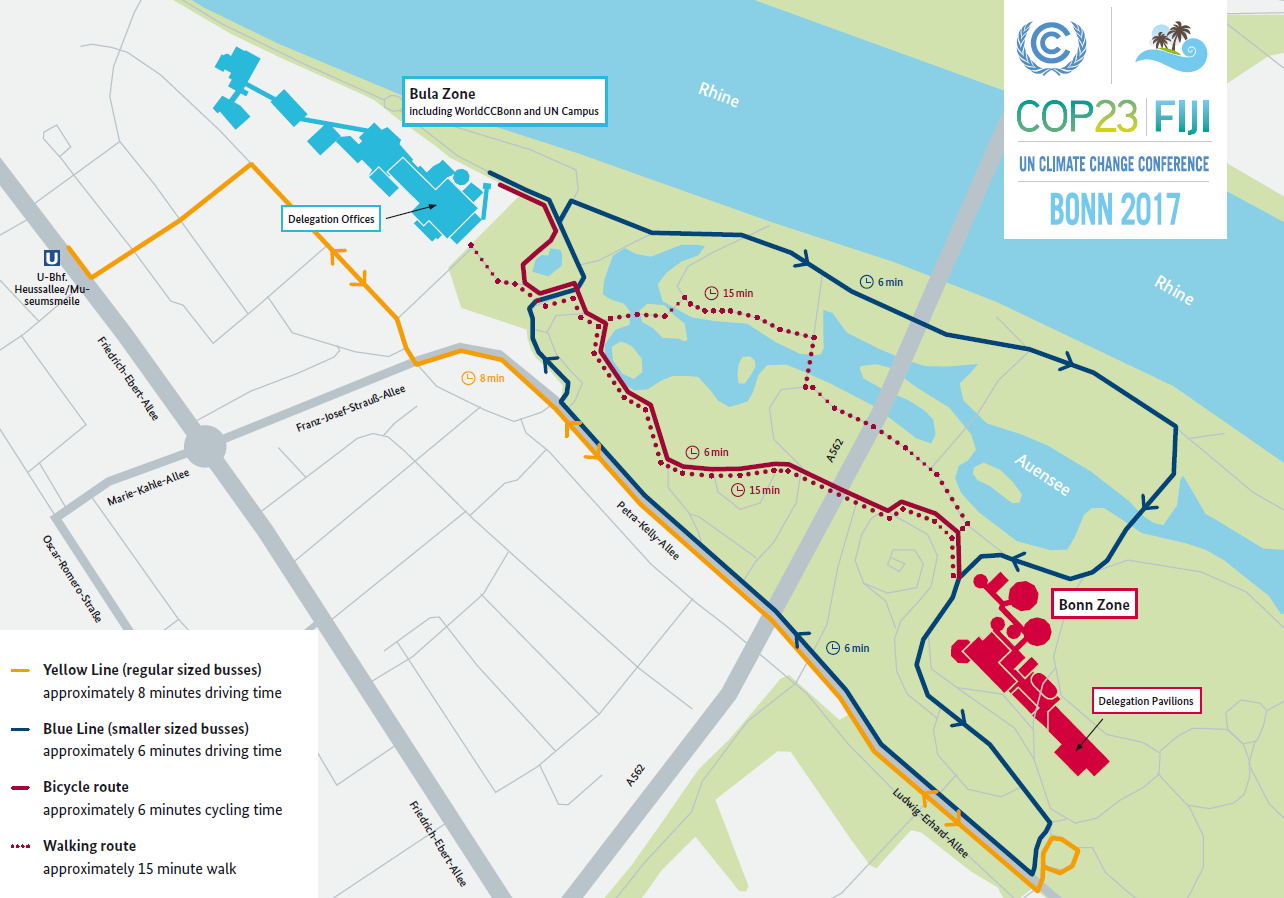
Two zones will be set up for COP23: The Bula Zone and the Bonn Zone. The Bula Zone will act as the formal negotiating zone will the Bonn Zone will act as the climate action zone.
The Bula Zone
The Bula Zone spans from the World Conference Center Bonn to the UN Campus as well as a temporary extension. Plenary halls, meeting rooms, delegation offices, a media and press center as well as catering and other facilities are prepared for a variety of activities.
The Bonn Zone
The Bonn Zone will host global climate action events (including high-level events), side events, media events, exhibits, and pavilion events..
Setup of the Conference
The distance between the two zones is about 1.4km, which is a 15-minute walk or 9-minute drive. Shuttles are provided to commute between the two zones. But, I feel that the most exciting thing about traveling between the two zones is that bicycles are provided for free! Yay!
Preliminary overview map
Here’s a virtual tour of the conference venue:
The presentation of the logistical preparation can be find HERE as well.
Sustainable Aspect of the Conference
The conference aims to be climate neutral through a series of action plans, hoping to offset the unavoidable emissions (like flights). Actions include virtual participation, paper reduction, European Eco-Management, and Audit Scheme (EMAS) verification, vegetarian catering and etc.
The SEA Games will take place from Aug 19 to 30 while the ASEAN Para Games will be held from Sept 17 to 23. The Games will coincide with the celebration of Malaysia’s National Day as well as Malaysia Day.
Green Games Initiative
Few months back, the Malaysian Sea Games Organising Committee (Masoc) launched the Green Games Initiative in conjunction with World Environment Day. The chief operating officer of Masoc, Shaiful Zahrin Subhan pledged to commit to deliver the event in an environmentally-responsible wayand to promote environmental protection. Besides, he also mentioned that the green initiatives will be implemented in collaboration with key partners which hope to inspire all stakeholders including venue owners, vendors and the public to continue their sustainable practices beyond the Games. [The Star]
This is how i felt during that time. So POWER, So AMBITIOUS, So MUCH WIN
They even came out with a framework on how to go “green” during the Games and publish on the website. In the website, it also stated that the events present broad opportunities to promote environmental awareness and sustainability practices to be shared and applied across different layers of society. OK LAH, SAY UNTIL LIKE DAT, CANNOT GIVE APPLAUSE ALSO CANNOT LIAO
As usual, my skeptical mindset started to tickle me. No matter how great is the plan sound like, it will fail if no proper implementation is given. Thus, Emily and i have decided to bought the opening ceremony ticket and head to the Bukit Jalil National Stadium to check whether they put words in their mouth.
For this “audit”, I am using the key green initiatives that clustered by The Star as a reference, which comprises of
Waste management
Transportation management
Outreach and Engagement
Other matter – Land Management
Disclaimer:
I am not focusing on energy management in this article as i have no access to any information regarding this, thus i will not provide any comment on this … yet
The content below are based on my findings and view.
Waste Management
People came all the way to Stadium Bukit Jalil to check on their favorite athletes and firework while i was there to check on the recycling bin and also the waste management system. #ironic #truestory
I know this is how you think of me now
As promised by the organiser, recycling bin for non plastics (the one in orange) can be spotted along side with non recyclable bin and food waste bin. Consider them as one set and each set was placed a few pillar away only. To stated the obvious, the bins are placed to encourage waste separation and to recover recyclable material. The food waste will also be processed into compost on site. Updates: I only spotted the recycle bin for plastics (the one in blue) during my 2nd visit to the venue.
The pictures above were taken around 5.30 pm. While waiting for Emily and her friends to buy some snacks at the food truck (it was quite a long wait), i was standing nearby the bins while stalking people on how they throw their rubbish. As you might expected, Malaysians in general (please bear with me for those who are not) still lack of awareness in waste segregation, or maybe we simply don’t care. Once they see a bin that look like trash bin, they will just open the lid and throw the rubbish in.
The picture below were taken after the opening ceremony (around 10.30 pm). As you can see, the waste were not segregated and some of them were overflowed with rubbish too. Same thing happened to the food waste bin. I wonder how will the organiser separate the food waste for on-site composting with the packaging still intact. Moreover, these kind of situation happened to almost all of the bins that i passed by. Till the end, human mentality is still the hardest to change.
Apart from these, do you notice anything fishyin the photo?
.
.
.
.
.
PLASTIC BAGS (LOTS OF THEM)
As mentioned in the beginning, the Chief Operation Officer, Shaiful Zahrin Subhan said that
“the green initiatives will be implemented in collaboration with key partners which hope to inspire all stakeholders including venue owners, vendors and the public to continue their sustainable practices beyond the Games”
But i noticed all of the food trucks are still using plastic bags, which defied the purpose of the green initiative.
Besides, one of the plan is using compostable/recycleable food packaging which i believed they were provided/supplied by SCGM Berhad, a thermoform food packaging manufacturer and also the silver sponsor for SEA Games. I am not going to say anything on the so called “eco-friendly” products here as the main point now is the usage of unnecessary plastic bags even though proper packaging is used.
I am wondering whether the target of reducing waste going to landfills by 30% is still achievable or not if plastic bags are still being used throughout the whole SEA Games.
I think more waste management awareness need to be done especially on the vendor side in order to really inspire everyone to continue their sustainable practices. Maybe we can ask Dato Seri Vida for some help. #Sayangx3 #wanmotaim #joke
Transportation Management
I would say the organiser did put great effort in transportation management.
On 10 August, our Ministry Youth and Sport release a statement to encourage everyone to take public transport to avoid delay. (I only found out about this after the opening ceremony!). Since Bukit Jalil LRT is just next to the stadium, coming here by public transport is so easy.
The best thing about using public transport now is getting 50% discount on all Rapid rail services. In conjunction with the opening ceremony, all public transport also extended their operation until 1am.
I heard discount!
We reached Bukit Jalil LRT station around 5pm and the station already crowded with people. A special thanks to the policemen that guarding at the exit while maintaining the order of the queue. The station was reinvigorated and look much sporty now.
People mountain people sea
After exit the station, signage and directory also can be spotted easily.
The organiser also partner withoBikewhich provide free bike-sharing services (for the first 1 hour) to and from LRT/MRT stations for the public. We attempted 2 times to ride around the venue but failed due to sudden down pour and the pathway are always crowded with people.
Everyone was rushing to the LRT station right after the event ended. The organiser already knew this is definitely going to happen and i could see they were already well prepared for this.
I (organiser) got you bro
Barricades were setup and policemen were stationed outside of the station. Once the train has arrived, then only they will allow a certain number of people to enter the station. This can ensure everyone safety. I dont think anyone will wish anyone to fall on the railway track as a result of “sardin-ing” right, unless you are a psychopath.
For this initiative, there is no doubt that it has already achieved the target of having at least 30% of volunteers and spectators to travel by public transport
Extra comment: As there were a lot of people waiting for the LRT (easily reach 40,000), the queue was utterly long. Even after we walk around the stadium for 1 hour to check on the waste management, the queue is just exactly the same as before. Bored of waiting, we decided to check on the price of taking Grab to KL Sentral. What happened in the next second stunned us. The price is RM49 due to surge rate. Albeit there are RM5 off x 10 rides in conjunction with SEA Games, the charges is still sky high.
Then we tried to check the price to go to the second nearest LRT station – Sri Petaling but there was no one want to fetch us despite plenty of drivers indicated on the map. Maybe our trip is not profitable for him/her kut. So, we ended up walking to Sri Petaling LRT station instead. It was a nice and windy 15 mins walk.
While the event is promoting the usage of public transport, i hope Grab can give us flat rate.
Outreach and Engagement
Aside from traditional media approach, the organiser also fully utilized the power of social media. They create a Facebook album specifically for public transport guidance. Do you know what lagi #ohsem? In the afternoon of the opening ceremony itself, a video was uploaded on Facebook that featured our Minister of Youth of Sport, Y.B. Brig. Gen. Khairy Jamaluddin on encouraging people to take public transport. #winliao
Based on the Star, there will be 1,000 volunteers from local universities trained as “green ambassadors” who will be responsible for advocating waste separation and collecting waste data. Indeed i saw quite a few of them throughout the event. As the name “green ambassadors”, they were wearing green shirts as well. After the event finish, they can be spotted easily as they walked around the venue to collect litter. But i am not sure what will they do with them after this.
So far i yet to notice any booth that educate waste separation nor do i know how are the data being collected. I will update here if i found answers during my next visit to the stadium, which will be on 24th September.
Moreover, the message of promoting the green initiatives/environmental awareness should be brought up publicly and proudly by the emcee throughout the event in order to gain a greater outreach. The message also can be shown on the 2 huge LED screen inside the stadium or even projected on the new facade of the newly reinvigorated stadium. I think it will be super awesome!
Last but not least, i would suggest the organiser to fully utilize the empty wall of the toilets by placing signs that promote and encourage sustainable practices.
Other matter – Land Management
Albeit land management related initiative is not stated in the framework, i think our government (at least the organiser) did a brilliant job in this. Instead of following the trend of building new stadiums (plural) for grand international sport event, they chose to reinvigorate them.
A new look in 2017 for one of the world’s biggest stadiums
Building new stadiums (plural) require to buy and develop a large piece of land which most of the time forest is the best candidate as it hits all the requirement needed.
In other words, deforestation has to be done in the name of development. Forest is one of the major carbon sink (reservoir) which continuously remove/store carbon. By destroying the forest, it will lead to the now carbon sinks becoming carbon sources in a foreseeable future. And the final product …
CLIMATE CHANGE! #perubahanIklim
Aside from environmental issue, spending billions to build new stadium for a 1 month event (including Para Games) is not a wise investment. A good example is the Olympic venues. Most of them go unused after the games and become white elephant – total waste of space and money. Photos of run down stadiums can be viewed HERE.
For this Games, only one new velodrome was built in Nilai (costing MYR 80 million ) to host track cycling events as there is no proper venue previously. For more information about the redevelopment of KL Sport City, you can refer to HERE. I believe by reinvigorating the venues instead of building new one, the carbon footprint can be reduced. [Example]
“In line with KL2017 mission to leave a meaningful legacy, we will support efforts to rehabilitate certain forest areas.” – Khairy Jamaluddin, Minister of Youth and Sports (KBS)
After the Games, 5,249 trees will be replanted in destroyed or degraded forests to support forest conservation and reduce carbon footprint of the games (layman term: offset). The total number of 5,249 are based on the total number of gold, silver and bronze medals offered in the SEA Games and Para Games. The “One Medal One Tree!” initiative will see every medalist receiving a seedling which will be planted at the Tropical Rainforest Living Collection Banun in Gerik, northern Perak. Landskap Malaysia is the official partner in implementing this initiative.
People see shades, i see unlimited power supply from solar.
In the near future, i hope that solar panels will be installed along the roof of the walkway as well as the stadiums to optimize the environmental footprint.
Summary
Despite there are #kantoi moments, the organiser did tried their best in adopting green initiatives for the Games. Not forgetting this is the first ever SEA Games that has such brilliant initiatives. OK LAH, GIVE YOU A LIKE #Negaraku #LetMakeOurEarthGreatAgain