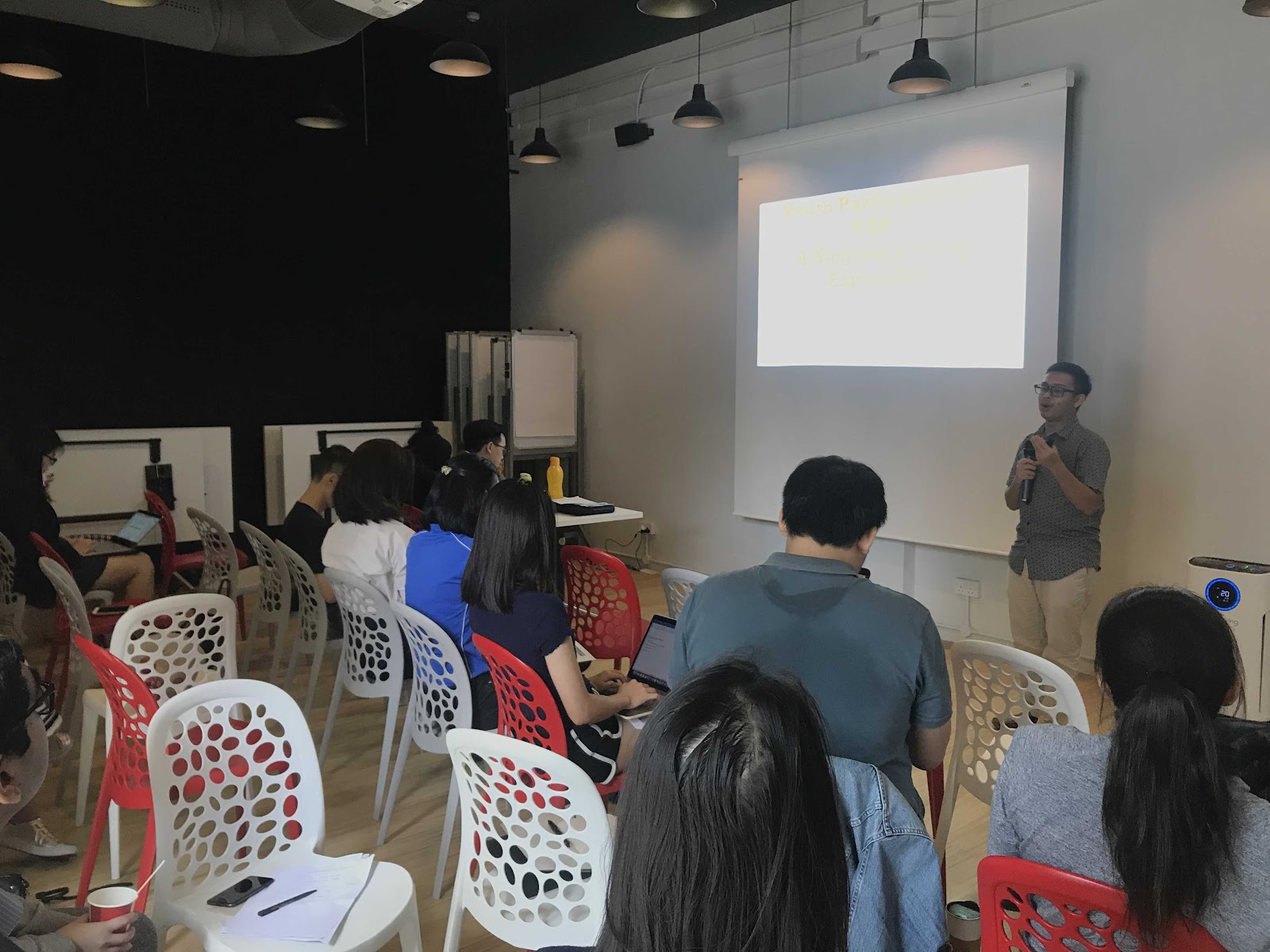
Malaysian Youth Delegation (MYD), Energy Studies Institute, National University of Singapore (ESI-NUS) and Singapore Youth Climate Action (SYCA) organized ASEAN Pre-Conference of Parties (Pre-COP) Capacity Building Workshop 2018 in Malaysia and Singapore. The ASEAN Pre-COP Session in Malaysia was hosted by MYD in Oasis Village, Ara Damansara follow by the session in Singapore, hosted by ESI-NUS and SYCA at The Red Box, Somerset Rd.
Five key points in both workshops are;
An introduction of United Nations Framework Convention of Climate Change (UNFCCC)
Introduction of Youth Constituency to the UNFCCC (YOUNGO) and the rest of the constituency.
Role of Youth on which covers youth organization that active in ASEAN region.
Info transition from Subsidiary Bodies Meeting (SB48.2) in Bangkok, Pre-COP in Krakow, Poland and finally heading towards COP24.
Focus topics that will be covered in COP24 and update on Katowice Rulebook.
In Malaysia, MYD covered most of the key points, where Mike presented on the Introduction of UNFCCC and Role of Youth. We had representation from our Singaporean counterpart, Lastrina Hamid from SYCA, who presented on her organisation and her experience in previous COP conferences. The session followed by a sharing session by Shaqib Shahril from MYD, who covered Key Topics in COP24. The workshop ended with Aaliyah from MYD, who spoke on the transition from SB48.2 to COP24.
The session in Singapore took on a similar approach to the Malaysian session. However additionally, Melissa Low from ESI-NUS covered in depth on the Katowice Rulebook. Meanwhile, the event in Singapore added a bit of twist compare to MYD which is introducing Singapore’s Carbon Pricing Act and its relationship with to Article 6 of the Paris Agreement. This session was facilitated by Environmental Law Student Association, National University of Singapore (ELSA-NUS). MYD member, Shaqib Shahril been invited as a panel for this session. The session continued with a storytelling workshop and writing tips – especially aimed for those who are going to COP24. It then followed by a pitching project by Yale-NUS College Student and their plans in COP24 as a part of Singapore Youth Delegation.
Shaqib Shahril presented on the Role of Youth in UNFCCC
Both Pre-COP sessions were really fruitful, covering the basics of this year’s COP24 – relating the Paris Agreement and Katowice Rulebook to national policy. Both of the Malaysian and Singaporean session has gathered approximately 40 ASEAN youths, with representation Malaysia and Singapore, Indonesia, Philippines, Vietnam and Japan.
The Pre-COP session in Singapore coincided with the ASEAN Summit 2018, whereby Singapore is the host for the ASEAN Meeting and high-level segments. Both session shows the credibility and position of youth from ASEAN in the climate change scene from this region.
We would like to express our appreciation and gratitude to WWF-Malaysia for supporting our workshop in Malaysia and our partners from ESI-NUS and SYCA, Melissa Low and Lastrina Hamid for making this capacity building workshop at an ASEAN scale into reality.
That seemed like the overarching theme of Day One.
Opening Plenary at the APAN Forum 2018.
“We only have 12 years to limit climate change within pre-industrial level,” Emmanuel de Guzman, Secretary, Climate Change Commission, Philippines, said in his opening speech for the 6th Asia-Pacific Climate Change Adaptation Forum 2018 (APAN 2018). He stressed the urgency of climate change, and how that we, as the Earth’s inhabitants, are under threat. He brought up that the Philippines recently hosted the Climate Vulnerable Forum, and to quote him, “even though the Climate Vulnerable Forum consists of a few nations, we are all affected – the whole world.”
Climate change does not discriminate, neither should our responsibilities.
Echoing the substance brought forward by Mr. Takahasi, Dechen Tsering (the United Nations Environment Programme Regional Director) pointed out that the theme of the conference was very timely, which was “Enabling Resilience for All: Avoiding the Worst Impacts.” He said, “while we look into the effort of resilience, we also need to look into reducing carbon emission.” Now more than ever, we need cooperation to be transboundary.
Addressing Intergenerational Equity
For the first time ever, the APAN 2018 kicked off its first plenary session with a panel of young people, with an important fundamental question of “Why Resilience Matters?” This session consisted of four young, bright and passionate individuals who advocate for climate change within their own capacity. With the youngest panel member being 13 years old, the ideas and innovations that they brought forward were definitely inspiring. Check them out:
The essence of intergenerational equity is something that should not be taken lightly. The young people are the most vulnerable when it comes to climate change as they are the ones who are going to live in the future. I wrote about this during APAN 2016, in a piece titled “Where Are the Children?”. It’s nice to see that 2 years later, the youth are on stage.
Local Climate Action
There was a total of three local leaders who convened at the second plenary l session with the topic “Local Government at the Forefront.” They were Sally Lee, Mayor of Sorsogon City in Sorsogon, Alfred Coro, Mayor of Del Carmen in Surigao del Norte, and Ronaldo Golez, Mayor of the Municipality of Dumangas in Iloilo. They all had the same message:
i) There is a need to repackage scientific knowledge, to be translated into local action.
ii) There is a need to improve climate information, warning, monitoring at the local level.
iii) There needs to be engagement at a national and sub-national level to bring together local actors.
Local leadership means that interaction occurs at grassroot levels. To quote Sally,
“What is power if to not empower?”
Cascading Climate Risks
The threat lies in slow onset events (SOE) – not in major typhoons, earthquakes and flooding.
An example of SOE is rising sea level, but there’s more. If all these are left unaddressed, there will be major complications that could potentially contribute to the collapse of modern economy as we know it. Contrary to popular belief that climate change is bad for the economy, there are opportunities that lie within this threat. If you look at it from a different perspective, “anticipating the impacts of climate change also presents an opportunity to spur economic transformation,” said Renato Redentor Constantino, Institute for Climate and Sustainable Cities.
Day One concluded with a cocktail session for participants to network over traditional entertainment.
I am writing this in Satchmi – a cosy, vintage cafe in Mandaluyong, Manila, Philippines. I landed this afternoon and it took me one hour to get from Manila Ninoy Aquino International Airport to my hotel in Ortigas, Pasig located in Metro Manila – a trip that usually takes 30 minutes. I now understand what everyone was warning me about before I left – the traffic and the rain.
The traffic was horrendous, coupled by rain
The 6th Asia-Pacific Climate Change Adaptation Forum will be held at the Asian Development Bank Headquarters in Manila, Philippines from 17th-19th October 2018. Every two years, the Asia-Pacific Adaptation Network (APAN) hosts the Adaptation Forum, and I had the privilege to attend #APAN2016 and now #APAN2018, thanks to the Secretariat and the United Nations Environment Programme. This year, #APAN2018 is co-hosted together with the Climate Change Commission, the Philippines, the Government of the Republic of Palau and the Asian Development Bank.
Climate talks have been on the rise for the past 2 weeks with the release of the Special Report 1.5C of the Intergovernmental Panel on Climate Change. It is anticipated that this would be a hot topic of discussion for the next three days during the Forum. The theme “Enabling Resilience for All: Avoiding the Worst Impacts” reflects the vulnerability of the host and co-host countries, the Philippines and Palau. Building on this, there are four streams that will be focused on during the forum, which are:
i) resilience of social and human systems
ii) resilience of natural systems
iii) resilience of industry and built environment
iv) resilience of island communities
The sessions will revolve around several approaches to adaptation, policy, legislation and institutions, planning, designing and implementation, science and assessment, technologies and practices and finance. To properly address these approaches, the Forum hopes to see through actionable and scalable “next steps” for communities, stakeholders, and governments.
In 2015, ahead of COP21 in Paris, the Philippines hosted the Climate Vulnerable Forum (CVF) to discuss critical climate policies that would safeguard the most vulnerable groups. With less than 2 months away from COP24, which is deemed the biggest COP after COP21, the Philippines is seen hosting yet another important Forum that would be a platform to accelerate climate action, adaptation, and resilience in order to feed in the Global Stocktake at Katowice, Poland at the end of the year.
It is time to create more conversations and build more awareness on adaptation and resilience. In the next three days, the Forum will uncover all of that and beyond.
Changes in the world’s climate has, and will continue to bring major shifts in food production. This includes the rise in temperature, increase in rainfall and coastal flooding that reduces the amount of land available for agriculture. In a nutshell, food crops and as it follows, food security, are sensitive to climate change.
After a successful SEEDS Malaysia back in 2014, it is back this year with the theme “GET REAL”.
This year’s theme could not be more timely – as the world’s population grows at an alarming rate, the increasing demand for food has put a strain on the planet’s resources to cope with feeding billions of people.
The event will be happening on 19th – 21st October 2018 at Oasis Discovery Centre (ODC), Oasis Village.
Throughout SEEDS Malaysia 2018, 2 of these events will be happening concurrently;
Together with SEEDS, Power Shift Malaysia will participate as the youth counterpart. The Youth Forum is an event organised by the youth for the youth with the objective of raising awareness about climate change and food production. Topics from food production to youth action on climate change will be discussed throughout the event.
Do you know what is LAGI BEST?! SEEDS is providing sponsorship to those who are really interested to participate in this event! T&C applies.
Climate finance is a more than just about money. Women empowerment and gender equality are important cross cutting themes in the realm of climate finance. This is because climate change makes a bigger impact on women and girls than on men. There are many reasons why this is the case and you can read this and this to understand more about how climate change impacts them differently. Ergo, effective adaptation and mitigation solutions should take gender into account. And climate finance should also be directed appropriately.
Financiers and policymakers are beginning to understand this need. As the Organisation for Economic Co-operation and Development (OECD) notes, more and more money is being channelled into gender-sensitive projects “intended to advance gender equality and women’s empowerment or reduce discrimination and inequality based on sex”.
During 2015-2016,
a quarter of all climate-related development finance went towards gender-sensitive
projects. About 81% of them had a significant gender objective. They included
monitoring the impact of adaptation and mitigation projects on women, providing
agricultural inputs to farmers, training rural women to become solar
technicians, and working with women-related micro-finance institutions and
savings groups to create demand for and access to clean energy products.
About US$14 billion
was reportedly channelled to projects with a gender objective during 2015-2016.
The actual figure might have been higher. Most countries represented in the
OECD’s Development Assistance Committee (DAC) include gender as a reporting
marker. However, not all multi-lateral organisations follow this. Only a few
such as the World Bank and the Green Climate Fund do so. More such
organisations should include OECD’s “gender-equality policy marker” in projects
across their board to give us a more accurate picture of how much finance gets
channeled into such projects in the future.
This marker is
also used by the Standing Committee on Finance (SCF), which advises the
Conference of Parties to the Paris Agreement. Its purview includes the major
climate funds under the United Nations Framework Convention on Climate Change (UNFCCC).
Most of these funds have their own gender policies. This gender-equality policy
marker is used as a qualitative statistical tool for evaluating bilateral aid
for achieving Sustainable Development Goal 5. SDG 5 addresses gender equality
and it can help identify gaps between policy and financial commitments.
Another obstacle
to effective data collection and therefore an obstacle to securing an accurate
picture of climate flows, is that climate finance has not been properly defined.
This has caused some debate at the SCF meetings. The committee’s working
definition is “financial resources dedicated to adapting to and mitigating
climate change globally, including in the context of financial flows to
developing countries”. However a lack of a proper definition will mean that
some flows get missed out while others that may not be going towards climate
change adaptation and mitigation programs per se get included.
On the whole,
the woman has been put into climate finance. However more can be done to
develop the framework so that climate finance can be used more effectively to
address the gender aspect of climate change solutions. And it would ensure more
meaningful financial flows towards gender-sensitive climate projects. The Paris
Agreement is scheduled to come into force in 2020. The SCF has a lot of work to
do in the next two years on setting up the framework to be recommended to the Conference
of the Parties (COP). After that its in the hands of parties to move forward as
quickly as possible while maintaining the integrity of their discussions.
You might think that Climate Finance is a dry topic, but it was made captivating by Dr Gary Theseira who is secretly considered as a heartthrob among climate change enthusiasts here in Malaysia!
On the 21st July 2018, the Malaysian Youth Delegation held its 6th Training Series at the Kuala Lumpur Teaching Centre of the University of Nottingham, Malaysia Campus. The session was conducted by Dr Gary Theseira, the Deputy Under Secretary of the Environmental Management and Climate Change Division, Ministry of Natural Resources and Environment.
Dr Gary started off the session by saying that there is no single definition of climate finance. This means that there has been no consensus on the term as it’s a diverse concept that needs to be adjusted to different situations around the world.
The closest definition one could find is stated by the UNFCCC Standing Committee on Finance that defines climate finance as:
“Finance that aims at reducing emissions, and enhancing sinks of greenhouse gases and aims at reducing the vulnerability of, and maintaining and increasing the resilience of, human and ecological systems to negative climate change impacts.”
That’s a mouthful!
THE BIGGER PICTURE
Dr Gary showed us how climate finance played out in real life situations by going through 3 major events that happened in July. He showed us how there’s a common thread weaving through all these events.
Extreme weather in Japan
There was a historic heavy rain in July Heisei 30 that lasted 10 days and covered a stretch of 800 km, which is the length of Peninsular Malaysia. Households were without water and the Japanese residents had to essentially go back to “third” world conditions. This heavy rain was followed by a heatwave.
There was a $429 million in machinery and agricultural damages as a result of this phenomenon. The damages included cars and solar panels, which means that mitigation measures could not be considered. However, as an Annex I country, much of the damages are insured. The situation cannot be adapted so Japan needs to use domestic budgets from the private sector and capital markets.
(Note: When UNFCCC was adopted, countries were classed into 3 basic groups i.e. Annex I countries, Annex II countries, and countries that were not listed in any of both annexes (the so-called “non-Annex I” countries). Annex I includes industrialised countries as well as many states of the former Soviet Union (the Economies in Transition, or EIT). Annex II is a further subset of Annex I: it includes only countries that were members of the OECD at that time. Thus, non-Annex I countries, which are the large majority, mostly correspond to developing countries.)
Status of Turkey under UNFCCC
Turkey is an Annex I country but the Turkish government wishes to be reclassified and removed from being an Annex I country. They claim that they could address climate change issues more effectively as a non-Annex I country, as a top-down approach can be adopted as well. However, no other country is keen to open Annexes for renegotiation.
Dr Gary then compared Turkey to Malaysia and said that we are similar in terms of population number, per capita GDP, religion and currency strength. The major difference is that Malaysia emits twice as much greenhouse gases per capita.
As an Annex I country, Turkey has no obligation to provide financial support, unlike Annex II countries. So if Turkey sheds their Annex I status, this would enable them to access resources that are not available to Annex I countries.
When trying to figure out who’s responsible for what, Dr Gary reminded us to get back to the source i.e. the Convention, specifically Article 4, as it highlights the different roles and commitments of Annex I & II Parties.
B20 of the GCF
The Green Climate Fund held the 20th Meeting of the Board on the 4th of July to discuss financial planning among other agenda. Dr Gary just talked about the main outcomes of the meeting:
GCF was unable to decide on the funding of 11 proposals valued at $1 billion.
US owes $2.8 billion and they are undecided on how to replenish this
GCF executive director Mr Howard Ramsey resigned
It wasn’t clear to me how significant the last event actually is but Dr Gary wanted to show us that all three events point to the relevance and importance of climate finance with competing interests and objectives. Mitigation and adaptation plans may not be able to be mobilised if there isn’t any financial support. Dr Gary believes that climate finance should work on various areas of life and not be treated as isolated cases.