Have you seen or experienced around 175 enthusiastic people on climate change in one arena to watch a movie on Climate Change?
It may not be too prevalent, but thanks to #PowerShiftMsia, the screening of Al Gore’s sequel movie on climate change “An Inconvenient Sequel – Truth to Power” was eventuated at TGV cinemas in One Utama Mall. The prequel of this movie was released back in 2006 and tried to permanently denounce climate change deniers. The movie was critically acclaimed by many, including climatologists from NASA.
Fast forward to 2017, the former Vice President of the US comes up with an even more engrossing movie, unlike the principal slideshow presentation in his previous venture. But what does the film have to offer this time around? To answer that question, the MYD members have some riveting reflections
~ OUR THOUGHTS ~
Diyana
“In this sequel, Al Gore made his point about climate change being real and urgent, as his prediction came true: New York (along with the 9/11 memorial) was flooded by ocean waters during Hurricane Sandy in 2012. He went on a mission to persuade governmental leaders to adopt renewable energy, including India, a developing country that has been relying on coal energy. In many cases, he succeeded in convincing the leaders with promises of support. However, he seemed unable to persuade his own country’s leader, which is quite sad. America is one of the important players in the fight against climate change and yet its leader is not on board, as segments of his speech kept implying. But I guess that should not stop any of us from making a change. Overall, I think this movie is a good update on Al Gore’s work and I suppose it encourages us to follow his footsteps to demand country leaders to actually lead the way towards cleaner energy.”
“The movie comes across as an afterthought on an important message. The message is not carefully thought out and the movie has not been meticulously crafted unlike the first of Al Gore’s movies. It’s more of a documentary actually, that highlights how Al Gore’s predictions came true and how wrong his detractors were and basically it was an Al Gore and Climate Change documentary.
Nevertheless, I will highlight it as a good rundown on the climate change scene in the U.S. From the impacts of weather disasters to the politics of it it sheds a lot of light on the scene. I will condemn it for being rather pro Global North and anti-Global South however. Al Gore portrays the Indian leaders in a very narrow perspective as the misguided bad guys who seem more concerned over economic development than climate change but fails to highlight the U.S.’s hypocrisy when it comes to this as well. For example there have been cases of the U.S. interfering in the solar energy market of the developing countries to prevent them from producing solar panels that are cheaper and more accessible to their people than U.S. made solar panels. Here is a good read on a WTO ruling against India to undermine its efforts to increase jobs in the solar panel industry and increase climate protections.
At the end of the movie I did walk out pledging silently to myself to #BeInconvenient but overall I believe Al Gore could have done a lot more with this ‘movie’. That would make it a more solid attack on climate change deniers and a film that can effectively rouse the international audience to take climate change seriously and spread the message.”
“This movie emphasizes a lot about the truth of climate change, and the ending really moved my friend and I as it did mention about other movements that have occurred through history and maybe, right now, it’s time to have a movement about climate change! It’s amazing how powerful people can be, a call from Al Gore to persuade the solar company is all it takes for India to try to adopt more renewable energy. The Paris agreement and UNFCCC were also shown in the movie itself, displaying the importance of them when it comes to climate change. Leaders of countries such as China and others were also very concerned with the well being of their nations, displaying their progress to adopting a greener lifestyle.”
“After watching the first ‘An Inconvenient Truth’, I find this documentary underwhelming because the lessons learned in the sequel may be obtained by solely watching the prequel. I would say that the only addition to this documentary was the Paris Agreement, whereby India was unfairly portrayed as the antagonist. Nonetheless, I commend on the message delivered by the documentary in trying to mobilise the public in championing against climate change. I say it’s underwhelming because as an environmental science student, the climate change 101 delivered by Al Gore has long been exposed to me. However, had the target of the documentary been towards to ‘non-converts’, those who are hearing about climate change for the first time and the daunting battle against it, An Inconvenient Truth 2 would be a sufficient introductory course.”
“The documentary was very interesting. When former VP Al Gore showed the “Blue Marble” taken by the Apollo 8, it was really mesmerizing. It was absolutely beautiful. In the documentary, you can see how Al Gore had a strong passion. Being able to watch this documentary, it really recharged me. Al Gore was ready to go to every corner of the world for convincing people not to use coal/fossil fuel and switching to renewable energy. He had even visited India to meet the environmental minister and convince them to phase out non-renewable energy plants. When the minister questioned back, he stated that Al Gore shouldn’t be speaking to him and rather was concerned with his own people. If I was at Al Gore’s position, I wouldn’t have known on how to react. He keep on calling here and there to ask for help, so that India would agree to sign the Paris Agreement; his hard work was incredible. This documentary shows us on how every parties, people with power, NGOs, citizens and scientists have their role to play, like one of the quote from the documentary ‘Fight like your world depends on it’.”
“The 1st episode and now the sequel, both films convey the messages in a TED Talk style which revolves around Al Gore talking about the basic science and consequences of climate change but little emphasis on the “who is the actual culprit” and the “how”. When compared to the 1st episode, Al Gore has a grumpy tone in the sequel. The scene when he yelled “What were you thinking?”(to the politicians/climate change deniers) staples in my mind until now and I believe it will stay for quite sometime. Besides, I believe in every film a central antagonist and protagonist will be featured in order to create the required conflict. The conflict will then create excitement which would boost viewership and eventually, the box office sales.
In my opinion, India was placed as the antagonist in this film as they loom as an obstacle to deal with. So, our good guy Gore (or you can say US in general) came to the rescue by persuading the US based solar company to provide tremendous support to India. Ultimately, India agreed, Paris Agreement was adopted and everyone lived happily ever after. Too bad, this only happens in fairy tale.
There are always 2 sides of a story. The right to development is a fundamental principle especially for developing countries. It is stated in Principle 3 in Rio Declaration on Environment and Development back in 1992. For instance, many of the 1.3 billion Indian population needing their basic amenities (i.e education, poverty eradication, healthcare) were still unmet, meaning that development was a necessity. Thus, the importance of Common But Differentiated Responsibilities (CBDR) can be seen. Nevertheless, memories of myself attending COP21 just streaming through my mind throughout the entire movie. So yeah, I have mixed feelings about this movie. It’s complicated.”
“The movie reiterated the collective struggle for demanding action against climate change. Al Gore instilled that climate action cannot be easily fulfilled without the help of governments and insisted on local action. Significant portions of the film focused on India’s renewable energy and issues related to it. There was a clear pressure on India to do more by the west- even Sunita Narain, who featured in a cameo, mentioned that shifting blame towards developing nations was unfair. India was shown to be delinquent. Interestingly, the film depicted the ‘phone call’ from Al Gore to SolarCity’s CEO for the company to provide solar technologies to India. This looked improbable; with all the negotiations, a mere call couldn’t have done the job. There was a strong hint that the western fear of developing countries becoming developed would prevent the achievement of the 2 degree celsius goal. On the contrary, this movie was another instance of climate change not being solely about climate change as science. Nevertheless, the film was also reminiscent of the floods at my hometown in Chennai. Overall, the show ended towards the optimistic side. We can see the light at the end of the tunnel but there are too many stalactites blocking the path.”
The overall view of the Malaysian Youth Delegation members is that the movie showed glimpses of promise for a sustainable future, but with actions getting hypocritical, we mostly remain ambiguous. However, the scope for development in the movie is considerably high.
On behalf of MYD, we would like to thank all those who made it for the screening and commend #PowerShiftMsia, United International Pictures Malaysia and TGV Cinemas for materialising the event!
COP23 is the 23rd Conference of the Parties to the United Nations Framework Convention on Climate Change (UNFCCC). It is the main annual meeting of all nations under the UNFCCC to build and strengthen intergovernmental climate policy.
COP23 will be held from November 6-17, 2017, in Bonn, Germany.
The Conference will comprise sessions of:
the Conference of the Parties (COP 23);
the Conference of the Parties serving as the meeting of the Parties to the Kyoto Protocol (CMP 13);
the Conference of the Parties serving as the meeting of the Parties to the Paris Agreement (CMA 1.2);
the Subsidiary Body for Implementation (SBI 47);
the Subsidiary Body for Scientific and Technological Advice (SBSTA 47);
the Ad Hoc Working Group on the Paris Agreement (APA 1.4).
A Little about COP23
COP23 will be focusing on:
Accelerating the implementation of the Paris Agreement
Catalyzing and supporting climate action happening at a global scale
The special thing about COP23 is that the conference is led by the Presidency of Fiji (Fiji is the host) but hosted off-site in Bonn (where the UNFCCC Secretariat is). So, the host team works closely with the secretariat of UNFCCC, both governments, the State of North Rhine-Westphalia and the city of Bonn in organizing this conference.
COP23 is fused with the Fijian Bula spirit, which means hello or welcome, with a deeper sense of wishing others a blessing of affection and good health. The conference plans on showcasing Fijian and Pacific culture, art and life. The design of the logo was meant to act as a reminder that rising sea levels are affecting not only small island developing states but also coastal cities in many other countries.
One Conference, Two Zones
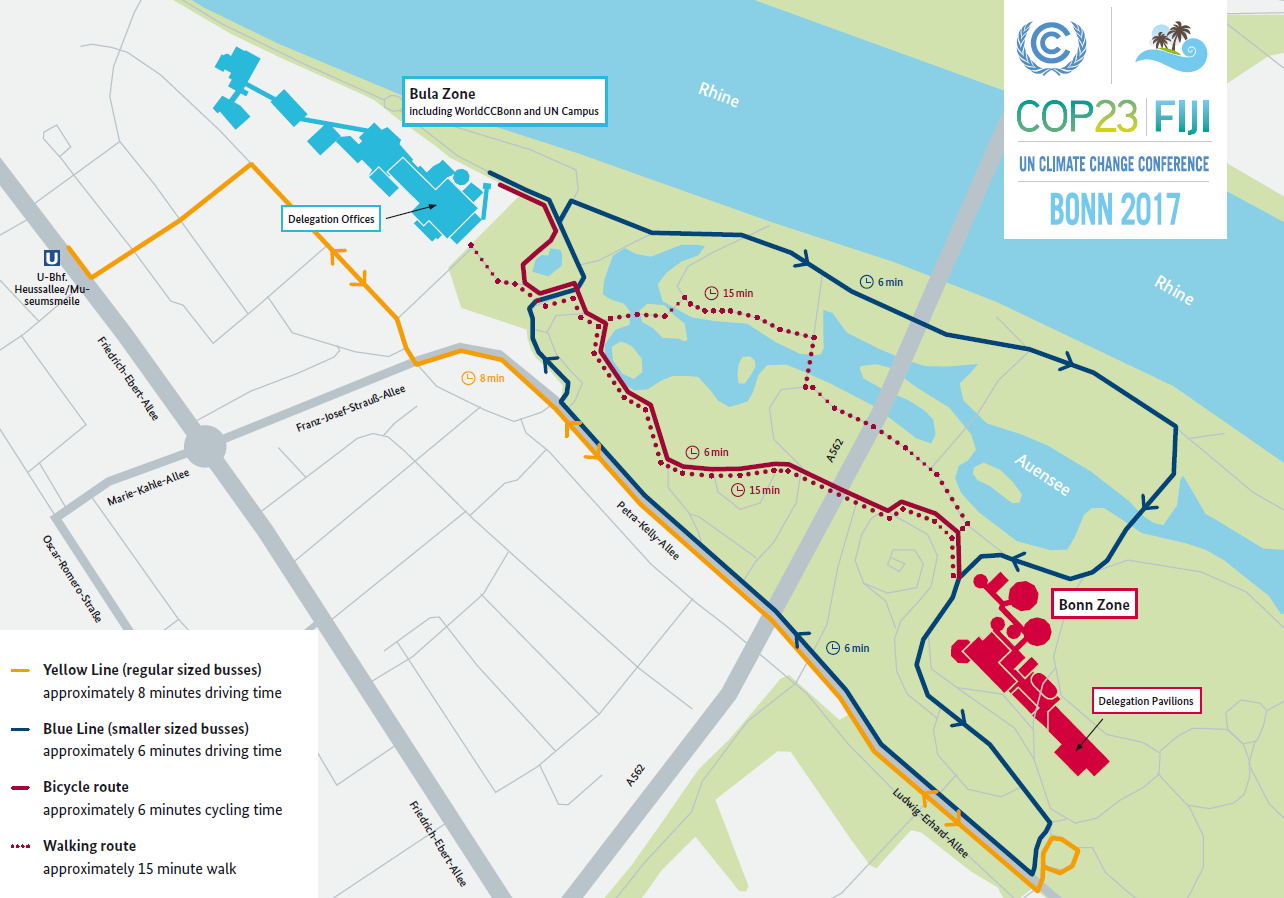
Two zones will be set up for COP23: The Bula Zone and the Bonn Zone. The Bula Zone will act as the formal negotiating zone will the Bonn Zone will act as the climate action zone.
The Bula Zone
The Bula Zone spans from the World Conference Center Bonn to the UN Campus as well as a temporary extension. Plenary halls, meeting rooms, delegation offices, a media and press center as well as catering and other facilities are prepared for a variety of activities.
The Bonn Zone
The Bonn Zone will host global climate action events (including high-level events), side events, media events, exhibits, and pavilion events..
Setup of the Conference
The distance between the two zones is about 1.4km, which is a 15-minute walk or 9-minute drive. Shuttles are provided to commute between the two zones. But, I feel that the most exciting thing about traveling between the two zones is that bicycles are provided for free! Yay!
Preliminary overview map
Here’s a virtual tour of the conference venue:
The presentation of the logistical preparation can be find HERE as well.
Sustainable Aspect of the Conference
The conference aims to be climate neutral through a series of action plans, hoping to offset the unavoidable emissions (like flights). Actions include virtual participation, paper reduction, European Eco-Management, and Audit Scheme (EMAS) verification, vegetarian catering and etc.
This training series was somewhat unique as we had a highly motivated youth from Singapore to share her experience and knowledge in the field of climate change.
Nor Lastrina Hamid, is the co-founder of both Singapore Youth for Climate Action (SYCA), which is a platform for young Singaporeans to act in solidarity towards the fight for climate change and Lepak in SG, a calendar listing for environmental events.
The event was held at University of Nottingham’s Teaching Centre in Kuala Lumpur on 7 July and it was a three hour session filled with understanding Lastrina’s and Singapore’s perspective on climate policy and action.
Lastrina chose to sit with the audience and do the sharing
Moving to the sharing session, Lastrina explained in detail on her roles in SYCA and COP21 and 22. She showed great ingenuity by describing her experiences in her spell at Paris and Marrakech. While delineating on Singapore government’s efforts towards bringing increased awareness to the public, she explained on the government providing funds and scholarships to those who were taking part in climate related movements and activities.
The food was good, so was the sharing session?
With respect to climate accountability and tracking the climate progress matter of the government, Lastrina encouraged more youth participation in negotiations and reaching out to the public by disseminating the information and awareness for localised action. SYCA bridges the gap between the government and the community, similar to MYD for Malaysia.
Presenting the Token of Appreciation (The mug is starting to become a part of gift culture)
By concluding, and as Lastrina had highlighted, the supportive Singaporean government underlined the strength of youth and paves way to steer the country towards a sustainable future which is something countries around the world can learn from.
Overall, from the Singaporean example, I had learnt that the governments across the globe can contribute much more towards encouraging youth and public on issues that need more action on a global scale. Singapore commits not only to training and building capacity for developing countries but also involves itself in assisting other parties of the Paris Agreement and International Institutions.
The MYD Squad ? (Not in full team yet)
MYD is beholden to Lastrina for contributing to the training series by sharing her experiences at the local and international stages for climate action and justice. The discussion was quite insightful and broadened our perspective of climate negotiations. With three months to COP23, the journey to Bonn is in full swing.
In conjunction to the upcoming COP23 in Bonn, Germany, this training series aims to educate both the public and the MYD members about the language of climate change policy, how to understand the words that were used in them and how it affects the length of actions taken by the country itself. Besides that, we will also delve into how different countries come into consensus to draft an international agreement that agrees upon certain policies.
Event: MYD 2017 Training Series #6- Understanding the language of climate change policy
Date: 19/8/17
Time: 9:00 a.m-1:00 p.m.
Venue: Sala KL , Vegan Restaurant, Galeria Sri Hartamas
Schedule:
9:00-9:30am- Registeration
9:30-11:30am- Training Series
11:30am-11:45am- break
11:45-12:30pm- Training Series
12:30-1:00pm- QnA
MYD Training Details:
Trainer Profile:
Chee Yoke Ling is an international lawyer whose areas of expertise includes the environmental, social and economic impacts of globalization.
She commonly discusses climate change issues, the interface between biodiversity/traditional knowledge at the UNFCCC and is a board of director in an international non-profit network of organisations and individuals involved in sustainable development issues called Third World Network.
Registration
Event Feedback
#MYD Training Series – Training on UNFCCC negotiations and media work with various climate experts, government bodies and civil society leaders. Each sessions will run for min 2 hours and will be broadcast/record and available on YouTube for future reference. For more info about the TS, please click here: http://powershiftmalaysia.org.my/myd-2017-road-map/
Malaysian Youths speaks out against USA pulling out of UNFCCC Paris Agreement
The Malaysian Youth Delegation (MYD) expresses their deepest disappointment in the United States’ decision to withdraw from the UNFCCC Paris Agreement, as announced by US President Donald Trump on 1 June.
The Paris Agreement stresses the principle of Intergenerational Equity, and is of paramount importance to over 1.8 billion youths around the globe. It reflects the moral obligation of the current generation to sustainably transition our planet to future generations. The United States’ decision is not only jeopardising the future of American youth, but also the youth of the world.
Please see attached for the MYD statement in full.
ABOUT THE MALAYSIAN YOUTH DELEGATION (MYD)
A group of young passionate Malaysians who represent the local youth climate movement at international climate conferences, such as the annual Conference of the Parties, part of the United Nations Framework Convention on Climate Change. Dedicated to raising awareness of climate policies amongst Malaysians, the youth are mentored and trained to translate technical policies into more relevant and relatable information for the public. MYD holds speaking engagements with various climate organisations to better understand the current landscape of local and international climate policy. With that, MYD endeavours to hold Malaysian leaders accountable for the promises made at international climate summits.
Malaysian Youth Delegation (MYD) established in 2015 with the ultimate aim of representing Malaysian Youth in global climate change arena. After 2 years of hard effort, we hereby proudly announce that MYD is still standing strong and ready to kick climate change’s ass again.
MYD term 2017 officially kickstarted 2 weeks ago after roughly 1.5 months of recruitment.
So, a basic recap of WHO ARE WE,
The Malaysian Youth Delegation (MYD) is the voice of the Malaysian youth climate movement at international United Nations climate conferences, UNFCCC. We strike to represent the demand of a generation and to advocate for a just, safe, and livable future for all. Our core objectives are to
Represent youth climate movement in Malaysia
Educate Malaysians on UNFCCC and Malaysian climate policy
Hold our leaders accountable for the promises and actions responsible for climate change
Act in solidarity with frontline communities for those suffering the effects of climate change in Malaysia and across the globe
In order to achieve all the 4 objectives, we have planned out our MYD17 roadmap.
Month
Agenda
March
Recruitment
April
MYD 2017 Retreat
TS #1 – MYD buddies experience sharing + understanding youth role in YOUNGO
May
MYD 2017 kickstarted
TS #2 – How to put the FUN in fundraising (crowdfunding)
*agenda listed above are subjected to change depending on the parties’ availability
Last but not least, let us welcome the members for the term 2017 that are selected to represent Malaysian youths in making a combined effort to combat climate change (names in ascending order). Their personal profile will be shared in the next update 🙂

 York (along with the 9/11 memorial) was flooded by ocean waters during Hurricane Sandy in 2012. He went on a mission to persuade governmental leaders to adopt renewable energy, including India, a developing country that has been relying on coal energy. In many cases, he succeeded in convincing the leaders with promises of support. However, he seemed unable to persuade his own country’s leader, which is quite sad. America is one of the important players in the fight against climate change and yet its leader is not on board, as segments of his speech kept implying. But I guess that should not stop any of us from making a change. Overall, I think this movie is a good update on Al Gore’s work and I suppose it encourages us to follow his footsteps to demand country leaders to actually lead the way towards cleaner energy.”
 moved my friend and I as it did mention about other movements that have occurred through history and maybe, right now, it’s time to have a movement about climate change! It’s amazing how powerful people can be, a call from Al Gore to persuade the solar company is all it takes for India to try to adopt more renewable energy. The Paris agreement and UNFCCC were also shown in the movie itself, displaying the importance of them when it comes to climate change. Leaders of countries such as China and others were also very concerned with the well being of their nations, displaying their progress to adopting a greener lifestyle.”
 because the lessons learned in the sequel may be obtained by solely watching the prequel. I would say that the only addition to this documentary was the Paris Agreement, whereby India was unfairly portrayed as the antagonist. Nonetheless, I commend on the message delivered by the documentary in trying to mobilise the public in championing against climate change. I say it’s underwhelming because as an environmental science student, the climate change 101 delivered by Al Gore has long been exposed to me. However, had the target of the documentary been towards to ‘non-converts’, those who are hearing about climate change for the first time and the daunting battle against it, An Inconvenient Truth 2 would be a sufficient introductory course.”
 “The documentary was very interesting. When former VP Al Gore showed the “Blue Marble” taken by the Apollo 8, it was really mesmerizing. It was absolutely beautiful. In the documentary, you can see how Al Gore had a strong passion. Being able to watch this documentary, it really recharged me. Al Gore was ready to go to every corner of the world for convincing people not to use coal/fossil fuel and switching to renewable energy. He had even visited India to meet the environmental minister and convince them to phase out non-renewable energy plants. When the minister questioned back, he stated that Al Gore shouldn’t be speaking to him and rather was concerned with his own people. If I was at Al Gore’s position, I wouldn’t have known on how to react. He keep on calling here and there to ask for help, so that India would agree to sign the Paris Agreement; his hard work was incredible. This documentary shows us on how every parties, people with power, NGOs, citizens and scientists have their role to play, like one of the quote from the documentary ‘Fight like your world depends on it’.”
 which revolves around Al Gore talking about the basic science and consequences of climate change but little emphasis on the “who is the actual culprit” and the “how”. When compared to the 1st episode, Al Gore has a grumpy tone in the sequel. The scene when he yelled “What were you thinking?”(to the politicians/climate change deniers) staples in my mind until now and I believe it will stay for quite sometime. Besides, I believe in every film a central antagonist and protagonist will be featured in order to create the required conflict. The conflict will then create excitement which would boost viewership and eventually, the box office sales.
 “The movie reiterated the collective struggle for demanding action against climate change. Al Gore instilled that climate action cannot be easily fulfilled without the help of governments and insisted on local action. Significant portions of the film focused on India’s renewable energy and issues related to it. There was a clear pressure on India to do more by the west- even Sunita Narain, who featured in a cameo, mentioned that shifting blame towards developing nations was unfair. India was shown to be delinquent. Interestingly, the film depicted the ‘phone call’ from Al Gore to SolarCity’s CEO for the company to provide solar technologies to India. This looked improbable; with all the negotiations, a mere call couldn’t have done the job. There was a strong hint that the western fear of developing countries becoming developed would prevent the achievement of the 2 degree celsius goal. On the contrary, this movie was another instance of climate change not being solely about climate change as science. Nevertheless, the film was also reminiscent of the floods at my hometown in Chennai. Overall, the show ended towards the optimistic side. We can see the light at the end of the tunnel but there are too many stalactites blocking the path.”