The Earth’s climate has changed, and global warming has been affecting the lives of millions. In the case of the people in Thailand, it is the livelihoods of the fishermen and the coastal communities that are being threatened by climate change. Local communities have also suffered from episodes of heavy rain, which has caused unwanted flood events.
Crowd demonstrating outside of the UN building Picture by Kiara Worth
On the 8th of September, people from all around the world took part in the Rise For Climate march held in their respective countries. Here in Bangkok, I witnessed the very first climate action in my life and had the privilege to take part in it. On my way to the United Nations building, demonstrators were seen crouching by the walkway, turning plain white sheets of paper into meaningful banners.
The banners and flags were held high by demonstrators from all over the world, demanding their respective governments to end the use of fossil fuels and transition to using clean energy, in which a Japanese demonstrator has called out “Heavy rain and typhoons had just happened a few days ago, and I can’t possibly go back to Japan because the airport is broken. We need a fossil-free society that will stop air pollution and catastrophic climate change.”
“In Bangkok now, we have many episodes of heavy rain, and it has never happened before. Even with our neighbouring countries, we can see floods due to heavy rains” a Thai lady said.
A fisherman demonstrating for #riseforclimate
Along with crowds that were clutching onto banners, the people of Thailand had laid out coals on the road to demand for clean energy, while farmers presented their yield to demand for climate justice.
Holding on to her produce, a young fisherwoman explained “Climate change has increased soil salinity, and the farmers’ crop yield have been affected by it. We are also affected by climate change, there are often no fishes, and the prices of fishes have increased, burdening the local people.”
“Everything that has been done is all for the future. Who is there to inherit the future but us youth? We need people inside and outside the UN to make sure they fight for a future where all of us are equal” youth representative calls.
Whilst demonstrating outside of the UN building, it got me thinking, that while demonstrators were standing out under the scorching sun to demand for climate justice, negotiators were sitting in air-conditioned and comfy conference rooms, discussing on the grammatical errors on documents. Will the text on the Paris Agreement help at all? Maybe (not). At the end of the day, it is the action that counts.
Written by Kitty Chen Peer reviewed by Syahirah Aron
I left Malaysia to Bangkok without knowing what to expect. Prior to coming for this session here in Bangkok, I had zero idea on what negotiations in the United Nations Framework Convention on Climate Change (UNFCCC) would look like. Sure, I had read pages upon pages of articles about the UNFCCC negotiation process as a whole and also topics discussed here in the UNFCCC, but that did not give me enough insights on how negotiations work.
Amongst all the topics discussed in the UNFCCC, technology development and transfer had interest me the most, and hence I have been following closely on negotiations regarding technology throughout my attendance here in SB48-2. Why technology? Why not other fancy topics like finance or adaptation and mitigation? Well, I don’t know. Something about the word ‘technology’ caught my eye when I was skimming through an article, and therefore I dived straight into reading articles and documents related to technology development and transfer.
During the strategy meeting with Climate Action Network (CAN) held just a day before the official opening of SB48-2, I finally made up my mind to join the CAN working group on technology. I had no idea what working groups in CAN are for. Based on my understanding, working groups are just teams that were formed within an organisation to work on particular matters. Nonetheless, it wasn’t as simple as I thought it would be.
On the first meeting for the CAN technology working group, I introduced myself as a youth delegate of Malaysia and had specifically told everyone about how I am new to the entire process of UNFCCC. They too, introduced themselves and had made me feel welcome before getting to work. However, just minutes into the discussion, I found myself lost. I swear that I had read many articles about technology development and transfer, but whatever they were discussing about was alien to me.
SBI informal consultations on Technology Mechanism Picture by Kiara Worth
Negotiations too, wasn’t how I had expected them to be. During the first three days, I went to all informal consultations related to technology development and transfer, expecting them to be interesting to observe. I did not see the point as to why a bunch of adults from all over the world huddle annually just to give comments on a document. But as usual, I took notes of everything (which I know that I will never read), from major changes of inclusion of new paragraphs to minor punctuation changes. I found the negotiations boring – it felt just like sitting in a lecture hall with a boring lecturer (or worse).
On the fourth day of negotiations however, it suddenly struck me that negotiations aren’t just about editing a long document. While I was taking notes during one of the informal consultations, I started to think everything through, and I realised that Parties were all editing the text not just because they were unhappy about how a sentence was phrased, but rather how the words would put unwanted commitments on their respective countries.
Daily ECO news article by CAN
Also, everything that the members of the working group had discussed earlier started to make sense, and I now understand that working groups in CAN exist so that members of the group can discuss and analyse decisions that were made in negotiations. In every meeting for the working group, we decide if CAN’s position is aligned with the negotiation outcome. Our stance regarding issues related to technology development and transfer will then be published on ECO, the daily newsletter operated by CAN at the UNFCCC. This ensures that our position is heard by the general public as well as negotiators of SB48-2.
Aside from observing negotiations and contributing to my working group, my days in Bangkok were filled with networking. No, I did not walk up to random people outside negotiation rooms just to network (unlike most of the people). I networked because looking for an empty table in the UN building was almost impossible. Albeit being forced into conversing with people, I have definitely enjoyed it as it allows me to understand the ordinary lives of people and listen to their stories.
Sure, it may be intimidating at times, but I definitely do not regret my decision of coming to Bangkok.
Written by Kitty Chen Peer reviewed by Jasmin Irisha
CAN strategy session at ibis Styles Khaosan Viengtai
It was two minutes to one when Syahirah and I rushed into Ibis hotel in the middle of Khao San Road. The setting of this session was rather daunting, as I didn’t expect it to be held in a ballroom (albeit a mini one). As the participants of the CAN strategy session finally settled down, Lina, the Head of Political Advocacy of CAN set the ball rolling by welcoming the participants. She then shared the State of Play of SB48 in Bangkok after a short round of introductions, highlighting the fact that with only 6 negotiating days, negotiations needed to be conducted in a timely fashion.
The session went on with discussions of the key elements and scenarios for COP24, which made me even more intimidated than I already was. There were times where I got lost completely and caught myself staring blankly at the projector, not knowing what was being discussed. I was surprised that I managed to answer a few of the pop quiz questions and actually understood the context of the quiz on CAN’s positions around the implementation guidelines for the Paris Agreement. I guess reading random articles did help a little?
Following a much-needed break, the session resumed with presentations on finance, NDCs as well as resilience and equity given by the coordinators of the respective working groups, followed by short stretches of discussions and intelligence sharing from the floor after each presentation. If you did not understand what the previous sentence is about, fret not, because I don’t too.
What captivated me the most was the presentation given by Harjeet Singh, a strong advocate of disaster resilience and Loss & Damage. After a long afternoon of rather dry presentations, Harjeet put forward his thoughts on how disaster resilience were not being communicated effectively. He stressed that clear actions needed to be taken in negotiations, for there still isn’t any standing agenda item on Loss & Damage at COP. He had also mentioned that it is necessary to put forward the fact that developing countries are not downright responsible for the crisis faced.
“The Paris Agreement is about people and planet, not solar panels”
Harjeet
Harjeet had also fired up a heated discussion when the status of countries in delivering their NDCs were presented in a colour code ranging from green to red, with India being the only country with a red status. He demanded explanation on the criteria used to evaluate each and every country’s status, and insisted on his stance even when other CAN members provided their thoughts on the colour coding system. Although the discussion went on for almost twenty minutes, I did not lose track and was left in awe. I wanted to be like Harjeet, to be able to speak up whenever I want to.
The six-hour session concluded with Andreas and Andres briefing us about the plans CAN had for the entire week, and it left myself feeling more intimidated than I already was.
Written by Kitty Chen Peer reviewed by Abirami Baskaran
National negotiators have talked for five days in these rooms, but what have they said?
The Paris Agreement (PA) calls for keeping global temperature rise well below 2˚C, yet we are still on the pathway of above 3˚C with the current set of nationally determined contributions (NDCs). it’s time to ratchet up our collective ambition.
As the Bangkok intersessional climate change negotiations draw to a close with just a day left, Parties are scrambling to the finish line. The mandate is for the Paris Agreement Work Programme (PAWP) to be complete by the end of 2018. In the May session in Bonn, it was recognized that the only way that would be possible was to organize an additional session in Bangkok.
Despite having just over five days of negotiations, many issues may be left on the table in Bangkok without being resolved. If this were to happen, negotiations to prepare draft texts would have to continue at COP24 in Katowice, Poland, where there will only be five or six days of negotiation.
Even though COP24 will be a two-week conference, it will see an absurd amount of time taken up by high-level ministerial meetings that will eat up into crucial negotiation time. Other issues and points of discussion regarding COP24 have been deliberated over the past few days in Bangkok, including a new daily badge system, a shift in the date of the first day of COP, along with the expected outcome of the Talanoa Dialogue – which may be downgraded to a Presidential note or high-level ministerial declaration.
While focus in Bangkok is to prepare draft negotiating texts in time for COP24, the talk of ambition has barely been heard
Article 4.3 is clear.
Each Party’s successive nationally determined contribution will represent a progression beyond the Party’s then current nationally determined contribution and reflect its highest possible ambition, reflecting its common but differentiated responsibilities and respective capabilities, in the light of different national circumstances.
It means that Parties need to update their nationally determined contributions (NDCs) over a period of time by including more ambitious climate action goals each time. This provision in the Paris Agreement to continually increase ambition is called the “ratcheting mechanism”.
So how can we increase ambition? There are a number of ways; such as means of implementation led by developed country Parties, feeding in Intergovernmental Panel on Climate Change (IPCC)’s Special Report on 1.5˚C, and the Talanoa Dialogue outcome. If we are serious about hitting our 1.5 ˚C or even 2 ˚C target, all three methods need to be utilized to the fullest.
Leadership by developed nations and means of implementation
Financial flows, capacity building, technology transfer and development are all pillars of the means of implementation. Trust-building is at the core of building ambition via means of implementation. If developing nations are being called upon to increase their ambitions, they should only do so on the back of increased ambitions by developed country Parties, who do not have conditional contributions in their NDCs.
In addition to leading by example, developed countries also need to fulfil their promises of providing developing nations with the means of implementation. Taking historical emissions into account, it has been reinforced time after time that the equitable way forward is to have nations that developed their economies on fossil fuel-intensive industries must pay up and provide support to developing countries that will be more affected over the coming decades, yet not be able to respond to the climate crisis.
Inherently built into many countries’ NDCs is a mini-ratchet mechanism of sorts – namely conditional contributions. Only upon support from developed nations with means of implementation, will developing nation Parties strive to achieve their more ambitious conditional contribution. With financial flows, technology development and transfer, and capacity-building we will be able to push for overall increased ambition.
Giving space to the Special Report on 1.5˚C (SR1.5) at COP24
Next comes one of the most important reports ever put out by the IPCC, the SR1.5. In decision 1/CP.21, paragraph 21, the COP invited the Intergovernmental Panel on Climate Change to provide a special report in 2018 on the impacts of global warming of 1.5 °C above pre-industrial levels and related global greenhouse gas emission pathways.
Parties are set to meet in early October to review and agree on the summary for policy makers of the report in Korea. This report has monumental implications should it reveal that global temperature rise will not be kept under either 1.5 ˚C or even 2˚C should we stick to our current NDCs.
While this report is a scientific paper, it will be highly politicized due to how it is meant to inform Parties on the reality of 1.5˚C pathway, by way of the Talanoa Dialogue. Although the report has been finalized, the summary for policymakers (SPM) is still in its draft phase and will be approved at the 48th Session of the IPCC in Korea in the first week of October.
When the SPM is approved and released, Parties must take its findings into consideration when finalizing the PAWP in Katowice and use it to call for stronger ambition in getting the world on the 1.5˚ pathway. While there is no information on plans from the IPCC for the COP24 opening plenary, the COP24 President has already indicated that there will be a dedicated space for the Talanoa Dialogue to consider the SR1.5.
Legitimizing the Talanoa Dialogue
Since launching in January this year, the Talanoa Dialogue (f.k.a. 2018 Facilitative Dialogue), has been lauded for its intent, the storytelling platform it provides, and its nature of being inclusive, participatory and transparent. It is still unclear as to exactly how the Talanoa Dialogue will conclude in COP24, but it should end meaningfully, with the collective input over the course of the year contributing to raising ambition.
The ratcheting mechanism in the Paris Agreement Pic: Carbon Brief
Is the Global Stocktake (GST) make or break?
The one ambition mechanism built into the Paris Agreement is the GST. Currently, the modalities, inputs, outputs and outcomes are still being negotiated in Bangkok. As the GST draft negotiation text begins to take shape, it’s important for it to be robust as it will inform and improve NDCs to come. Finally, it’s crucial to ensure there is space for inputs from all stakeholders – not just the Parties themselves, but third-parties as well as non-party stakeholders.
What the final draft text from Bangkok will look like remains to be seen and although there is little time left, there are still some avenues to promote ambition in order to better the current set of NDCs. Let’s get finance flowing to countries that need it the most. Once that happens, the rest will follow, and we’ll continue on our fight to 1.5˚.
The most recent round of climate change negotiations started with a bit of a furor. At the very last minute, constituencies and parties were suspended from giving interventions. The SBSTA Chair came around, asking the constituencies if they would be agreeable to this. Safe to say, the request was more of a formality than anything else.
As one of the people who was supposed to deliver an intervention on behalf of Climate Action Network, I was somewhat annoyed. It was an inconvenience, especially since several of us had spent time drafting and editing the intervention. However it was nowhere near the level of the Youth NGOs. A heated exchange ensued between a YOUNGO representative and the chair. Both parties brought up salient points which I thought served as interesting talking points to the principles and practicalities of the UNFCCC.
Me eagerly (with a hefty dose of nervousness), looking forward to delivering an intervention for the very first time ever.
The UNFCCC process is built on being inclusive. However, many civil society groups complain that they do not get enough of a say in the process. At this point in fleshing out the Paris Agreement Work Programme, inclusivity is an important factor because if a document is not inclusive and representative of everyone’s viewpoints then inevitably people are less likely to adhere to something they cannot relate to. It is also important that people have confidence in the UNFCCC process so that they will have faith in the outcomes such as the Paris Agreement Work Program. These were some of the arguments the representative brought up.
The Chair on the other hand, highlighted that the UNFCCC is a party-driven process, which means that ultimately the text will be written and finalised by parties alone. Time is of the essence here as parties aim to have an agreement on the Paris Agreement Work Program by the end of COP 24 in Katowice and therefore it is essential that parties get as much time as possible to work on the text.. Hence this additional 6-day session in Bangkok. Cutting out this section would save an hour and a half. However, it could be argued that parties interventions can be cut while keeping the opportunity for civil societies. Parties already have plenty of opportunities to voice their opinions. This was certainly a point YOUNGO representatives reinforced over and over.
Members of the youth constituency sitting down with the SBSTA chair.
The move to cut out the interventions was a pragmatic one. However, it has ideological and substantial repercussions – it signals that the voice of non-party stakeholders are not as important to the process. While there are of course other opportunities for non-party stakeholders to interact with the text, such as through and bilaterals, this is much less than the opportunities parties receive. Also, interventions are one of the few formal avenues that is visible to the outside world as the sessions are video-recorded and uploaded online.
After the heated exchange and some discussion among the other youths, once again YOUNGO chose to go up to the Chair to have a sit-down discussion on this matter. Youths are a key stakeholder because they are one of the most vulnerable to this process and also climate change in general. Firstly, because youths are usually self-funded and are not experienced in this arena. They are usually students who are passionate about climate change issues and have to study while doing this on the side. Secondly, youths will feel the impact of climate change much more in the future and will be the most impacted by the policies to combat climate change.
The outcome of the decision was that the chairs and the secretariat agreed that this would not set a precedent for things to work out like this in the future. They apologised for the impromptu decision and said they really believed this was the best choice. This incident reflected an interesting clash between practicality and principles. Which should be prioritised is up in the air. As a youth I would definitely be inclined towards principles as someone who is going to live the rest of my 60 years or so under the governance and impacts of the Paris Agreement.
It was a struggle at first. To attend, or not to attend. But when the YOUNGO speaking opportunity was secured, I knew it was a sign. I had been quite detached from the climate negotiations conversation and I guessed it was time I immersed myself once again, even for a short few days.
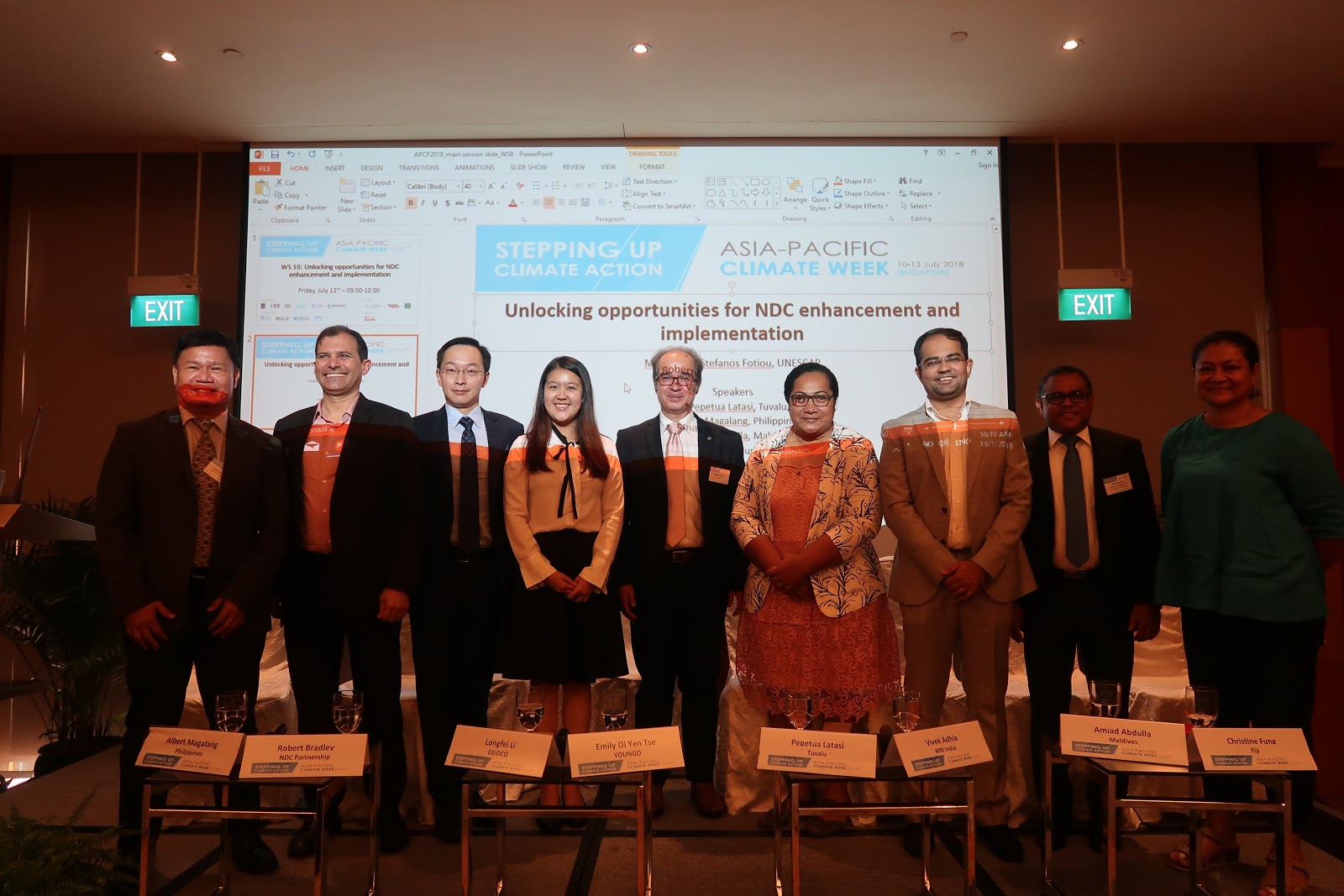
Pre-work of preparing for my session, “Unlocking opportunities for NDC enhancement and implementation’ was rather limited. All of it was done in a rushing manner as I was drowned with work. Yet, while drafting the key points with assistance from other members, I was pleased that my knowledge in both MYD and my full time job have been able to contribute nicely. The most exciting part was that a subject matter expert of this area had agreed to share his thoughts and inputs on top of mine and it was all done in the nick of time.
Looking at the panelist profile, I felt small. Sitting with these people working on NDC implementation on a national and inter-governmental level, I asked myself, what can I bring to the floor? YOUNGO (insert link), the official youth constituency of UNFCCC had entrusted me to represent the youths. How do I strive to establish the balance between not being the typical “hoo-ha-youths-who-only-know-to-make-noise” and being able to deliver my pressing message?
In the morning, after saying goodbye to our host, Cheryl from Singapore Youth Climate Action (SYCA), I travelled with Hanis to Resorts World Sentosa, the conference site for my 9am session. As if weeks of sleep deprivation wasn’t enough to torture me, the purple line on the MRT decided to freak me out at the final moment – with just 3 stops to the designated station, it broke down and delayed our journey for more than 10 minutes.
Time was ticking. With no time to spare, we rushed for a cab and went straight to the conference site. A rush of relief went through us both. We reached just on time, at 9am sharp. Not knowing if the other MYD members would make it on time to set up and live stream the session (as they too were stuck on the purple line). We ran through the corridors and met the session moderator, Mr. Stefanos Fotiou, Director of United Nations Economic and Social Commission for Asia and the Pacific (UNESCAP), who was kind enough to brief me through with patience and reminded me “not to worry”. Of course, a big thanks goes out to Hanis for being my luggage guardian at this crucial moment. Another blessed moment was Melissa Low’s presence, a research fellow at NUS Energy Studies Institute who showed up at the session and calmed me down with providing me guidance on what to speak about. In chaotic times as such, you see kindness in people.
When all the courtesy introductions to the panelist were done, I sat down as the fourth speaker from the left. When the first speaker, Mr. Albert Magalang, Head at Climate Change Office, Philippines started his take on NDC implementation, my heart was thumping at the speed of light. All of my pre-drafted speech was all over the place in my mind. I was screaming for help from the inside but I knew that I still had to look cool and collected. Soon, it would be my turn.
Mr Stefanos took an unexpected and refreshing approach while cueing me in. He asked the floor “How many of you in this room were born at the end of the 60s or beginning of the 70s?” Few hands were raised, including Mr Stefanos himself, exposing their age (oops). He then turned to me and said, “Emily, for us who have raised our hands, we have completely failed to deliver a better planet to your generation.” He then asked what should youths be doing to deliver a better planet to the next generation and also our roles in NDC implementation. Amused by his introduction, it cracked me up a little and prompted me to share my thoughts.
I started off with one of my favourite framing sentences: “While our future is being negotiated, we, the youths need to be part of the process”. I shared that youth participation is in fact, another form of capacity building to nurture talents and to ensure succession and a just transition. I proudly slipped in the Malaysian government as a good example in allowing MYD to engage with them and learn from the national delegation in COP, hoping this could urge other nations’ participants in the room to mobilise their government to do the same. NDC implementation is a long term strategy and thus, sustainability in ensuring the talent pipeline to continue the work is vital.
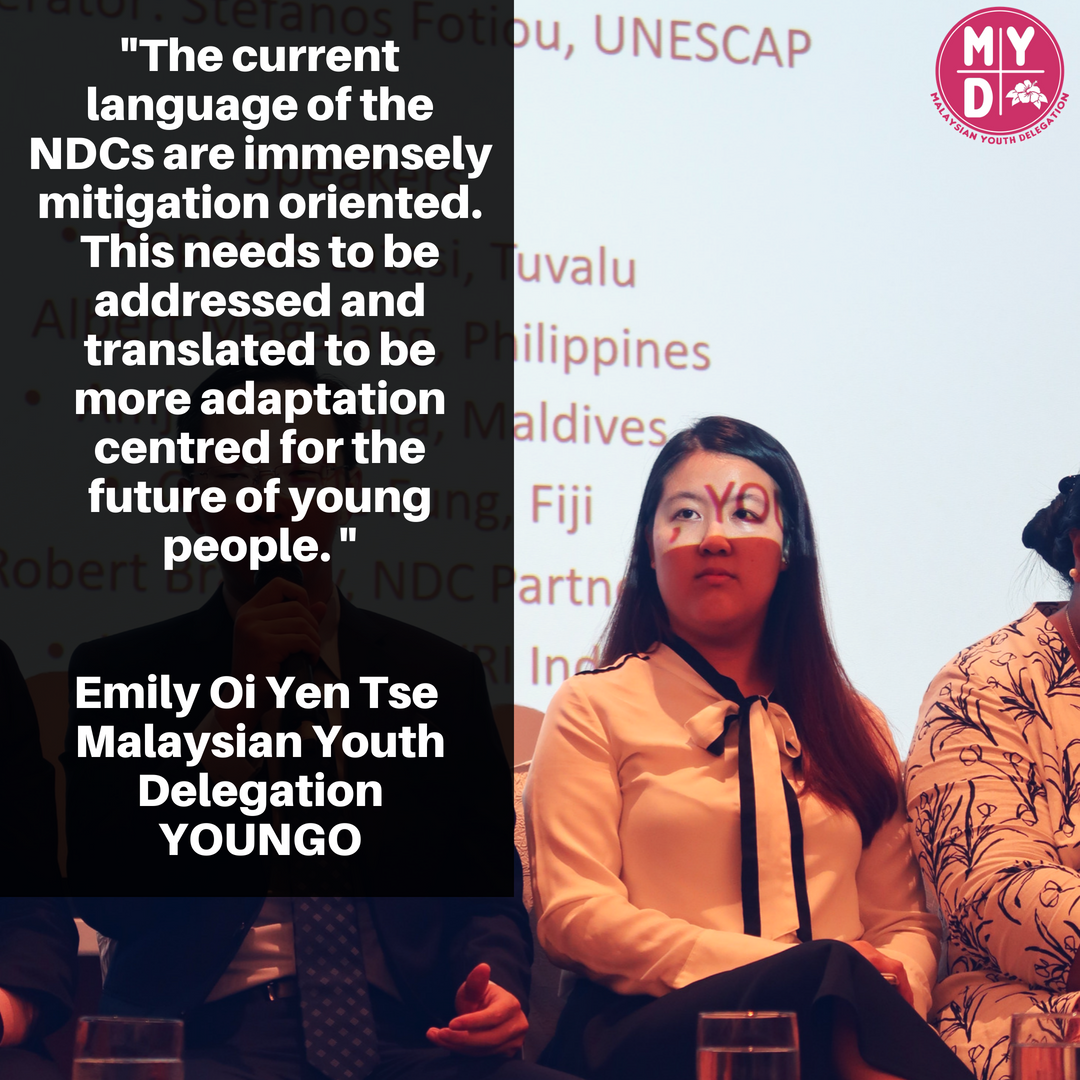
The second point I raised was on adaptation. It was one of the strongest messages from my heart, yet, I felt a sense of intimidation to share my message with the crowd. Gathering all my guts, there it went – I said it. I shared my sentiment on how the whole conversation in climate negotiations have been very mitigation-centric. It channels out to affect how corporate, cities, and even financing opportunities lean towards being mitigation-focused. We should now have more tools and mechanisms to enhance adaptation projects’ environmental and social impact assessment and the respective ROI to let investors see the value of it. I witnessed a few nodding heads from the floor and even from the panelists, which was a very assuring response for me, as this was my first time voicing my views out in a public forum as such.
After I spoke, other panelists also voiced their thoughts on adaptation. When the session ended, a lady from FAO came and thanked me for raising up adaptation matters. It was a humbling experience to hear from everyone. I hope I did my part to raise the youths voice, especially on our concern about adaptation. Mr. Stefanos concluded my part fittingly with “If the youths talks about it, it is a signal that it is not in a very optimistic situation. And therefore we should pay more attention and look more into it.”
Dear world, it is time for a paradigm shift within the climate circle.