Loads of surprises for the Malaysian Youth Delegation (MYD) on the first day upon our arrival in Paris. First it was Jolene’s luggage being late, then Adrian’s uninformed occurrence, following by the good news of getting pink badges (accreditation to enter the COP21 venue, registered under our national government)!
photo credit: Rappler
Let me introduce you about the badges in UNFCCC. To enter the COP venue, you need to have accreditation, and the badge is the prove of your accreditation. This is to control the nuimber of people accessing to the venue. There are actually several types of badge representing different identities:
Pink (National Delegate)
Yellow (Civil Society Organisation)
Red (Head of Delegation)
Green (Observer State)
Blue (UN Agency Observer)
Initially MYD only managed to secure a yellow badge for second week, we were lucky to get 2 full yellow badges and 4 more full pink badges as the COP21 commence. Initially we did not realize the difference, or rather, pros and cons, of the pink and yellow badges, until the COP21 official starts. We found out that the pink and yellow badges combination works the best.
“What’s the difference of pink and yellow badge?” ”How do you feel to have a pink badge?” These are the questions that all the youth delegations that we met have raised.
As a “Party Overflow” (Under National Delegation, but sort of secondary) pink badge holder, I have been following the negotiation since the day that the Ad Hoc Working Group on Durban Platform for Enhanced Action (ADP) opened. I’m very grateful of having such amiable Head of Delegation who are very willing to share his knowledge with us. I’ve got the chance to follow him to almost all the meetings, including closed meetings, on the first few days. With all the sharing and debrief from Dr. Gary, we managed to have a clearer picture about the negotiation.
It was funny how the pink badge holders “trapped” themselves in the conference rooms for most of the time. We felt obligated to do so because we have the privilege to access to the live negotiations while many civil society members cannot. Anyway, the team worked together and get involved in action and negotiation tracking which I am really happy to see!
ADP spin-off group on technology development and transfer (Article 7), and related decision paragraphs
There were some special badges too. How special? If you manage to get that badge, you will be able to stand just 1 meter away from Obama, Xi Jin Ping and Putin! Those badges are very limited and usually will be distributed by the Secretariat to the observer constituencies like YOUNGO, ENGO, RINGO accordingly, and the constituencies will give them out to the selected members. These special badges usually will be used when there are significant meetings that involve high level segment like the Head of States or Ministers.
Lastly, I would like to thank the Minister of Natural Resource and Environment, YB Datuk Dr. Wan Junaidi bin Tuanku Jaafar for granting us the “Party Overflow” badges that allowed us to have such awesome and eye-opening experience!
First time attending an United Nation Conference, first time standing in Europe, first time meeting the Malaysian Conference of Parties (COP) Delegation, first time joining a large scale of climate civil disobedience. So many more new experiences that make my 19 days in Paris an unforgettable journey. I would like to share my first COP experience with 4 things that I have learnt/gained:
The difference between rich and poor countries
I was flabbergasted when I heard about how much the allowance that the youth from an American NGO get while some Global South scholarship recipients are still starving during COP21 because they did not get their stipend on time. It is sad to hear that the gap between the developed countries and developing countries are not only present on the negotiation table, but also at the youth level. Many of the Global North youths are so privileged that they do not understand the struggle of the Global South youths to even fly to Paris.
Negotiator’s life is not easier
I thought being a good negotiator is lucky because he/she can travel to overseas attending UNFCCC meetings. After tracking the Malaysia’s Head of Delegation and observing the negotiations for 2 weeks, I comprehended that being a true hero is not easy. Besides being knowledgeable and diplomatic, our national delegates need to be good at preparing food (tight budget), good at writing an intervention (to create impact), patient enough to explain the situation to high-level officers and amateur like me and on top of everything, have high resistance against starvation and lack of sleep (meeting from 9am to 12am is normal). Please give a round of applause to our national delegates!
MYD huddle to get a debrief from Malaysian Negotiator after a midnight session
UNFCCC COP processes is NOT that difficult
I was lucky to be able to witness the negotiation process and to engage with our national delegates. From being confused about simple things (like the difference between spin-off groups, informal-informals and contact groups) to being able to understand the text and negotiations, I have learnt so much more about the process of producing an universal agreement especially from the people in COP21. The main reason is that I am forced to do research and find ways to understand new things that I am not familiar with. If I do not do so, it will be very hard for me to catch up and be on the same track with the others. Next, talking to different people and getting to know different perspectives and views on a single topic is much more interesting than a boring thousand-word article.
How different is the atmosphere in and out of COP21 venue
I thought the Parc des Expositions (COP21 venue) was considered pretty lively as people were bustling, many colourful animals decorations were set up and a lot of big actions/movements by the civil society members in it. However, this impression was totally changed when I visited the Climate Action Zone and the Climate Generation Zone. Both of these zones do not require accreditation to enter, it is therefore packed with people from NGO and are passionate about climate movement. Both are energetic and motivating. I then labelled the Parc des Expositions, the venue for COP21, as solemn, formal and boring.
Hangout between participants from International Eco-Schools Conference Malaysia and Malaysian Youth Delegates at COP 21 in Paris.
A recording of the video conference between participants of the 4th International Eco-Schools Conference 2015 with Adrian Yeo and Amalen Sathananthar in Paris is now available on YouTube!
Adrian and Amalen are from youth climate empowerment and education group, #PowerShiftMsia & #MYD and are there following the COP21 negotiations on behalf of Malaysian youth.
This is the first time an official Malaysian Youth Delegation (MYD) is present at a COP
Guess whom I met during the Conference of Youth (COY) in Tokyo? It was Roux Nicolas, a student from University of Tokyo. He is currently undertaking a graduate program on Environmental Science. During the first day of COY, he facilitated the ice-breaking session and came up with ground rules for COY11, Tokyo. Find out more about the short interview session with Roux below.
ii) Young press from Global Environmental Forum (GEF)
Hi from Mizuki Okumura. This was the first time Mizuki participated in a conference where youth gather and raise our voices on climate change issues. She is representing an environmental NGO in Japan, Global Environmental Forum (GEF). GEF is a non-profit organization, which focuses on global environmental issues such as deforestation and climate change; raising awareness of local community and make policy recommendations.
As a young intern, planning and researching in GSGES Kyoto University, she is very excited and feels positive about the climate movement especially among youth. She believes youth is powerful and, together we should take action! To her, it was a great experience attending COY 11. Stay tuned with our young journalist as she will be publishing articles on what’s happening in COY 11, Tokyo in GEF.
iii) Biphasa from India I managed to interview one of the volunteers during COY 11, Tokyo – Bipasha Kaur Chatterjee. She is from India and currently studying Social Science (East Asian Relation) at the University of Tokyo. Her friends, who joined the organizing committee invited her to volunteer in this program. She is involved in the communication team and is in charge of note taking. Her homeland is in New Delhi, India. After studying in Japan for two years, she is happy with the policy implemented in Japan, especially waste separation. It has become a cultural for people to separate their waste and everyone practices it. Rivers in Kyoto is clean and nice. She has seen much more polluted rivers in India.
In India, there are many environmental issues such as water pollution, air pollution, land destruction, deforestation, etc. There are many existing laws, but it lack implementation and enforcement. One of the interesting phrases she shared with me is “CHIPKO Movement in India”. The meaning of Chipko in Hindi word is “to hug”. It is a big environment protection movement by the local communities especially aborigine people as men, women, children are hugging the tree when the government decided to clear the forest. It was a huge success of people movement to put their lives in the frontline to protect the trees.
She also mentioned that climate change is a big mess which human created since industrialization. Instead of learning from history, we are following the footsteps of developed countries. We are facing climate change in this era and the blaming games should end. We need to deal with this major issue now. In line with COP21, she hopes to see world leaders coming up with concrete solutions in saving our mother earth.
iv)
Glad to meet Akane Ota from Nagoya University. She is studying Environmental Science and doing research in Comparative Analysis of Japan International Cooperation Agency , JICA’s REDD+ projects. It is interesting to know that her research focuses on four different countries, which consists of Indonesia, Cambodia, Laos and Mozambique. Most of us in ASEAN have heard about Indonesia, Cambodia, Laos but not Mozambique. This is also my first time knowing about Mozambique.
Akane’s research is about Reducing Emissions from Deforestation and Forest Degradation (REDD) among the four countries. REDD is one of the topics in Conference of Parties (COP21). It is an effort to conserve and preserve forest through financial support and incentives for developing countries. Four of these countries have tropical climate with two seasons, wet and dry. These countries are vulnerable to climate change and deforestation rate is increasing. REDD+ have been implemented in these countries by working closely with the local government. Institutions are established to improve the system of REDD+. With the continuous support of REDD+ program, it can help to keep forest intact and reduce the concentration of Greenhouse Gases (GHG) into the atmosphere. Let’s protect the forest and implement more REDD+ program in other countries.
v) Participants from China, Li Lin (李琳)
I interviewed Li Lin from China during the last day of COY11. She is currently studying International Political and Economics in Peking University. Besides studying, she is also a volunteer in OXFAM Hong Kong , an NGO which focus on the power of people against poverty.
OXFAM is a global organization which can be found in countries such as the United States of America, Germany, Japan, Sweden, etc. OXFAM Hong Kong shared the event of COY 11, Tokyo in the mobile application, What’s App. She finds COY an interesting event and there you go, Li Lin in COY 11, Tokyo!
Li Lin shared her concerns on the interrelation between Climate Change and Poverty. In China, there is a huge gap between the poor and the wealthy. Those suffering from the impact of climate change are farmers from rural areas. Even though China is developing rapidly, 50% of the people are depending on agriculture as a living source. The government has taken steps to reduce poverty level among farmers through farmer tax reduction, providing basic facilities, building proper irrigation, etc.
However, the direct impact of climate change such as floods and drought make it difficult for the government to help the poor. Compare to western countries, the agriculture industry in China is still lacking behind in terms of technology. There is a lot of improvement needed for environmental protection by the government. The environmental impact is not as major concern of government as compared to others when comes to economic development.
OXFAM Hong Kong also focuses on research related to precision poverty alleviation, which involve community and NGOs to provide recommendations to government. In line with COP21, OXFAM supports a story telling contest organized by United National Development Program (UNDP). It is called the Voice2ParisGlobal Storytelling Contest. It is available in English and Mandarin. Winner of the contest stands a chance to attend COP21, PARIS. Let’s have a look at video below on Li Lin’s video during COY 11, Tokyo.
Paris. A trip which many are looking forward to. To travel, to explore and… to fall in love. Fall in love with the city, people, culture, fashion, food… and? Well, I am looking forward to the upcoming COP21 at Paris that is to be held on 30th November 2015.
Before every COP, an annual youth conference will be held annually. This culture has been going on since 2009 where young attendees of the world get the opportunity to gather, to share, explore, experience and grow together towards a global smart climate community.
This year, the 11th Conference of Youth (COY11) is one of the largest ever held where the event was graced by 5000 other young attendees around the globe at Parc des Expositions de Villepinte. There are many workshops, conferences, debates, and forum occurred concurrently throughout the 3 days from 26th November 2015 to 28th November 2015. The message of the COY 11 is to show that young people are able to mobilize. They are important actors of change and leaders of tomorrow where, they are able to convey concrete solutions to combat climate change together. Majority of the people come with this objective in mind, “to imagine and create the society of tomorrow”.
One of the highlights in COY is their “Make It Real” program as it is an open innovation track where young people get the opportunity to explore, to convey their dreams and visions into practical solutions to make a better society. For me, words such as creativity, visions and dreams are keys to bring humanity one step forward. If you ask me, to be better or worse? I do not know. Perhaps, James Diamond study on “How Societies Collapse” has the answer for this.
Nonetheless, this year is also the first experience for Malaysian Youth Delegation (MYD) team to explore COY11. In my opinion, the experience is enriching especially having one of our team member “Amalen” to co-organized a brief Asian meetup session with at least 30 enthusiastic Asian Youth at COY! These energetic young Asian leaders are here – to share and engage with one another, to express their environmental initiatives they have back home. For instance, we have Kai from China, who does global research on bees; Mia from Indonesia – who focuses on youth climate action at COP and Bhaskar Padigala from India, whom had done an amazing work on researching available renewable energy technologies that are applicable to his home country.
Although it is only a day at COY11, it is still an enriching global experience for me. Hopefully, if I am fortunate enough, to explore the next COY in full.
Welcome to day 2 of COY 11 in Tokyo. It’s great to see new participants coming in for today’s session. The program starts from 9am to 10pm. I get to mix around with different participants from Japan, Taiwan and Korea. Of course, thanks to the advancement of technology, I managed to say HI to my teammates in Paris: Emily and Thomas who are attending the COY11 at Paris during the session of “meet a local COY Session”. It is so happy to meet up with team members even though we are far apart. There are several round table discussions today. I learnt the importance of teamwork in finding a common solution. As we know, one voice can’t be heard but many voices make a huge impact.
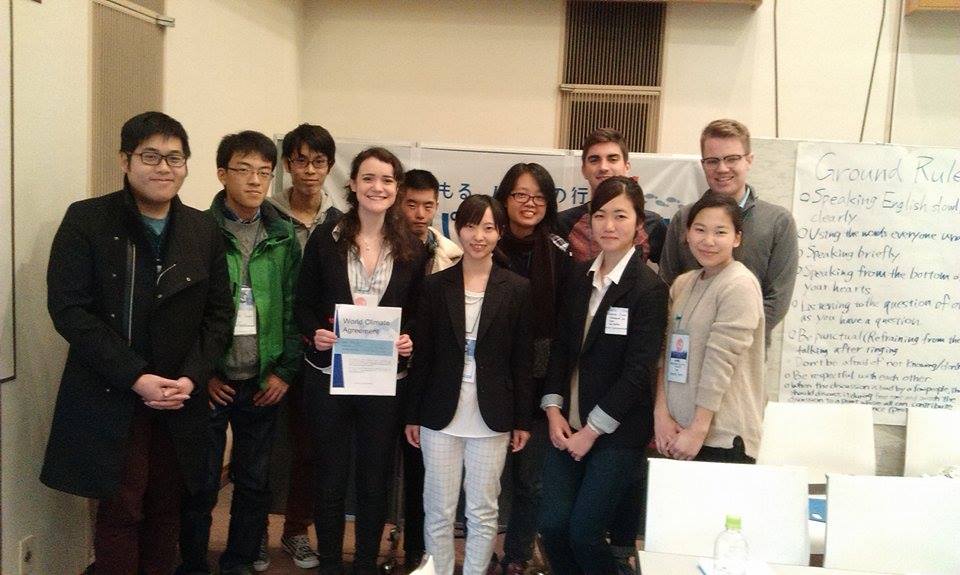
I joined COP in My City session. The main objective of this session is to bridge the gap between youth and COP. We are given the chance to experience a Model COP in 3 hours. It is just like the real negotiations in COP with each of the participants representing different countries such as: China, India, US, EU and other developed countries. We are given confidential data as a reference. I represented other developed nations which comprised of Australia, Canada, Japan, New Zealand, Russia and other former Soviet Republics like South Korea, etc. Our main goal is to negotiate a global agreement to reduce green house emission (GHG) based on the current situation of economies and national interests. At the end of the session, we managed to reach a consensus. Each delegation signed on the World Climate Agreement. The organizer will submit the document to COY 11 Paris and COP21.
The first session of the day is Renewable Energy. Participants gained greater insights on what is sustainable energy and what’s Japan has learnt from Fukushima Disaster. It is a disappointment to know the fact that 26 out of 46 nuclear plants are applying for inspections to restart. Japan’s energy policy is not moving towards sustainable energy. Our team, Malaysian Youth Delegation, participated in the poster session where we presented the rice and PowerShift Malaysia bunting. It is a great platform to interact, exchange information and most importantly to inspire each other. If you read the day 1 blog post, we continued the discussion of Youth of East Asia Action Agenda (YEAAA). It can be pronounced as YEAH !!! Team members got together and provided a final solution to the topics mentioned earlier. This is a very crucial step as selected ideas will be included in declaration.
I joined an interaction session between Paris and Tokyo. We discussed about the necessities of nuclear power plants, individual actions to reduce CO2 and important aspects to combat climate change.
The last session of the day was the planetary health flim, “ Mamtaz’s Story” – The fight for climate justice in the Bay of Bengal. The people are leading a simple lifestyle depending on the available resources. They are least responsible towards climate change yet most vulnerable to the impact of climate change.
We are getting closer to submitting a declaration to COP21. I am very excited about it and looking forward to get youth voices heard in COP21. This is the future we want and remember “YOU”th are the solutions. I’m counting down to Day 3 of COY11 at Tokyo.