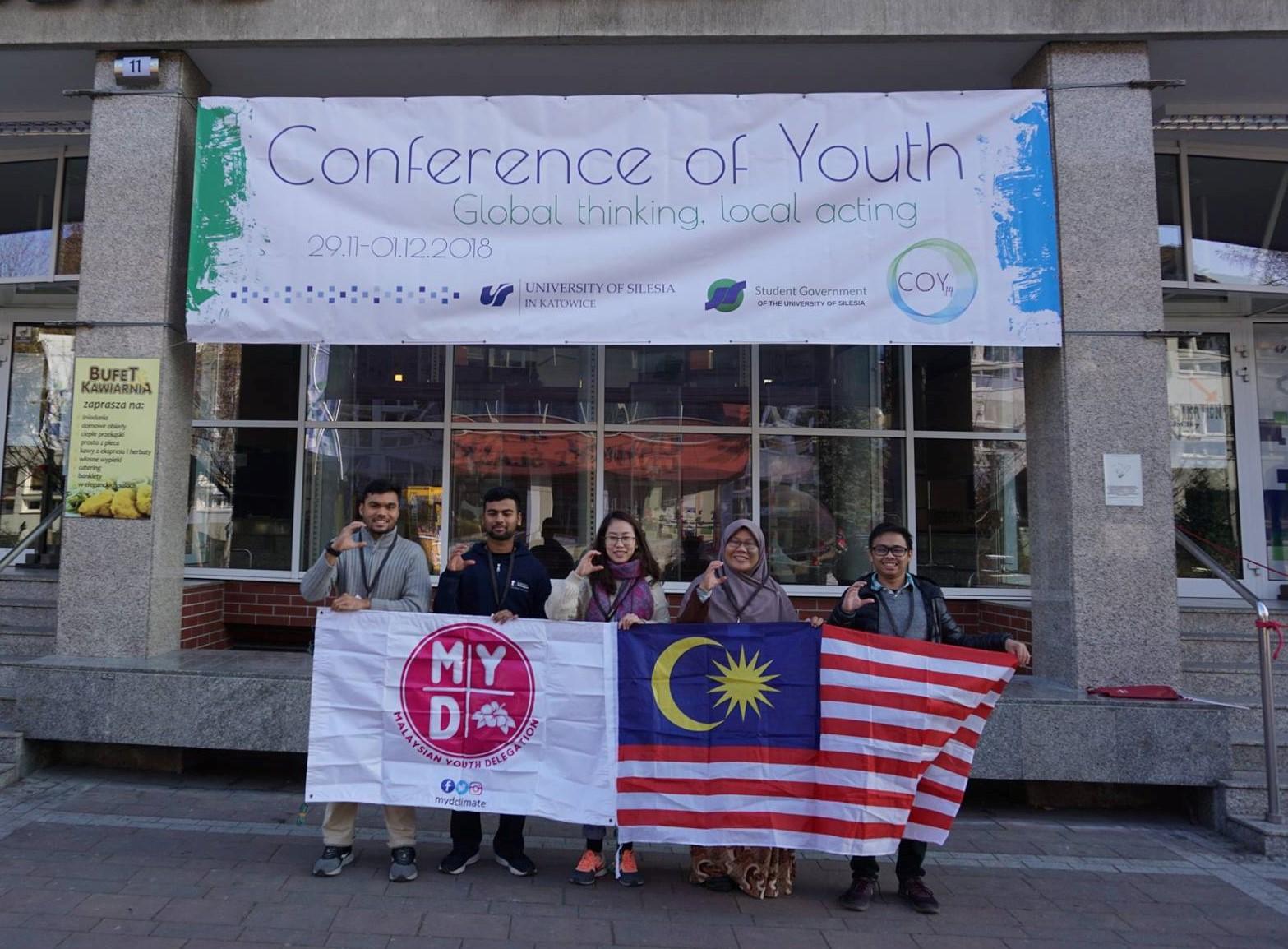
After traveling for a total of about 48 hours, I was more than glad to settle into our quaint little apartment, lock, stock and barrel. After what seemed like an eternity of brisk walking, navigating and mad-bursts to catch buses and trains, it was pretty difficult not to lose one’s self in a hot steamy shower followed by well-deserved slumber.
MYD’s COP24 team at COY14, from left to right: Syaqil, Varun, Cai May, Liyana and Shaqib
Ironically enough, the mad-bursts to catch trams and/or buses, on top of the occasional grab, did not stop – as evident during the first day of COY 14. Having left our Airbnb at 6.15 in the morning to catch the 7 o’clock bus to Katowice seemed straight forward, until it dawned upon us that the chance of getting lost in an unfamiliar city is too familiar a likelihood. Not only did we miss Bus 141 which was to take us to the tram station that was supposed to take us to Blonia Park – where the COP bus will be stationed – Tram 24 cynically decided to appear on the other side of the road, leaving us in a state of disbelief. Determined not to have our spirits dampened by a triviality, we decided to walk to Blonia Park, being aware that it was a straight path anyway, albeit it being the road less travelled – or so it looked that way.
After having walked for about 10 minutes whilst simultaneously looking for our elusive bus to Katowice, an unremarkably grey bus zoomed by us and to our incredulity, it bore a neon green COP24 banner. As if it were already second-nature to us, we made a beeline for our bus, though with each passing second it seemed to have shrunk more and more until it was no longer conceivable to the naked eye. No matter, we kept on marching like the proverbial troops we were, trudging towards base camp in the field of battle, where lo’ and behold, there she was like an obedient wife waiting for her husband, that unremarkably grey, beautiful miraculous bus stationed not too far off from where we thought we lost her.
The rest of the day flowed smoothly in such a sequence: I half attended a climate change education game followed by the first YOUNGO induction cum briefing session (I half attended the former as it clashed with the latter). That followed by a breakout session into respective YOUNGO working groups, where I decided to pursue my interest in renewable energy. I was a little apprehensive with regards to the renewable energy WG as there was little indication that it was going to be active prior to COP, but my concerns were banished during the YOUNGO session when it was announced that such a group does exist and that it has a predetermined agenda.
Nonetheless, it was slightly concerning that the person handling the renewable energy working group is also handling the oceans working group, albeit temporarily as he waits for his colleague to take charge as she will only be coming in late for COY. I was also slightly taken aback at the revelation that the working group facilitator had to leave for Bonn the next day as he is to speak at the Global Landscape Forum.
No matter. I take this as an opportunity for the team to take ownership of the working group and produce meaningful outcomes. During COY13, I found myself to be disconnected and detached from the spirit of the conference, feeling lost and overwhelmed (it didn’t help that I came in halfway into it either). But with COY14, I feel that I’m coming in with a bit more confidence and a sense of purpose. Just like how some say that the failure of the Copenhagen Accord was necessary for the advent of the Paris Agreement, the shortcomings I faced at COY13 and COP23 leaves me no choice but to succeed at only my second ever COY and COP.
Malaysian Youth Delegation (MYD), Energy Studies Institute, National University of Singapore (ESI-NUS) and Singapore Youth Climate Action (SYCA) organized ASEAN Pre-Conference of Parties (Pre-COP) Capacity Building Workshop 2018 in Malaysia and Singapore. The ASEAN Pre-COP Session in Malaysia was hosted by MYD in Oasis Village, Ara Damansara follow by the session in Singapore, hosted by ESI-NUS and SYCA at The Red Box, Somerset Rd.
Five key points in both workshops are;
An introduction of United Nations Framework Convention of Climate Change (UNFCCC)
Introduction of Youth Constituency to the UNFCCC (YOUNGO) and the rest of the constituency.
Role of Youth on which covers youth organization that active in ASEAN region.
Info transition from Subsidiary Bodies Meeting (SB48.2) in Bangkok, Pre-COP in Krakow, Poland and finally heading towards COP24.
Focus topics that will be covered in COP24 and update on Katowice Rulebook.
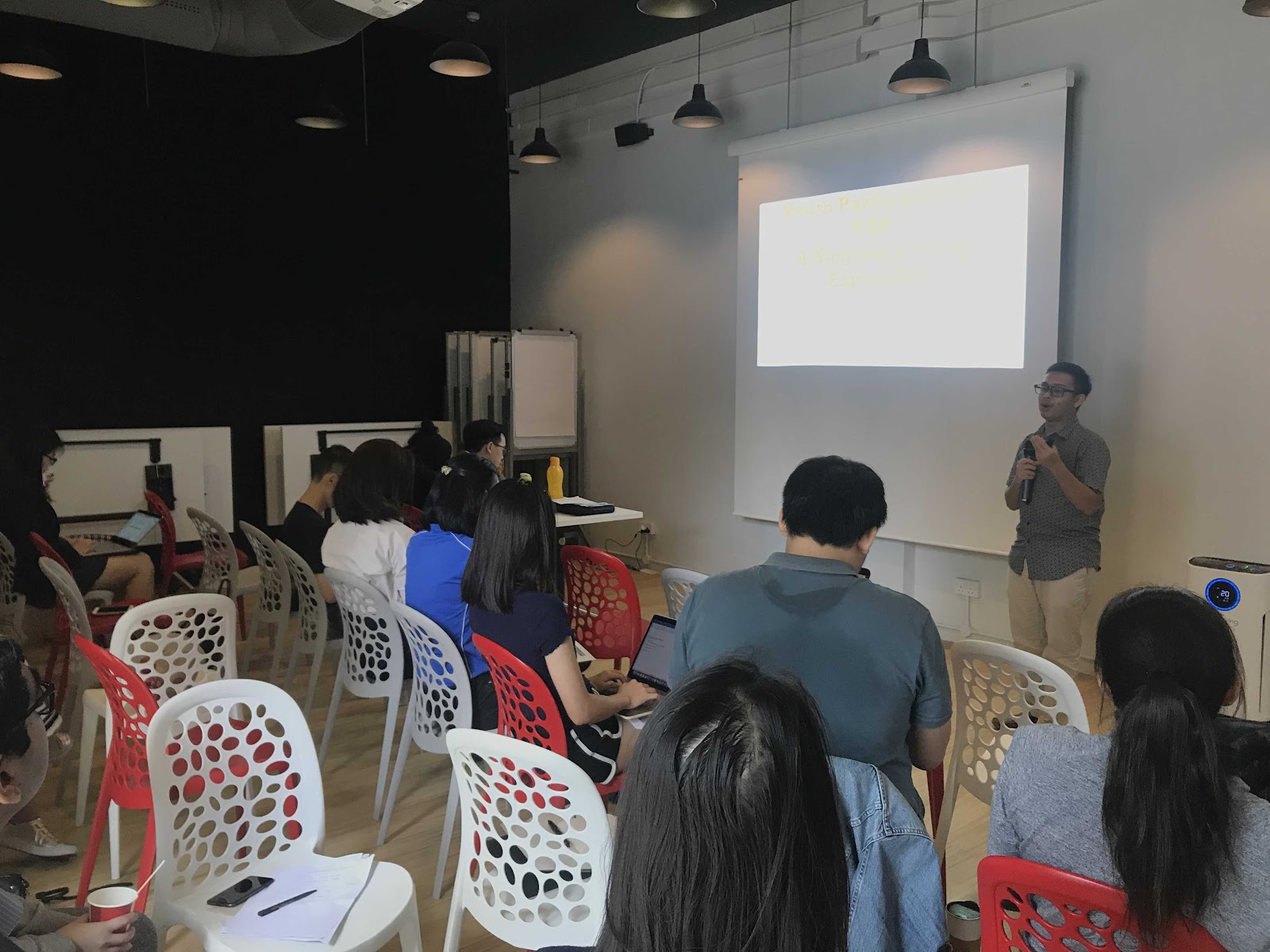
In Malaysia, MYD covered most of the key points, where Mike presented on the Introduction of UNFCCC and Role of Youth. We had representation from our Singaporean counterpart, Lastrina Hamid from SYCA, who presented on her organisation and her experience in previous COP conferences. The session followed by a sharing session by Shaqib Shahril from MYD, who covered Key Topics in COP24. The workshop ended with Aaliyah from MYD, who spoke on the transition from SB48.2 to COP24.
The session in Singapore took on a similar approach to the Malaysian session. However additionally, Melissa Low from ESI-NUS covered in depth on the Katowice Rulebook. Meanwhile, the event in Singapore added a bit of twist compare to MYD which is introducing Singapore’s Carbon Pricing Act and its relationship with to Article 6 of the Paris Agreement. This session was facilitated by Environmental Law Student Association, National University of Singapore (ELSA-NUS). MYD member, Shaqib Shahril been invited as a panel for this session. The session continued with a storytelling workshop and writing tips – especially aimed for those who are going to COP24. It then followed by a pitching project by Yale-NUS College Student and their plans in COP24 as a part of Singapore Youth Delegation.
Shaqib Shahril presented on the Role of Youth in UNFCCC
Both Pre-COP sessions were really fruitful, covering the basics of this year’s COP24 – relating the Paris Agreement and Katowice Rulebook to national policy. Both of the Malaysian and Singaporean session has gathered approximately 40 ASEAN youths, with representation Malaysia and Singapore, Indonesia, Philippines, Vietnam and Japan.
The Pre-COP session in Singapore coincided with the ASEAN Summit 2018, whereby Singapore is the host for the ASEAN Meeting and high-level segments. Both session shows the credibility and position of youth from ASEAN in the climate change scene from this region.
We would like to express our appreciation and gratitude to WWF-Malaysia for supporting our workshop in Malaysia and our partners from ESI-NUS and SYCA, Melissa Low and Lastrina Hamid for making this capacity building workshop at an ASEAN scale into reality.
Changes in the world’s climate has, and will continue to bring major shifts in food production. This includes the rise in temperature, increase in rainfall and coastal flooding that reduces the amount of land available for agriculture. In a nutshell, food crops and as it follows, food security, are sensitive to climate change.
After a successful SEEDS Malaysia back in 2014, it is back this year with the theme “GET REAL”.
This year’s theme could not be more timely – as the world’s population grows at an alarming rate, the increasing demand for food has put a strain on the planet’s resources to cope with feeding billions of people.
The event will be happening on 19th – 21st October 2018 at Oasis Discovery Centre (ODC), Oasis Village.
Throughout SEEDS Malaysia 2018, 2 of these events will be happening concurrently;
Together with SEEDS, Power Shift Malaysia will participate as the youth counterpart. The Youth Forum is an event organised by the youth for the youth with the objective of raising awareness about climate change and food production. Topics from food production to youth action on climate change will be discussed throughout the event.
Do you know what is LAGI BEST?! SEEDS is providing sponsorship to those who are really interested to participate in this event! T&C applies.
Article 10, paragraph 4 of the Paris Agreement has established a technology framework to provide an overarching guidance to the work of the current Technology Mechanism. The principles of this framework, which includes coherence, inclusiveness, result-oriented approach, transformational approach and transparency will provide guidance on the promotion and facilitation of technology development and transfer. This supports the implementation of the Paris Agreement, in the pursuit of its long-term vision of improving resilience to climate change as well as to reduce greenhouse gas emissions.
Purpose of the technology framework
So will the technology framework help the Technology Mechanism? What do Parties think of the framework? Here in Bangkok, I attended informal consultations regarding technology framework as well as the Technology Mechanism to find the answers.
Informal consultations in SB48-2
The informal consultations, aka negotiations on technology development and transfer were discussed in two of the subsidiary bodies to the UNFCCC, which are the Subsidiary Body for Scientific and Technological Advice (SBSTA) and Subsidiary Body for Implementation (SBI). In SB48-2, SBSTA covers matters regarding the technology framework (Agenda 5), while SBI covers matters regarding the Technology Mechanism (Agenda 14a).
In means to guide the flow of the negotiations, Parties were asked to comment on the following questions regarding the framework:-
Is the technology framework a guidance for Technology Mechanism?
Is the guidance clear enough? Does it align with the principles of the technology framework?
Is the guidance in coherence with the provisions in the technology framework? Does it repeat or overlap with other provisions?
During the first informal consultations, one Party specifically commented that tremendous progress have been made since the last meeting in Bonn, and hopes that this session in Bangkok will be as efficient as before. But has it? Well, sort of.
What do Parties think of the Technology framework?
Generally, parties had shown their positive views towards the framework. Nevertheless, the framework itself have much room left for improvement, in terms of the small scope of the entire framework, taking into account the fact that this framework is supposed to guide the already existing Technology Mechanism.
One of the major issues that was brought up during the informal consultations by developing countries was that developing countries lack financial resources for the technology framework. Although developing country Parties have all agreed that more financial resources should come from developed countries, developed country Parties did not align themselves with the idea. “I will lose my job if I align my country with said proposal.” However, without compromising, the technology framework may not be able to meet its principles of being inclusive. Another issue that has been brought up by Parties were that the structure of the framework itself does not contain elements that specifies the guidance from the framework to the Technology Mechanism.
With some of the Parties browsing through Facebook and some of the observers snoring beside me, I wonder if the sessions of informal consultation for technology development and transfer are held important at all. From my point of view, at this stage of negotiations, the technology framework may not reach its full potential in facilitating the Technology Mechanism. It is, unless developed and developing country Parties cooperate and compromise in Katowice, the framework will just be rendered pointless. Also, considering the fact the scope of the technology framework is covers only this much, will the technology framework actually complement the existing Technology Mechanism and help in improving it? We’ll know very soon.
I left Malaysia to Bangkok without knowing what to expect. Prior to coming for this session here in Bangkok, I had zero idea on what negotiations in the United Nations Framework Convention on Climate Change (UNFCCC) would look like. Sure, I had read pages upon pages of articles about the UNFCCC negotiation process as a whole and also topics discussed here in the UNFCCC, but that did not give me enough insights on how negotiations work.
Amongst all the topics discussed in the UNFCCC, technology development and transfer had interest me the most, and hence I have been following closely on negotiations regarding technology throughout my attendance here in SB48-2. Why technology? Why not other fancy topics like finance or adaptation and mitigation? Well, I don’t know. Something about the word ‘technology’ caught my eye when I was skimming through an article, and therefore I dived straight into reading articles and documents related to technology development and transfer.
During the strategy meeting with Climate Action Network (CAN) held just a day before the official opening of SB48-2, I finally made up my mind to join the CAN working group on technology. I had no idea what working groups in CAN are for. Based on my understanding, working groups are just teams that were formed within an organisation to work on particular matters. Nonetheless, it wasn’t as simple as I thought it would be.
On the first meeting for the CAN technology working group, I introduced myself as a youth delegate of Malaysia and had specifically told everyone about how I am new to the entire process of UNFCCC. They too, introduced themselves and had made me feel welcome before getting to work. However, just minutes into the discussion, I found myself lost. I swear that I had read many articles about technology development and transfer, but whatever they were discussing about was alien to me.
SBI informal consultations on Technology Mechanism Picture by Kiara Worth
Negotiations too, wasn’t how I had expected them to be. During the first three days, I went to all informal consultations related to technology development and transfer, expecting them to be interesting to observe. I did not see the point as to why a bunch of adults from all over the world huddle annually just to give comments on a document. But as usual, I took notes of everything (which I know that I will never read), from major changes of inclusion of new paragraphs to minor punctuation changes. I found the negotiations boring – it felt just like sitting in a lecture hall with a boring lecturer (or worse).
On the fourth day of negotiations however, it suddenly struck me that negotiations aren’t just about editing a long document. While I was taking notes during one of the informal consultations, I started to think everything through, and I realised that Parties were all editing the text not just because they were unhappy about how a sentence was phrased, but rather how the words would put unwanted commitments on their respective countries.
Daily ECO news article by CAN
Also, everything that the members of the working group had discussed earlier started to make sense, and I now understand that working groups in CAN exist so that members of the group can discuss and analyse decisions that were made in negotiations. In every meeting for the working group, we decide if CAN’s position is aligned with the negotiation outcome. Our stance regarding issues related to technology development and transfer will then be published on ECO, the daily newsletter operated by CAN at the UNFCCC. This ensures that our position is heard by the general public as well as negotiators of SB48-2.
Aside from observing negotiations and contributing to my working group, my days in Bangkok were filled with networking. No, I did not walk up to random people outside negotiation rooms just to network (unlike most of the people). I networked because looking for an empty table in the UN building was almost impossible. Albeit being forced into conversing with people, I have definitely enjoyed it as it allows me to understand the ordinary lives of people and listen to their stories.
Sure, it may be intimidating at times, but I definitely do not regret my decision of coming to Bangkok.
Written by Kitty Chen Peer reviewed by Jasmin Irisha
National negotiators have talked for five days in these rooms, but what have they said?
The Paris Agreement (PA) calls for keeping global temperature rise well below 2˚C, yet we are still on the pathway of above 3˚C with the current set of nationally determined contributions (NDCs). it’s time to ratchet up our collective ambition.
As the Bangkok intersessional climate change negotiations draw to a close with just a day left, Parties are scrambling to the finish line. The mandate is for the Paris Agreement Work Programme (PAWP) to be complete by the end of 2018. In the May session in Bonn, it was recognized that the only way that would be possible was to organize an additional session in Bangkok.
Despite having just over five days of negotiations, many issues may be left on the table in Bangkok without being resolved. If this were to happen, negotiations to prepare draft texts would have to continue at COP24 in Katowice, Poland, where there will only be five or six days of negotiation.
Even though COP24 will be a two-week conference, it will see an absurd amount of time taken up by high-level ministerial meetings that will eat up into crucial negotiation time. Other issues and points of discussion regarding COP24 have been deliberated over the past few days in Bangkok, including a new daily badge system, a shift in the date of the first day of COP, along with the expected outcome of the Talanoa Dialogue – which may be downgraded to a Presidential note or high-level ministerial declaration.
While focus in Bangkok is to prepare draft negotiating texts in time for COP24, the talk of ambition has barely been heard
Article 4.3 is clear.
Each Party’s successive nationally determined contribution will represent a progression beyond the Party’s then current nationally determined contribution and reflect its highest possible ambition, reflecting its common but differentiated responsibilities and respective capabilities, in the light of different national circumstances.
It means that Parties need to update their nationally determined contributions (NDCs) over a period of time by including more ambitious climate action goals each time. This provision in the Paris Agreement to continually increase ambition is called the “ratcheting mechanism”.
So how can we increase ambition? There are a number of ways; such as means of implementation led by developed country Parties, feeding in Intergovernmental Panel on Climate Change (IPCC)’s Special Report on 1.5˚C, and the Talanoa Dialogue outcome. If we are serious about hitting our 1.5 ˚C or even 2 ˚C target, all three methods need to be utilized to the fullest.
Leadership by developed nations and means of implementation
Financial flows, capacity building, technology transfer and development are all pillars of the means of implementation. Trust-building is at the core of building ambition via means of implementation. If developing nations are being called upon to increase their ambitions, they should only do so on the back of increased ambitions by developed country Parties, who do not have conditional contributions in their NDCs.
In addition to leading by example, developed countries also need to fulfil their promises of providing developing nations with the means of implementation. Taking historical emissions into account, it has been reinforced time after time that the equitable way forward is to have nations that developed their economies on fossil fuel-intensive industries must pay up and provide support to developing countries that will be more affected over the coming decades, yet not be able to respond to the climate crisis.
Inherently built into many countries’ NDCs is a mini-ratchet mechanism of sorts – namely conditional contributions. Only upon support from developed nations with means of implementation, will developing nation Parties strive to achieve their more ambitious conditional contribution. With financial flows, technology development and transfer, and capacity-building we will be able to push for overall increased ambition.
Giving space to the Special Report on 1.5˚C (SR1.5) at COP24
Next comes one of the most important reports ever put out by the IPCC, the SR1.5. In decision 1/CP.21, paragraph 21, the COP invited the Intergovernmental Panel on Climate Change to provide a special report in 2018 on the impacts of global warming of 1.5 °C above pre-industrial levels and related global greenhouse gas emission pathways.
Parties are set to meet in early October to review and agree on the summary for policy makers of the report in Korea. This report has monumental implications should it reveal that global temperature rise will not be kept under either 1.5 ˚C or even 2˚C should we stick to our current NDCs.
While this report is a scientific paper, it will be highly politicized due to how it is meant to inform Parties on the reality of 1.5˚C pathway, by way of the Talanoa Dialogue. Although the report has been finalized, the summary for policymakers (SPM) is still in its draft phase and will be approved at the 48th Session of the IPCC in Korea in the first week of October.
When the SPM is approved and released, Parties must take its findings into consideration when finalizing the PAWP in Katowice and use it to call for stronger ambition in getting the world on the 1.5˚ pathway. While there is no information on plans from the IPCC for the COP24 opening plenary, the COP24 President has already indicated that there will be a dedicated space for the Talanoa Dialogue to consider the SR1.5.
Legitimizing the Talanoa Dialogue
Since launching in January this year, the Talanoa Dialogue (f.k.a. 2018 Facilitative Dialogue), has been lauded for its intent, the storytelling platform it provides, and its nature of being inclusive, participatory and transparent. It is still unclear as to exactly how the Talanoa Dialogue will conclude in COP24, but it should end meaningfully, with the collective input over the course of the year contributing to raising ambition.
The ratcheting mechanism in the Paris Agreement Pic: Carbon Brief
Is the Global Stocktake (GST) make or break?
The one ambition mechanism built into the Paris Agreement is the GST. Currently, the modalities, inputs, outputs and outcomes are still being negotiated in Bangkok. As the GST draft negotiation text begins to take shape, it’s important for it to be robust as it will inform and improve NDCs to come. Finally, it’s crucial to ensure there is space for inputs from all stakeholders – not just the Parties themselves, but third-parties as well as non-party stakeholders.
What the final draft text from Bangkok will look like remains to be seen and although there is little time left, there are still some avenues to promote ambition in order to better the current set of NDCs. Let’s get finance flowing to countries that need it the most. Once that happens, the rest will follow, and we’ll continue on our fight to 1.5˚.