The most recent round of climate change negotiations started with a bit of a furor. At the very last minute, constituencies and parties were suspended from giving interventions. The SBSTA Chair came around, asking the constituencies if they would be agreeable to this. Safe to say, the request was more of a formality than anything else.
As one of the people who was supposed to deliver an intervention on behalf of Climate Action Network, I was somewhat annoyed. It was an inconvenience, especially since several of us had spent time drafting and editing the intervention. However it was nowhere near the level of the Youth NGOs. A heated exchange ensued between a YOUNGO representative and the chair. Both parties brought up salient points which I thought served as interesting talking points to the principles and practicalities of the UNFCCC.
Me eagerly (with a hefty dose of nervousness), looking forward to delivering an intervention for the very first time ever.
The UNFCCC process is built on being inclusive. However, many civil society groups complain that they do not get enough of a say in the process. At this point in fleshing out the Paris Agreement Work Programme, inclusivity is an important factor because if a document is not inclusive and representative of everyone’s viewpoints then inevitably people are less likely to adhere to something they cannot relate to. It is also important that people have confidence in the UNFCCC process so that they will have faith in the outcomes such as the Paris Agreement Work Program. These were some of the arguments the representative brought up.
The Chair on the other hand, highlighted that the UNFCCC is a party-driven process, which means that ultimately the text will be written and finalised by parties alone. Time is of the essence here as parties aim to have an agreement on the Paris Agreement Work Program by the end of COP 24 in Katowice and therefore it is essential that parties get as much time as possible to work on the text.. Hence this additional 6-day session in Bangkok. Cutting out this section would save an hour and a half. However, it could be argued that parties interventions can be cut while keeping the opportunity for civil societies. Parties already have plenty of opportunities to voice their opinions. This was certainly a point YOUNGO representatives reinforced over and over.
Members of the youth constituency sitting down with the SBSTA chair.
The move to cut out the interventions was a pragmatic one. However, it has ideological and substantial repercussions – it signals that the voice of non-party stakeholders are not as important to the process. While there are of course other opportunities for non-party stakeholders to interact with the text, such as through and bilaterals, this is much less than the opportunities parties receive. Also, interventions are one of the few formal avenues that is visible to the outside world as the sessions are video-recorded and uploaded online.
After the heated exchange and some discussion among the other youths, once again YOUNGO chose to go up to the Chair to have a sit-down discussion on this matter. Youths are a key stakeholder because they are one of the most vulnerable to this process and also climate change in general. Firstly, because youths are usually self-funded and are not experienced in this arena. They are usually students who are passionate about climate change issues and have to study while doing this on the side. Secondly, youths will feel the impact of climate change much more in the future and will be the most impacted by the policies to combat climate change.
The outcome of the decision was that the chairs and the secretariat agreed that this would not set a precedent for things to work out like this in the future. They apologised for the impromptu decision and said they really believed this was the best choice. This incident reflected an interesting clash between practicality and principles. Which should be prioritised is up in the air. As a youth I would definitely be inclined towards principles as someone who is going to live the rest of my 60 years or so under the governance and impacts of the Paris Agreement.
It was a struggle at first. To attend, or not to attend. But when the YOUNGO speaking opportunity was secured, I knew it was a sign. I had been quite detached from the climate negotiations conversation and I guessed it was time I immersed myself once again, even for a short few days.
Pre-work of preparing for my session, “Unlocking opportunities for NDC enhancement and implementation’ was rather limited. All of it was done in a rushing manner as I was drowned with work. Yet, while drafting the key points with assistance from other members, I was pleased that my knowledge in both MYD and my full time job have been able to contribute nicely. The most exciting part was that a subject matter expert of this area had agreed to share his thoughts and inputs on top of mine and it was all done in the nick of time.
Looking at the panelist profile, I felt small. Sitting with these people working on NDC implementation on a national and inter-governmental level, I asked myself, what can I bring to the floor? YOUNGO (insert link), the official youth constituency of UNFCCC had entrusted me to represent the youths. How do I strive to establish the balance between not being the typical “hoo-ha-youths-who-only-know-to-make-noise” and being able to deliver my pressing message?
In the morning, after saying goodbye to our host, Cheryl from Singapore Youth Climate Action (SYCA), I travelled with Hanis to Resorts World Sentosa, the conference site for my 9am session. As if weeks of sleep deprivation wasn’t enough to torture me, the purple line on the MRT decided to freak me out at the final moment – with just 3 stops to the designated station, it broke down and delayed our journey for more than 10 minutes.
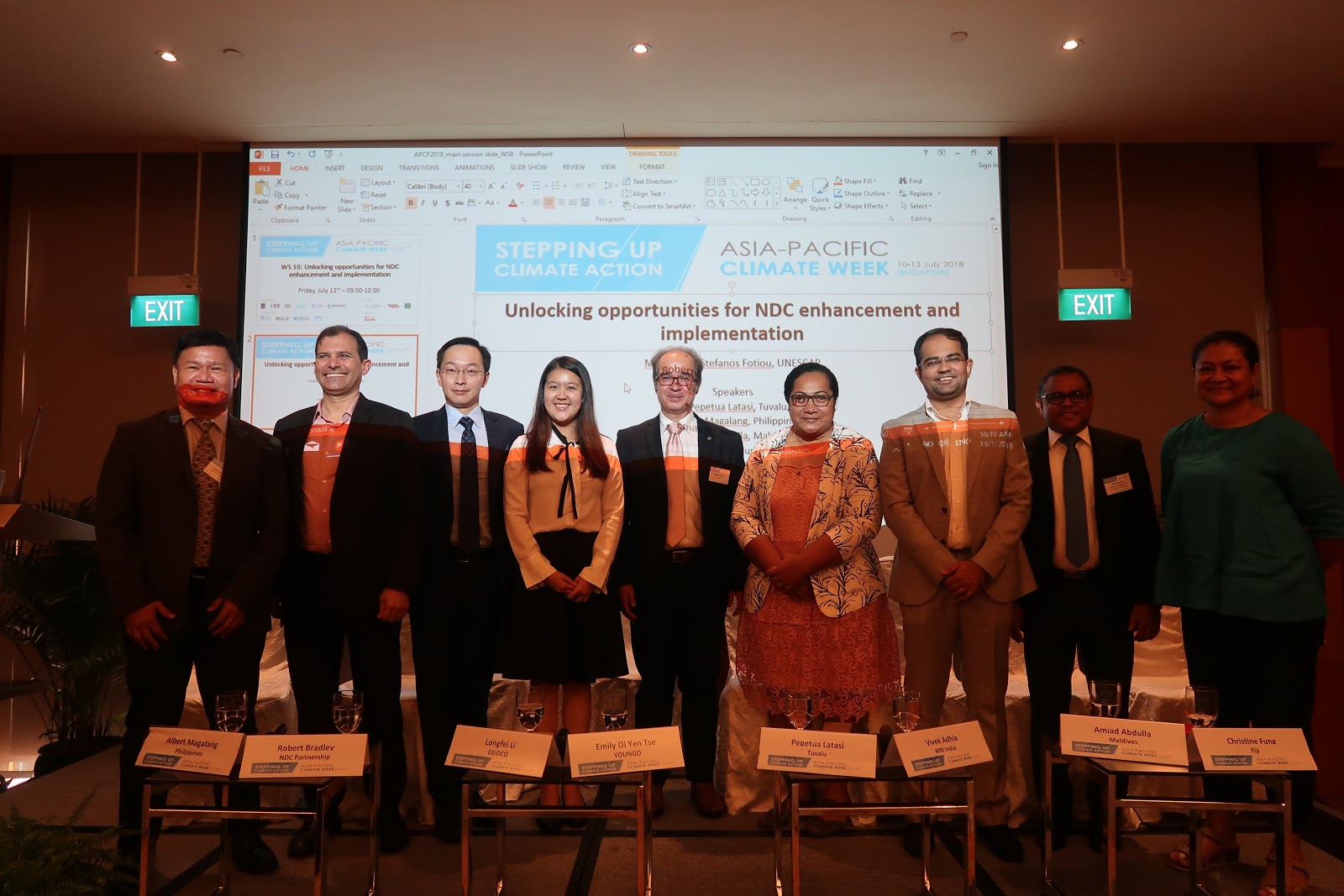
Time was ticking. With no time to spare, we rushed for a cab and went straight to the conference site. A rush of relief went through us both. We reached just on time, at 9am sharp. Not knowing if the other MYD members would make it on time to set up and live stream the session (as they too were stuck on the purple line). We ran through the corridors and met the session moderator, Mr. Stefanos Fotiou, Director of United Nations Economic and Social Commission for Asia and the Pacific (UNESCAP), who was kind enough to brief me through with patience and reminded me “not to worry”. Of course, a big thanks goes out to Hanis for being my luggage guardian at this crucial moment. Another blessed moment was Melissa Low’s presence, a research fellow at NUS Energy Studies Institute who showed up at the session and calmed me down with providing me guidance on what to speak about. In chaotic times as such, you see kindness in people.
When all the courtesy introductions to the panelist were done, I sat down as the fourth speaker from the left. When the first speaker, Mr. Albert Magalang, Head at Climate Change Office, Philippines started his take on NDC implementation, my heart was thumping at the speed of light. All of my pre-drafted speech was all over the place in my mind. I was screaming for help from the inside but I knew that I still had to look cool and collected. Soon, it would be my turn.
Mr Stefanos took an unexpected and refreshing approach while cueing me in. He asked the floor “How many of you in this room were born at the end of the 60s or beginning of the 70s?” Few hands were raised, including Mr Stefanos himself, exposing their age (oops). He then turned to me and said, “Emily, for us who have raised our hands, we have completely failed to deliver a better planet to your generation.” He then asked what should youths be doing to deliver a better planet to the next generation and also our roles in NDC implementation. Amused by his introduction, it cracked me up a little and prompted me to share my thoughts.
I started off with one of my favourite framing sentences: “While our future is being negotiated, we, the youths need to be part of the process”. I shared that youth participation is in fact, another form of capacity building to nurture talents and to ensure succession and a just transition. I proudly slipped in the Malaysian government as a good example in allowing MYD to engage with them and learn from the national delegation in COP, hoping this could urge other nations’ participants in the room to mobilise their government to do the same. NDC implementation is a long term strategy and thus, sustainability in ensuring the talent pipeline to continue the work is vital.
The second point I raised was on adaptation. It was one of the strongest messages from my heart, yet, I felt a sense of intimidation to share my message with the crowd. Gathering all my guts, there it went – I said it. I shared my sentiment on how the whole conversation in climate negotiations have been very mitigation-centric. It channels out to affect how corporate, cities, and even financing opportunities lean towards being mitigation-focused. We should now have more tools and mechanisms to enhance adaptation projects’ environmental and social impact assessment and the respective ROI to let investors see the value of it. I witnessed a few nodding heads from the floor and even from the panelists, which was a very assuring response for me, as this was my first time voicing my views out in a public forum as such.
After I spoke, other panelists also voiced their thoughts on adaptation. When the session ended, a lady from FAO came and thanked me for raising up adaptation matters. It was a humbling experience to hear from everyone. I hope I did my part to raise the youths voice, especially on our concern about adaptation. Mr. Stefanos concluded my part fittingly with “If the youths talks about it, it is a signal that it is not in a very optimistic situation. And therefore we should pay more attention and look more into it.”
Dear world, it is time for a paradigm shift within the climate circle.
The Asia Pacific Climate Week (APCW) 2018 opened with a strong pro-business and private sector sentiment. A number of heavy weights sat on the opening panel: Patricia Espinosa, Luke Daunivalu, Masagos Zulkifli, President Michal Kurtyka, Bambang Susantono. Steve Chao moderated the session. The importance of a business and private finance solution to climate change was well highlighted by the presence of such individuals.
The rhetoric among the speakers on the panel and also subsequent ones, stressed highly on the need for private finance, investments and the engagement and evolution of the business industry. The need for increased ambition by these sectors and more finance poured into addressing climate change was emphasized upon.
Singapore’s Environment Minister Masagos Zulkifli was the first of the panel. He started with an appeal to emotion and enhanced action by narrating the disasters that have been happening in the region including the ongoing flood in Japan that has claimed almost 200 lives as of then. Then, he stressed the importance of trade and the need to keep global systems open and made the age old call for urgency and the spurring of global climate action.
He highlighted innovation and collaboration as two important thrusts towards achieving a low carbon future. Certainly the image of Singapore is also based on this. Then he announced that Singapore plans to implement a carbon tax starting at 5 dollars for every tonne of greenhouse gas emitted.
“No exception!” he exclaimed.
He also reinforced that the integrity of the Paris Agreement needs to be preserved, which was somewhat ironic given that a petrochemical company was one of the platinum sponsors of this APCW.
Following him was the Executive Director of the UNFCCC, Patricia Espinosa. She brought up the need for carbon forums to be more inclusive of input from different groups of people. She also called for more action on climate change using a personal story to evoke emotion in the people. She narrated her visit to Tuvalu. At a visit to a primary school she had been ‘deeply moved’ by how the children were aware of and had to deal with the floods. It would be great if more high ranking individuals were ‘deeply moved’ by such sights so that they would persuade governments and important businesses to increase ambition.
She listed a number of things that should be done: All levels of government need to be involved. The PA work program needed to be finalised, firm commitments should be made by countries to increase climate ambition by 2020, proper financing should be provided by developed countries and they should honour their promises. She also highlighted the inadequacy of current finances,
“the global community is talking in millions and billions, but it should be trillions.”
She compared financing climate change with current finances to walking into a category 5 hurricane protected only by an umbrella. Ms Espinosa presented climate change as an unprecedented opportunity instead of an unprecedented challenge. All in all it is a dire picture, our current rate of addressing climate change.
Luke Daunivalu followed after Ms Espinosa. He stressed the importance of climate leadership at all levels: government, grassroots and the private sector. One key point he mentioned that I found particularly interesting was how he stressed on leadership that is feasible and heard by the international community. Presumably he is referring to his own. What I took away from his implications is that it is important for leadership to be mindful and inclusive of counter agendas but also one that is inspirational and significant enough to make a difference in the international community. He reiterated the importance of the Talanoa dialogue and how we need to share our stories and followed up by saying that we need to move beyond rhetoric, towards action.
Subsequently the next President designate of COP24, President Michal Kurtyka of Poland took the podium. He reinforced the messages of the previous panelists, picking up on Masagos’ idea of innovation and innovative leadership. He then praised the EU’s goal of a 40% reduction of carbon emissions. Another ironic statement, considering earlier on, Poland had protested against being assigned a portion of the intended distribution. Specifically, it had been assigned a 7% reduction in overall emissions, a percentage somewhat proportionate to its contribution to the EU’s total emissions. Given that Poland is organising the upcoming COP, it would have been a good show of faith if the president could have committed to actions that move it away from being a coal powered nation and announced policies to encourage renewable energy. As of now, more than 90% of Poland’s electricity comes from lignite and coal.
Bambang Susantono from the Asian Development Bank (ADB) wrapped up the panel. He outlined measures the ADB was undertaking with respects to climate change such as how it has been supporting the Asian Carbon Forum. One of the ADB’s seven operational strategies is also tackling climate change. He mentioned how the Asia Pacific is home to more than 60% of the population and emits 40% of total output of green house gases. Seven of the top 10 vulnerable countries are also located in the region. He issued a warning that climate change will reverse the benefits of economic development in the region. He moved on to the progress ADB has made in mobilising finance for addressing climate change and how they are working with countries to help them transform Nationally Determined Contributions into climate investment plans.
Strategies to Reach Scale: Adaptation and Climate Resilient Initiatives in Coastal Zones
The coast is a battle zone. Coastal communities all over have to fight to survive against rising sea levels, worsening typhoons, depleting fish stocks and ocean acidification. That makes them one of the more vulnerable communities to climate change. At the recent Asia Pacific Climate Week that took place in July in Singapore, coastal zone climate initiatives got its own discussion session. A panel sat down to talk about “Strategies to Reach Scale: Adaptation and Climate Resilient Initiatives in Coastal Zones”.
The panel featuredYoussef Nassef, Director of Adaptation, UNFCCC; Singapore Red Cross secretary-general Benjamin Williams, Andi Eka Salva, Ms Rima Al-Azar Senior Natural Resources Officer from the Climate and Environment Division of the FAO,Stefanos Fotiou, Director for Environment and Development at UNESCAP and the UNFCCC High-level Champion Tomasz Chruszczow.
Community led adaptation and mitigation measures are important in coastal zones. This is for a variety of reasons such as:
They can respond flexibly to disasters,
Their knowledge of local issues is advantageous in such situations,
They can be more efficient than a government or an international NGO in many instances and
Their solutions can be very unique and suited to their context.
The panel was asked to share some innovative models from communities in coastal zones that have managed to achieve a large impact. While they did not quite manage to share on these (perhaps a reflection of the general lack of attention on ground up initiatives) they each spoke of coastal adaptation and mitigation measures in their own contexts.
Benjamin Williams talked about the Redcross’ Vulnerability and Capacity Assessment (VCA). The tool aims to enable local priorities to be identified and appropriate action taken to reduce disaster risk.
Mr Williams also stressed on the importance of finance in adapting coastal communities for climate change resilience as well as in disaster risk responses. The financing model needs to improve to take an integrated approach to addressing climate change issues by involving all relevant partners, across geographic and type boundaries.
Andi Eka Salva talked about a variety of conditions needed for effective adaptation and mitigation in coastal communities. These included early warning systems, timeliness in response and building literacy among communities regarding such measures. This is so that they will be prepared to aid and respond to such problems. For example, teaching farmers how to collect data.
He also emphasised on the importance of youth involvement in scaling up coastal climate change adaptation and mitigation measures. Forest fire and tsunami response education should be adapted into suitable mediums for children. In order to engage with the younger generation, he stated that there is a need to adapt to using their language and technology. In line with the principle of intergenerational equity, this is an area that should be given more focus in general. There is a lack of involvement and consideration of the future generations in climate change adaptation and mitigation strategies.
Stefanos Fotiou referenced the 1991 publication by John Clarke as a good guidebook on integrated coastal management. The guidebook puts out 17 different activities that can be taken in coastal zones. He also noted that participation is an important factor for the Small Island Developing States.
Ms Rima Al-Azar focused in on the context: that 3.1 billion people around the world live within 10km of the coast. Coastal zones also have large implications for countries given that 84% of NDCs and INDCs mention aquaculture and fisheries as important.
She made a distinction between scaling up vs scaling out: up has not been as successful and that we are still at the pilot stage of scaling out. Better vertical and horizontal coordination and integration management is needed to address this. And this needs to be paired with a greater awareness about this issue.
Youssef Nassef also highlighted that coastal zones are important areas of focus for the Warsaw International Mechanism (WIM) for loss and damage. This Mechanism addresses climate induced loss and damage. These could be extreme events or slow onset events.
He reiterated that developing countries in particular are vulnerable to the adverse effects of climate change. There should be more contingent measures such as insurance and innovative finance. It must be noted however, that insurance is a controversial solution. This stems from the international negotiations where developed countries were careful to address the issue of loss and damage as one that does not provide a basis for any liability or compensation. Therefore insurance was brought up as the alternative.
However many CSOs highlight the unfairness of expecting poor, vulnerable communities in developing countries to bear the costs of climate change disasters when they have disproportionately smaller greenhouse gas emissions.
EnviroNewsNigeria: Tomasz Chruszczow, Special Envoy for Climate Change from Poland
Tomasz Chruszczow spoke on how adaptation measures need to be integrated into general development planning in the countries. There is potential here for synergy between the Sustainable Development Goals and climate change when making national infrastructure, education and development plans. He highlighted an obstacle to adaptation which was that it is difficult to measure and there is no standardised system for this.
Image courtesy of TODAYOnline: The view of causeway bridge (Johore-Singapore)
Asia Pacific Climate Week 2018 (APCW) was held at Resorts World Sentosa, Singapore and Johore observes the start of the weekend on Friday whereas Singapore starts its weekend on Saturday.
Before the event started, all the members of Malaysia Youth Delegation who participated in APCW had a meeting for coordination and task purposes. When it came to accommodation, I decided to stay with my parents in Johore Bahru and make daily trips.
Day 1
I felt the first day of the event was more into business, financial dealings and promotion – nothing more, nothing less. One thing that I liked about the first day of the event was the inconvenient truth and realistic view for climate finance stated by UN, businesses and government representatives. The balance of adaptation and mitigation should be the priority for funding the projects. People need to understand market demand and supply.
The day ended for me after I headed back to Johore Bahru with full confidence and belief that the second day would not let me down. I was excited to go back early as I boarded the MRT at 8.30 pm and reached Queen St. around 9.30 pm. I also got to the bus on time and reached home around 12.00 am.
Day 2
The second day was more fascinating – the event was attended by national negotiators and United Nations representatives. I interviewed and spoke to them regarding what was on my mind regarding climate finance. At the same time, this conference helped me understand further on the United Nation’s role in every sector.
Mr. Stefanos Fotiou from United Nations, Economic and Social Commission of Asia Pacific (UNESCAP) said:
“Our role (United Nations) is to facilitate, not to mandate or to dictate the country to follow the agreement. NDC (National Determined Contributions) are determined nationally, and the nations need to coordinate.”
Amjad Abdullah, National Lead Negotiator for Maldives said:
“I’ve been there in the process back in United Nations, the UN’s role is to facilitate, not to dictate, and most of the agreements are voluntary based.”
Back to the interviews, the first approach was with Mr. Clifford Polycarp from Global Climate Fund who advised on seeking an opportunity behind ASEAN Banking Integration Framework 2020 for climate finance. I met with Mr. Yossef Zahar from Institute for Global Environment Strategies (collaboration with UNFCCC Secretariat) and Mr. Adam Cotter from The Official Monetary and Financial Institutions Forum (OMFIF) regarding blockchain technologies as a catalyst of green credit in the green finance context and Climate Related Financial Disclosure (CRFD).
A fruitful discussion was held with them and I was filled with excitement for such discussions to succeed in other sectors. However, I do hope that all of the connections have a better focus or balance between mitigation and adaption programs and investment.
With the second day drawing to a close, at the end of the conference, the representing MYD members at the event carried out a daily reflection and repositioning of tasks for the final day. Singapore Youth Climate Action (SYCA) and the MYD members mingled over dinner and got to know one another.
Day 3
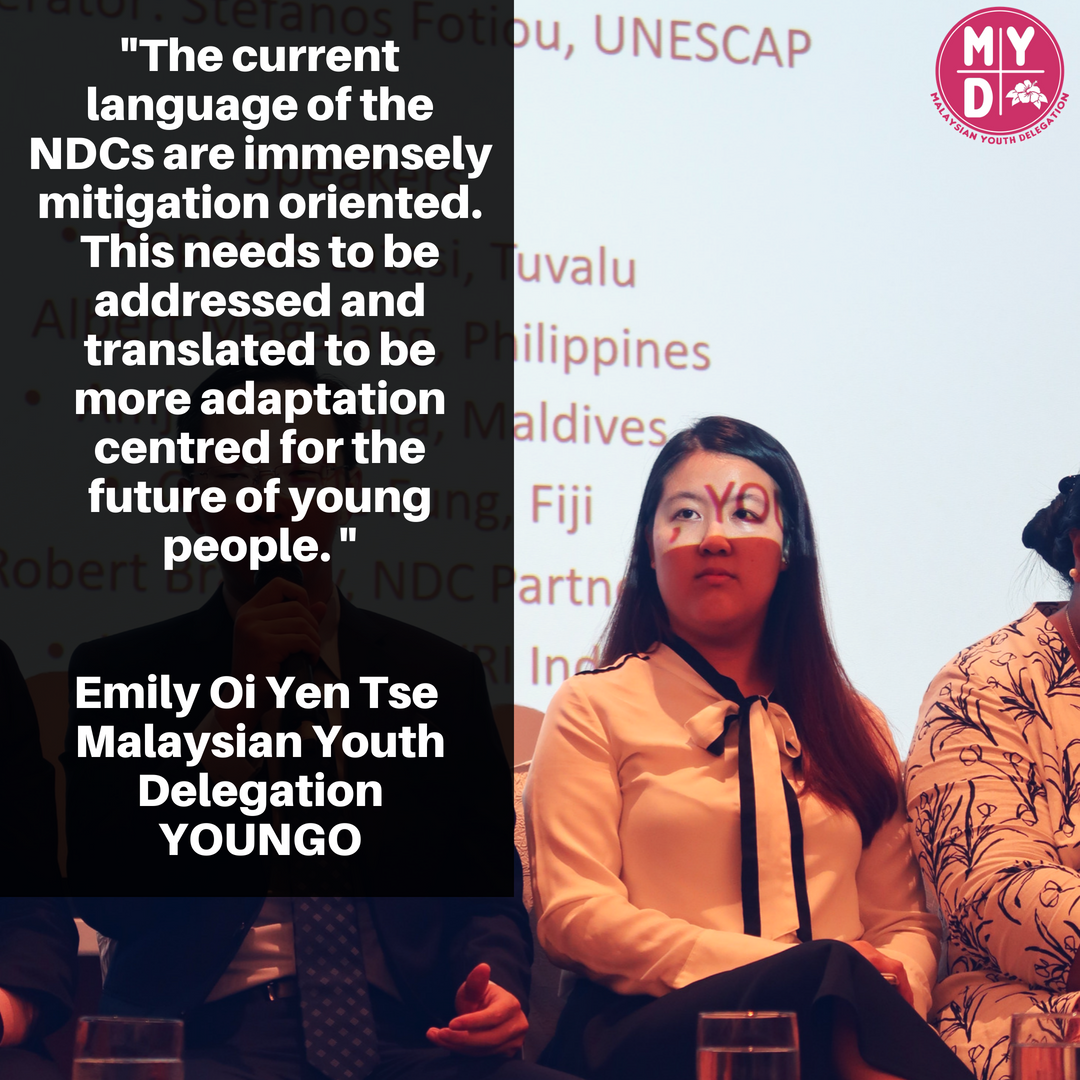
As I reached the event for the last day, Emily Oi Yen Tse from the Malaysian Youth Delegation and Youth Non-Governmental Organization of Climate Change (YOUNGO), was there to speak on a session that focused more on the National Determined Contributions (NDC) – Mr. Stefanos Fotiou and Emily stressed the importance of youth in combating climate change.
Mr. Stefanos asked: – “How many of you in this room were born at the end of the 60s or beginning of the 70s?” Sadly, the response showed that most of the participants in the room had raised their hand. He then said,
“For us who have raised our hands, we have completely failed to deliver a better planet to your generation.”
Emily then said: –
“The current language of NDC’s are immensely mitigation oriented. This need to be addressed and translated to be more adaptation centered for the future of young people.”
The final session ended with the Talanoa Dialogue on Green Financing with it’s main focus on the aspirations and what we are looking forward to at the 24th Conference of Parties (COP 24) in Katowice, Poland and the end phase of Paris Agreement. One of the panelists was our very own Nur Syahirah Khanum, an MYD member and representative of YOUNGO.
The topic got interesting after Steve Chao from Al Jazeera opened the session and the momentum of the session rose when the earliest carbon trader (1990), Frank Joshua and Dirk Forrester talked about carbon exchange and climate finance in the financing language. The heated session ended with Syahirah emphasizing her point regarding youth participation in climate change, especially in the climate finance context.
Syahirah Khanum said: –
“We (the youth) are here, and we are dedicated to make the Earth a better place.”
I caught up with Frank Joshua after the session and interviewed him regarding carbon exchange, the future of carbon exchange in the Asia Pacific region and the relation to the next financial crisis and how it would affect the carbon market. Deadly question for him indeed, yet, he did not break a sweat.
All of the MYD members gathered after the conference ended, had dinner and a short discussion at the Harbourfront Point Food Court before we left the island. It was the same routine going back to Johore Bahru – I would gladly remember this event seeing as my goals and objectives had been fulfilled.
Urgency of South-South and Triangular Cooperation to Combat Climate Change
Image courtesy of An Sionnach Fionn: Climate Change Deniers and Sceptics in Ireland
Asia Pacific Climate Week 2018 (APCW) happened in Singapore on the 11-13th of July 2018. The focus of this conference was on Business to Business (B2B), Business to Government (B2G), and Government to Government (G2G) – these were to enhance the green finance and effective implementation on Paris Agreement as we enter the second half of the year prior to 24th Conference of Parties (COP 24) in Poland.
For those who don’t know much about the focus in the Paris Climate Agreement, 195 countries signed a pact called the Paris Climate Agreement (Also known as Paris Accord) to combat greenhouse gas emissions, mitigation, adaptation and finance starting from 2020. The agreement was adopted by consensus on 12 December 2015. The Paris Agreement’s long-term goal is to keep the increase in global average temperature to well below 2 °C above pre-industrial levels and to limit the increase to 1.5 °C – this substantially can reduce risk and climate change.
Most of the public sector, private sector and government officials came to the conference with optimism and expected to contribute more for adaptation and mitigation purposes. It was an opportunity to share best practices and technological cooperation at the regional level and allowed engagement with interested stakeholder. This information is vital as we try to make Paris Climate Agreement goals successful by developing sustainably and giving a green comprehensive structure as a whole.
United Nations Framework Convention on Climate Change (UNFCCC) Executive Secretary, Patricia Espinosa stressed on to complete the implementation of the Paris Climate Agreement and dramatically accelerate climate ambition before 2020; she also added that this ambition should be reflected in the next round of National Determined Contributions (NDC).
“Climate Change is about more than just the weather or economy, of course. Climate Change is connected to almost every significant challenge humanity faces.”[1]
She mentioned, all of us need to cooperate at all levels on which focusing on more integrated and coherent approaches to meet outlines in Sustainable Development Goals. The businesses can play a complementary role as same as what North-South cooperation respectively.
For me, the beauty of this year APCW event was the introduction of high level technologies that came in, especially blockchain technology. I believe that this is one of the game changer to enhance more on climate change action in 21st century business canvas. A part of climate change as one of the focus in business sector, green blockchain technology has introduced a promising mechanism in the midst of technology efficiency. As optimistic as it may sound, I believe that on cooperation with full confidence to integrate adaption and mitigation at this level looks promising.
Government has to make a realistic stand on their own National Determined Contributions (NDC) before 2020 heads up on Paris Agreement’s goals.I suggest a committee on green finance to be set up and filled in with every sectors including non-governmental organizations (NGO), youth participation, government officials and business organization to create a short plan for climate exchange, and to create a realistic approach upon “Climate Integrated Framework” in Malaysia context.
[1] UNFCCC Executive Secretary, Patricia Espinosa (2018), Workshop South-South and Tech Cooperation, Asia Pacific Climate Week 2018, Singapore
A realistic view on climate finance and carbon exchange
Climate change and climate exchange in the world of finance. Picture edited from 88.5 WFDD and An Sionnach Fionn
The main topics focused on during the Asia Pacific Climate Week 2018 in Singapore were Climate Finance and Carbon/Emission Trading. Most delegates and even the speakers noticed that the conference was set on mitigation rather than adaptation in the climate change context.
For those who aren’t familiar with these two terms; mitigation focuses on an action to reduce the intensity of climate change, generally through reducing Greenhouse Gas (GHG) emissions. Mitigation measures are long-term actions to reduce GHG emissions, and are not an immediate cure for climate change (IPCC, 2007), with even climate exchange leaning towards mitigation.
Meanwhile, adaptation is an action to help individuals, communities, organizations and natural systems to deal with the consequences of climate change that cannot be avoided. It involves taking practical actions to manage risks from climate impacts, protect communities and strengthen the resilience of the economy. Adaptation can take shape as a gradual transformation with many small steps over time, or as a major transformation with rapid change.
Green finance involves financing national, regional and international entities for climate change mitigation and adaptation projects, as well as programs. Under Green Finance, a framework known as the Kyoto Mechanism, involved legally under the Kyoto Protocol, has established an outcome concerning the introduction of three market-based mechanisms; joint implementation, clean development mechanism and international emissions trading.
International Emissions Trading goes through six entities;
Carbon Emission/Greenhouse Gas (GHG) emissions as a product for exchange.
Carbon Credit: a permit which allows a country or organization to produce a certain amount of carbon emissions of which can be traded if the full allowance is not used.
Carbon Pricing: charges those who emit carbon dioxide (CO2) as part of their emissions or an amount that must be paid for the right to emit one tonne of CO2 into the atmosphere.
Green Bond: represents debt obligations — therefore, is a form of long term borrowing to fund green projects (in layman’s terms). Just like normal bonds, it allow investors to earn interest and to receive their principal back at maturity. Types of green bonds include the securities bond, “use of proceeds” bond, revenue bond, project bond, covered bond, loans and other debt instruments.
Carbon/Emission Trading: alsoknown as cap and trade;
The cap on greenhouse gas emissions is a limit backed by science. Companies pay penalties if they exceed the cap, which gets stricter over time.
The trade part is a market for companies to buy and sell allowances that permit them to a certain amount of emissions. Trading gives companies a strong incentive to save money by cutting emissions.
6. Carbon Exchange: a facility where brokers and traders are able to buy and sell carbon emissions, green bonds and other financial instruments. Stock exchanges may also provide facilities for the issue and redemption of such securities, instruments and capital events including the payment of income and dividends.
Three mechanisms introduced by the government for the industrial platform and social economics;
Carbon Tax: a fee imposed on the burning of carbon-based fuels (coal, oil, gas). Carbon tax is a monetary policy to reduce and eliminate the use of fossil fuels, which as a byproduct of its combustion continues to destabilize and destroy our climate.
Green Subsidies: a subsidy that contributes to reducing damage on the climate and environmental programs or by increasing the purchasing power for more green programs e.g. subsidies for public transportation.
Prior to the Asia Pacific Climate Week, I felt that the argument surrounding the event was baseless, while some points proved to be crucial. The involvement of a rating agency to assign ratings on the bonds and the market (especially the countries) was a good initiative – a precise move as it gave an advantage to the countries and companies to highlight their contributions towards combating climate change.
Although most of the climate warriors did not see this through, as it gravitates towards adaptation such as controlling livestock, adopting a vegan lifestyle in order to reduce meat consumption (because cows emit higher levels of methane), I believe that as a financier, my fellow finance colleagues worldwide have a right to take part in this process too.
The 2008 Global Financial Market was a catastrophic event to us all. At the same time, this event brought about a huge impact on carbon exchange, where the carbon exchange experienced a recession and decline, largely similar to the situation in the New York Stock Exchange.
In the midst of hardship, the monetary policy and public policy related to finance and climate change has evolved from time to time. As such, it has posed as a challenge for carbon exchange to rise from the abyss up until the last two years. The market itself has found its holy light again seeing as the market has started to be more active as of this year.
Frank Joshua from the Carbon Asset Group stated that;
Today’s market is getting stable despite it already being the year 2018 where the year should display a financial crisis according to the economic cycle, but yet again we are faced with a strong start over the past two years with most of the company seeing the value behind carbon exchange as compared to the year 2008.
Despite the carbon pricing in any carbon exchange beginning to increase rapidly, it does give confidence for the future climate change private budget in terms of loads of return earning investment. Financiers will start to see the value behind the new market that could benefit them as well as the social economical purposes.
I assume that the market will crash six years from now but by that period of time, the stock exchange worldwide would have recovered, thus allowing carbon exchange a fast recovery for the near future.
At the end of the day, carbon exchange and climate finance are not just for mitigation purposes. It helps to boost our circular economy and transform our social economics into more of a green coherent site while changing the pseudo-market into a more sustainable and yielding market.
It was the 26th of July 2018 and the Malaysian Youth Delegation met YB Yeo Bee Yin, the Minister for Energy, Science, Technology, Environment and Climate Change (MESTECC) in the Parliament. To know more about how the meeting fared, the members of MYD18 share their reflections.
Were we excited before the meeting?
But let’s hear from our members if they felt the same post-meet!
Can we really relate to the Paris Agreement?
Tan Cai May
Today the Malaysian Youth Delegation (MYD) met with Yang Berhormat Yeo Bee Yin, the Minister of the Ministry of Energy, Science, Technology, Environment and Climate Change. It was a great step forwards for the Malaysian Youth Delegation, but I found myself with more questions coming out from the meeting. At the core of it all, I felt the urgent need to revisit the purpose of international treaties, conventions, agreements, protocols and all of that, what is it that makes the collection of seemingly vague plans work in a complex world?
As an NGO, MYD’s main purpose is to provide a platform for Malaysian youth to talk about climate action within the context of UNFCCC negotiations and our country’s policy implementation process. The meeting with YB Yeo made me feel small, in the context of being a member of a youth-led organization, trying to figure out the complexities and realities behind taking climate action in the Malaysian society. In terms of UNFCCC’s efforts to facilitate measures taken against climate change, YB Yeo brought up the argument that real efforts of climate mitigation and adaptation take place on the grassroots level. Whatever was going on the international arena has always been a little too disconnected from what is happening on the ground. As she talked about Malaysia’s Paris Agreement ambitious commitments (and how she perceived that Malaysia’s monitoring numbers did not seem to add up), I saw the gap between the international pressure to deliver and actually making concrete progress. “There are only three ways we can go about this” she said. “It’s business as usual where we are meeting it but just on the surface (with) no hard figures, or we don’t hit our targets at all. Or we could have really aggressive actions.” She paused. “I have not decided which route we should take yet, we really need the data.”
She has a point. The international community are still gearing their way towards hammering down the agreement details; there is a need to progress on solid mechanisms in place for collaboration, technological transfer and capacity building in negotiations, and improve on the accountability beyond NDCs and self-reporting. Under the international climate regime, most countries have a realist outlook and they are not wrong for having so. YB Yeo mentioned that when interest groups demand for immediate climate action (i.e. decreasing fuel subsidies for lack of a better example), we do not go into the details of how much external benefits can be reaped in the long run as opposed to the temporary social costs that the rakyat has to bear. Politics come into play when pursuing a pro-climate action agenda. But how much should we risk in long term climate mitigation benefits for political stability?
It’s not so much of the realist argument for Malaysia in the international context, because we are not affected by mutual distrust. We (aka the Malaysian state) are not so much neo-mercantilist as we are protective of the rakyat internally. However, I believe that participating in the UNFCCC constituency has greater benefits beyond the high-level political handshaking. Liberal-institutionalist approach by means of co-operation have worked in the past to create effective environmental changes. Flashing back to the 1987 Montreal Protocol, the international community agreed to banning ozone-depleting chlorofluorocarbons (CFCs), motivated by the common desire for ecological protection. The move practically put a stop to the destruction of the ozone layer (and prevented subsequent UV-related disasters). The protocol would not have come into effect without large-scale collaboration to phase out CFCs and exchanged technological knowledge through shared management plans and the development of hydrofluorocarbons (HFCs). In fact, its cooperative legacy has given enough confidence that the international community are talking about phasing out HFCs under the proposed Kigali Amendment in effort to mitigate climate change.
However, I have to note that the stakes are different for the Paris Agreements goals of keeping the global temperature rise below 2 degrees Celsius by 2050. The Paris Agreements have started a new phase of the international climate regime, because the agreements depend on co-accountability, in a “naming and shaming” practice, strongly embedded in the principle of Common But Differentiated Responsibilities (CBDR). The new regime is birthed under the collective recognition of the importance of addressing climate change for a sustainable future, where the 179 parties have agreed to do something about it. Constructivism talks about shifting identities and interests based upon interactions with one another, and calling for and implementing collective action. But the Paris Agreements are still in midst of establishing collective action. It is challenging to establish trust on the international scale for cooperation, but I think it is even more onerous to have states implement and see through their commitments. I have faith that YB Yeo will be able to bridge the gap between negotiations on the international scale and relate back down to what she can deliver within the capacities of her Ministry. She stressed that for now, establishing the correct database will be the focus of her Ministry’s climate action plan. I hope to see that there will be action beyond measuring Malaysia’s carbon emissions, and proceed to the stage of translating international calls to action within Malaysia
Is climate change not a priority?
Nur Syahirah Khanum
#MalaysiaBaru is committed to making the people happy but not necessarily doing the right thing.
Malaysia’s chances to natural disaster such as earthquakes and volcano eruptions are not as high as those of our neighbours such as the Philippines and Indonesia. Regardless, we have to realise that our country’s coastline is prone to massive floods especially during the monsoon season. Considering these notorious floods Malaysia experiences every year and the hotter-than-usual days, these are the effects of climate change.
In regards, to the Paris agreement, Malaysia has defined their own contribution to address the climate change issue and according to our Nationally Determined Contribution, we are committed to reduce 45% of greenhouse gas (GHG) emissions intensity by 2030. Under the new administration, this commitment might be altered in the near future with heightened ambition.
Recently, with the MYD team, I had the chance to meet the minister of Energy, Technology, Science, Climate Change and Environment (MESTECC) Yeo Bee Yin. It was an enlightening meeting as I am starting to notice a pattern that emerged from various ministries from my brief exposure to the #MalaysiaBaru. Basically, the new cabinet is going through an expansive to-do list to reset their priorities. One thing for sure, their priority is to make the rakyat happy by fulfilling their basic needs. But of course, Malaysia wants more and as a progressing nation, we should have a set of aspirations that could direct us to progress.
As a youth advocating for climate change, it is slightly disheartening because the advocacy of climate change seems to not be a priority by the ministry. Democracy strives on participation of the public sphere, but participation will not happen when people are not aware nor bothered to do so. One way to make everyone learn that they are affected by climate change is to advocate for it as a government through introduction of necessary policies such as the carbon tax, or energy subsidy.
The lack of committed support among key decision makers on this particular issue is detrimental to the health of our planet and the lives of Malaysian citizens. Certainly, climate change is a whole-planet issue that is a burden to take on the shoulder. However, it can be broken down and addressed part by part and directed towards the bigger illustration of climate change to create an understanding and change of behaviour. After all, that is what the Paris pact attempts, to change behaviour through norm-building and consensus.
Saying “the government has many other priorities, and we have to choose carefully to allocate funds” will not create the norm that will drive behaviour change. In fact, it will train ourselves to think of it as the least problematic issue on the “priority list” and the behaviour change that will emerge within Malaysians is ignorance. We can learn from Bhutan with how they advocated for climate change through the project “Bhutan for Life”. Now, they are a carbon negative country. Yes, it does not directly make a huge dent in the efforts of mitigating climate change by reducing emissions in the atmosphere, however, it gives an avenue for nations to exemplify and explore possibilities to mitigate climate change.
Malaysia intends to be an economically robust nation with striving industries. However, without the proper execution, we will neglect the sustainability of these industries as well as the health of the planet. Good for Malaysia that we have a minister that is data and impact driven. At the meeting, Yeo Bee Yin reaffirmed that, in regards to climate change, she is committed to ensure legible mechanism of carbon accounting which will yield economic benefits for Malaysia. Currently she pressed that we do not have sufficient data to create a need for allocation of funds that will create impact. There are still a lot of studies and reviews that needs to be done to recognise the talent and the technology that will create a sustainable ecosystem. In her words, we will have to wait for her map to know the direction of Malaysia in the field of energy, science, technology, climate change and the environment.
It is more than just climate change
Liyana binti Yamin
Meeting the newly appointed Minister of Environment, Science and technology and Climate Change, YB Yeo Bee Yin today left me in a state of stillness thinking that I have to impact more people nevertheless and not be comfortable with the current state. My previous perspective has always revolved on following what the typical environmentalist would advocate for – which is for the sake of environment only. It is undeniable that humans have destroyed the environment negligently, but solving climate change will not happen overnight just because we say “Save the environment!” It is more than just climate change. We have people in the equation.
Now, knowing that YB Yeo is a realist, data driven kind of person with a back to the grassroot focus, I realised that grassroot solutions is also part of the important measure to be taken to educate people about climate agenda. Some with an English education background may be privileged to learn about climate change, but people from the rural areas may not have the same exposure as the urban areas. With the right level of investments and support, everyone should play a role in being inclusive of rural communities. It should be more than English to impact the grassroots. Bahasa Malaysia, Chinese language or Tamil should have been in the training series said YB.
Apart from that, another key point given by YB Yeo is to evaluate an environmental action. Do not simply ban something we dislike without proposing an alternative and think about the consequences. For instance, if we were to ban plastics, what would be the alternative for it and how will the citizens face the consequences without a plastic bag. There is so much more we can do for adaptation and mitigation of climate change. Strategically using the resource we currently have is essential to monitor our economic activities. Carbon accountings are part of her vision to keep track of what is happening to Malaysia. We should be more ambitious to ensure our impacts are measurable and targets are achievable. As it is, YB Yeo said that we have four global problem: energy, water, waste, and food security. Malaysia are prone to face a huge food security crisis as Malaysia currently imports food from abroad.
Reflecting back the meeting with YB Yeo, I felt that MYD has so much more to offer but our say was pruned away due to her inclination of justifying the needs of grassroot people. As if what I have been doing with MYD was pure waste of time. My spirit crushed. Thanks for the memorable impression, dear YB. Regardless, I still feel that MYD can improve better with a stronger vision. Hopefully, we learn from this mistake to be a stronger NGO in the future. Youth is the hope for the future, after all. Have faith, peeps!
I met Yeo Bee Yin
Jasmin Irisha Jim Ilham
She’s feisty. The Minister of Energy, Science and Technology, Environment and Climate Change is a force to be reckoned with. Equipped with beauty and brains, she is a data-driven person and speaks boldly based on verified facts and figures.
As a person who has been with MYD since 2016, my time has pretty much been invested in tracking climate change policies, organising training series for knowledge sharing and capacity building and communicating on the importance of climate change and youth involvement in climate change to people.
Previously, MYD has been engaging with the former government, the Ministry of Natural Resources and Environment, relatively closely, having been participating at COP since COP21 in 2015. We were familiar with how they operated, their stance on climate change approach nationally and internationally, as well as the key people involved from the ministry, including the former minister himself.
This time round, we didn’t know what to expect. One thing for sure is that we were certainly excited that for the first time, Malaysia has a Climate Change Ministry. For the first time, we thought that there was hope that climate change is being put high up on the agenda, as it is now part of the Ministry, not just a department in a ministry.
It didn’t take long for the hope to be slowly crushed. Lol.
As YB walked in the meeting room, we introduced ourselves and ran through briefly our presentation slides. There was one particular slide that caught her attention – the Fuel Subsidy Statement, that was written by Mike. The discussion kicked off from there.
“Removing fuel subsidies will not help with the climate change agenda, for the simple reason that Malaysia is a small country. Reducing carbon emission in Malaysia will not help the world, or make a dent on what’s going to happen – climate change is irreversible.”
“If you call for the government to reduce the subsidy, that is not going to help you to reduce climate change.”
Instead of removing fuel subsidies, she said that the first step to help curb the carbon emission is to have proper carbon accounting and monitoring system. Yes, improving the public transportation is important – but what is more important is the living quality for the people. “How do we price energy correctly?” is a better question.
These are the four steps that the climate change division in MESTECC will be doing:
Calculate carbon
Do up a plan
Monitor action
Introduce an Energy Efficiency Act (Milestone)
When asked about her plans in the Ministry in terms of Climate Change, she answered to not expect much, since she’s merely been in office for three weeks. She pointed out that there are a lot of plans in her Ministry, and that all of the plans are loosely monitored without close monitoring. She emphasised on measurable impacts, and said that, “If you don’t have an impact, whatever you do at UNFCCC is nothing. Must come back with an action.”
We had a 1 hour session with the Minister, and the Minister spoke for a good 40 minutes. It is clear that there are a lot of things that needed to be ironed out in the Ministry. It is also clear that climate change is not high up on the agenda just yet.
As for MYD, perhaps we went in the meeting unprepared, perhaps we went in the meeting without an objective. It is time for us as an organisation to rethink and re-strategise our approach with the Ministry – to reinforce the importance of upholding our commitments made in the NDC to the UNFCCC and the Paris Agreement. With the government and leadership in place, it is important for MYD to keep the promises made accountable, and contribute towards check and balance.
It wasn’t a good meeting and I felt a bit disheartened. But we are here to learn, and the next one will be better.
Challenges make us better
Mike Campton
The Malaysian Youth Delegation recently went into a meeting with Yeo Bee Yin, Minister of Energy, Science, Technology, Environment and Climate Change (MESTECC) in the hopes of engaging the new minister. But what does it even mean to ‘engage’ someone, especially a minister, who has a ton on her plate and part of a government with a strong reform agenda? Do we even know what engaging someone is supposed to achieve? Maybe, maybe not.
A combination of not knowing what to expect, inexperience, a new way of doing things by the government and our lackadaisical attitude led us to go into the meeting underprepared. While not disastrous, it was hard to pull positives from our meeting. From the outset, the meeting was a case of misaligned expectations. YB Yeo expected questions and a dialogue with us, while we had prepared a presentation to show off what MYD has achieved in the past three years.
I think our complacency set in as MYD came off a pretty successful streak. As an organization run by volunteers with busy lives, we had achieved a lot over the course of a year. We had grown in size, published statements in the media, participated in YOUNGO and CAN, traveled to COP23 and organized with other youths.
The thing is, doing all of this was relatively easy. To achieve all of this, we just had to put in the time and the work. It’s almost as if we had forgotten how it feels to be challenged. During our meeting with YB Yeo, we were just not up to the challenge.
While it’s easy to focus on regrets from a negative outcome, it’s better to identify the opportunities to be better. What’s done is done. My process over the last 24 hours has been to give myself space to feel regret, think of what we didn’t do well, accept that things didn’t go well because of our complacency, and try to figure out how to solve this. If we truly want to make an impact on climate action, we need to be great problem solvers.
So, as always, I like to list down what to do next. We brush ourselves off, we collect our thoughts, and we push on with our plans as usual. And the next time we get the same opportunity, we will be better and more prepared.
How do we do that?
First, we need to be aligned on and sure of our objectives. We need to come into meetings with one voice. Everyone on the team needs to be on the same page, and we need to do this far enough in advance to give us time to prepare.
Second, we set the agenda of every meeting according to our objectives, even if the meeting is not arranged by us. This allows us to cover the issues we want to cover – anything else discussed is additional to that.
Third, we need to do way more research on the most pressing issues we want to discuss, as well as on the issues the other party is concerned about. I always believe that with knowledge and data comes confidence. With confidence, we can defend our opinions and challenge other opinions.
On a personal level, this meeting has made me realize how invested I am in the organization. I find solace in the fact that I’ve found something I enjoy so much that I’m willing to put in the work.
So, from here we push on to Bangkok, where we will attend SB48-2. We’ll be sure to go there with strong objectives, put the work in and come back with measurable outcomes.
My reflection
Megat Deeney
The general conclusion with meeting with YB YBY was that it went less-than-perfect. Within the first 5 minutes there was already a discrepancy in expectation: YB YBY was expecting a dialogue rather than a presentation, and from her initial reactions seemed to enough about MYD to request skipping some of the slides. There is also the possibility that some of the content in the presentation (specifically the content related to Power Shift Malaysia) gave her the wrong initial impression of what MYD’s objective was when meeting YB YBY. A lot of the conversation turned to outreach and environmental awareness, which in vague terms is the overlapping areas of PSM and MYD. The lesson that I have learned from this is that MYD should present only the relevant parts it needs to. What was relevant was only gathered in hindsight.
Because there was a possible conflation between PSM and MYD, there is a chance that YB YBY now thinks MYD is a grassroots organization and outreach is our primary goal. This in turn has affected the chances the Ministry will provide MYD with badges for COP24. When the topic of MYD’s COP attendance came up, YB YBY gave no clear answer but did mention “giving other [organizations] a chance,” a statement which could be interpreted in many ways, many of which are not helpful to MYD’s goals of attending COP.
The topic of fuel subsidies and its reform/abolishment also came up. MYD’s statement was to end fuel subsidies and YB YBY’s response was that doing so would hurt the poorer citizens more than it would help save the environment. She mentioned that China and the US were the biggest emitters of CO2 in total and per capita, respectively, and that Malaysia’s change in fuel subsidy policies would affect very little of that. I would argue that such a mindset could lead to a Tragedy of the Commons problem with every other smaller country taking a similar stance, but such an argument would be beyond the purview of the conversation. As minister, it is YB YBY’s job to prioritize the citizen’s interest. It would also make sense to maintain the subsidy while the public transportation infrastructure is still being improved. Best case scenario would be that a well-functioning and efficient public transport system would render the fuel subsidy unnecessary.
The topic of public transport never came up but most of the other talking points that arose could be drawn tangentially to it. The idea of the fuel subsidy and a proper public transportation system are connected by one common denominator, which would be the poorer and more rural citizens of Malaysia. Fuel subsidies benefit the rich more than the poor because it makes an affordable resource cheaper, but its abolishment would hurt the poor more than the rich because the lack of alternatives for transportation make fuel a necessity. From that perspective it would make sense to maintain a subsidy until its abolishment would not have the same detrimental effect because of the change in circumstance.
As for Ministry’s role in fulfilling Malaysia’s NDCs in the UNFCCC, YB YBY claims that the Ministry needs to be “data-driven,” with whatever effects the Ministry achieves be both demonstrable and quantifiable rather than just the typical “ribbon-cutting” process of starting something, cutting a ribbon, and yelling ‘mission achieved’. What YB YBY means when the Ministry needs to be data-driven is that the math needs to be done within the Ministry for any of the progress to be quantifiable, and this would mean that carbon accounting would need to be a part of the ministry. Possible collaboration with other Ministry may be possible in the future but at the moment each other Ministry has their own fish to fry.
First time to the Parliament and meeting YB Yeo!
Adeline Ng
It was a super exciting day being my first time entering the Malaysian Houses of Parliament, as well as, meeting the Minister of Energy, Green Technology, Science, Climate Change and Environment, YB Yeo Bee Yin. At about 2.00pm we gathered to enter the Parliament with lots of mixed feelings – the feelings being excitement and nervousness. As the debate on Royal Address were happening concurrently, it was exciting to spot many other Ministers as we walked through the hallways of the Parliament.
During the one hour session, we spent a good time introducing MYD, touching on our objectives and outcomes throughout the years. It was then followed by a session on question and answers where we deep dived into her plans for Malaysia as she heads the ministry. As it is only her third week, she mentioned that a detailed plan is in progress and expected to be out in October 2018.
Here are a few items that her ministry would look at:
Carbon accounting
YB Yeo emphasized on how important it is to have proper processes undertaken to measure amounts of carbon dioxide emitted by entities like industries. Therefore, a focus area that her ministry will pursue is for proper carbon accounting to be in place. At the moment entities are only tracked based on economic activities. Unfortunately, actions do not justify the percentage of carbon emitted in a year and only gives a “feel good” feeling without much results. Hence, having proper carbon accounting would help to identify the activities that could bring the most impact in combating climate change. She has also shared that a baseline measure is required for tracking and monitoring of emissions by entities.
Proper implementation of roadmaps and blueprint
Speaking about tracking and monitoring, YB Yeo shared the significance of proper roadmaps and blueprint implementation. She touched on proper planning and policies where impacts are measurable. Most importantly, YB Yeo reminded us that when a policy is introduced, alternatives should be available for the ease of the people and also as incentive for the people to accept the policy. For example, if we would want to ban plastics entirely, there should be sufficient alternatives to it. Policy makers should also think of how will the policy be feasible, how much impact can it produce to save the climate and environment. In summary, as policy makers, we should have empathy to the people we represent.
Focus on adaptation and mitigation
YB Yeo also mentioned that as youths we should be ambitious and aim for a wider reach as there are a lot more to do to protect and improve the climate. My takeaway from her was to be prepared for the future as young leaders, for Malaysia to start focusing on adaptation and mitigation plans. She also shared some recent issues like Malaysian coastline protection and also the recent flood in Penang as examples of why adaptation and mitigation is vital for the country.
A New Hope?
Syaqil Suhaimi
Yesterday’s meeting with YB Yeo invoked mixed feelings of hope and renewed ambition for youths to further its involvement in the climate change conversation in Malaysia. What initially proved to be a misdirected dialogue between MYD and the Minister of Energy, Technology, Science, Climate Change and Environment with regards to MYD’s recently published statement urging the new government to end fuel subsidies led to the Minister vehemently defending its initiative, as well as questioning MYD’s stance, based on ‘pragmatism’ and the ‘needs of the Rakyat’.
The overall impression received from the whole dialogue indicated that this was going to be a completely different ball game compared to that of the previous Minister, Wan Junaidi Tuanku Jaafar. On top of having to re-establish relations with a Ministry which consists of climate change under its umbrella, as a result of the ousting of Barisan Nasional, there was a strong sense that much needed to be done for both parties – for MYD it would be to gain the support of the rebranded Ministry, especially after seemingly having started on the wrong foot, and for the Ministry itself, to put it as bluntly as possible, cleaning up the mess of the previous government.
Though YB Yeo had only been in the office for 3 weeks, she was adamant that her Ministry focus their efforts based on mitigation, adaptation as well as capacity building in tackling the climate change agenda. She had also made it clear that the Ministry will come up with the ‘correct’ carbon accounting method as it was suggested that calculations made by the previous government were incorrect, and that a monitoring plan be implemented to oversee the performance. Furthermore, it was suggested that the idea of increasing the nation’s renewable energy mix to 20% by 2025 (as suggested in the PH’s manifesto) may be out of reach, hence the idea of the energy efficiency act. Nonetheless, it should be noted that all these policies are still in the infancy stage of discussion, with YB Yeo indicating that come October, a plan will have materialised.
Based on the meeting, it goes without saying that our brand new Minister will have a lot on her hands, and it can be assumed that whatever plans the previous Ministry (Ministry of Natural Resources and Environment) had will not be upheld by her. Rather, YB Yeo seems intent on a new direction, a direction that is quantitative-driven, data-based and, supposedly, realistic.
Personally, and selfishly, I have to admit that one of the major qualms I had about a change in government was the idea that most Ministries (if not all), not just MESTECC, would have to start from square one. Yet, if it is true that the Ministry from the previous government was not effective in tackling the nation’s climate change agenda, then truly a new direction is what we need. However, only time will tell if such a step would yield a desirable outcome.
Sometimes breaking pragmatism is the way forward
Varunkanth Muralikanth
Have you felt crestfallen at yourself and others simultaneously? How can a simple meeting with the Climate Change minister shift the dynamics of thought? We went into the meeting with virtually no plan but came out with a much larger outcome – an outcome that persuaded us to be critical of ourselves as an NGO and YBY/ministry.
Starting off with the meeting itself, YB Yeo seemed slightly jaded, potentially due to her strenuous work schedule and dealing with a plethora of requests from various stakeholders, and this requires plenty of patience and virtue, which is commendable of her.
Upon completing our keynote presentation, the session was maneuvered to YBY’s interests and ideas rather than our suggestions – fueled partly due to our inexperience of meeting a newly elected minister.
The discussion on fuel subsidies consumed most of the time in the meet as YBY was outright disapproving of ending them. This was following the publishing of Mike’s statement on ending fuel subsidies in Malaysia. She commenced with the “developing country” rhetoric of how the population, especially the lower and middle income groups, would be affected and the industries shifting to other developing countries due to relatively higher fuel prices. She also pointed out that Malaysia was a far less emitter of GHGs as compared to countries like the US and China and hence fuel subsidies should be left unabated. In her words, removing fuel subsidies was not the best way take action against climate change.
Most of her arguments were undoubtedly rational and pragmatic but if we are going to be persistent with this frame of thought, and if other developing nations choose to compromise on the environment, the future only looks bleak. Malaysia’s annual CO2 emissions per capita accounts to about 8 tonnes, which is nearly on-par with many developed nations, and one of the poorest performing country in reducing its carbon footprint . Also, despite the country contributing to less than 1% of the global GHG emissions, it does not mean that we have the license to pollute. Malaysia has its own NDCs to be fulfilled and should ideally strive to be more ambitious with its targets – doing this would also set an example to the region and the world. Unequivocally, at the same time, it is the developed nations that ought to mitigate and be financially supportive to the developing countries.
Apart from all the commotion, YBY is a data-driven person, who looks out for quantifiable action in climate change, implying this to be the first step in making before climate mitigation and adaptation.
Overall, MYD could have been more critical within that one-hour period of meeting but it would be safe to say that we weren’t prepared to counter the pragmatic intricacies of the minister’s straightforward queries.
Despite the ministry designed to be working in a vertical policy integration setting (working in silos), which has its own set of drawbacks, we are unsure as to how the ministry needs to be dealing with their subsidiaries or its stakeholders. As YBY herself mentions, it would be best on taking the time and initiating a masterpiece rather than coming up hurriedly with a decision on their working plan.
The rendezvous had my mind glued within the premises of the meeting since it was a battle of pragmatism and climate righteousness. However, I am pretty confident that, if we are to meet the next time, both MYD and YBY would be in optimal positions to be conversing – only time will tell if that would be dramatic or pragmatic. Nevertheless, she might be having a plenty of things to be worrying about since we very well understanding climate change is to be looked at in a holistic manner.
On the first day of the Asia Pacific Carbon Week 2018, I attended a panel titled “Transport in Cities – Parties and Non-Party Stakeholders Working Together to Deliver Low Carbon Urban Mobility”. The panel was straightforward in its presentation, delivering technological solutions that have tackled urban mobility challenges. However, I found myself thinking about the core of change in the context of climate action throughout the session, something that many sessions failed to address during the APCW.
When we think about the main culprits behind climate change (I am talking sectors, not people), we think energy usage, food production, fossil fuel burning, etc. What we neglect to discuss are our everyday actions that drive the main climate change contributors. Climate action is a tough-sell because many people cannot relate to the subject matter as climate change implications take time to impact individuals directly. The lack of empathy is compounded by the call for climate action causing behavioral change. Who would want to give up the comfort of their air-conditioned homes to cut their carbon footprints down by a little? I say no way. But how would it be should policies catalyze the behavioral change? It would definitely be a different story because the population will then be motivated to make the most economic choices.
In the urban transportation context, the panel reaffirmed that good policy will make good changes. Cities hold a great density of everything – people, services, culture, economic activity, accessibility, and more. These elements that constitute a city are intrinsically linked. That is why city management is a grand task, because one policy always affects another. Some institutions and governments recognize cities as grounds (literally) for policy experiments. Take China’s pilot programs on carbon emission trading and London’s efforts in redesigning transportation corridors. None of them are guaranteed successes, but in return for risk, new policy strategies are unveiled.
Thinking in terms of the energy usage and the resulting emission in urban areas, transportation is a big driver of climate change. The transportation industry itself already produces approximately 23% of the global carbon dioxide (CO2) emissions from fuel combustion.[1] Although urban greenhouse gas (GHG) emissions fluctuate depending on population, density, infrastructure and stages of development, we can link city growth to increased transportation and increased GHG emissions. A 2009 World Bank study of seventeen sample cities have shown that the increased GHG emissions are linked to increased urban transport energy use.[2] In the Asia-Pacific region alone, urban areas are home to 60% of the world’s urban population.[3]Estimates have projected that the region’s urban population will grow to 1 billion people, or two-thirds of the region’s population. With a growing population, the demand for transportation increases because, as panelist Ms. Talya Romano from SloCaT put it “everybody needs to be at places and everybody needs to commute”. The questions that follow the phenomenon then become these: how can we scale up transportation and do it in a way that doesn’t amplify climate change contributions?
Mr. Mohamed Mezghani, Secretary General from the International Association for Public Transport (UITP) emphasized that traditional infrastructures for car usage cannot meet the growing demand of transportation, especially since the current management cost of infrastructure is approximately 10% of a nation’s GDP. He mentioned that this problem presents an opportunity to shift the traditional system of cars and decarbonize urban transport systems. Per population head, public transportation usage emits 30 – 40% less emissions compared to car usage. He listed compact planning and transportation development as a solution, but these are low hanging fruits. The real challenge to get countries to commit to low carbon development in the long term.
The discussion continued as Ms. Dechen Tsering, Regional Director of UN Environment in Asia and the Pacific, talked about the potential of climate action that comes with decarbonizing urban transportation systems. She mentioned that regional governance should take the opportunity to engage with more private and public companies and stakeholders to achieve Nationally Determined Contributions (NDCs). NDCs have important 2020 emission targets, and rethinking urban transportation acts as a well-established solution. Ms. Tsering called for more political will in translating clearer action plans and having concrete goals in getting to their NDCs. She gave an example of some Southeast Asian cities having measures to address the emission of black carbon particulate matters, but fail to engage with private sectors to hold them accountable and involve them in the effort to decarbonize cities. According to Ms. Tsering, cities need to think more in order to remain the level of ambition going forward with decarbonization.
Mr. Thani Ahmed Al Zeyoudi, the Minister of Climate Change and the Environment of the UAE, shared with the crowd some of the steps that the UAE has taken in supporting long term decarbonization of urban transportation. According to Mr. Al Zeyoudi, the UAE chose to concentrate on decreasing emissions of existing vehicles on the road. For example, they have rolled out new fuel-efficient public buses that have decreased carbon footprints. In addition, fuel prices and subsidies have been adjusted to favor fuel-efficient vehicles. As a country, they have also participated in South-South technological transfers. The ministry is currently engaged in project grants worth USD $30 million in a number of Small Island Developing States (SIDS) to build capacity on climate adaptation.
The panel’s private sector representatives, Mr. Eric Grab, Vice President of the Strategic Anticipation, Innovation and Sustainable Development at Michelin, and Mr. Sun Muqian, Chairman of TAILG, highlighted some of the roles their companies have played in moving towards NDCs’ urban decarbonization goals. Mr. Grab mentioned that his department is currently working under the Transport Decarbonisation Alliance (TDA), launched as part of COP 23’s Transport Day in 2017, to accelerate the transition to an overall net-zero emission economy. Michelin’s strategy is to identify and share best practices, develop synergies between the 3Cs (country, cities and regions), and advocate for transport decarbonization in high political level discussions. Mr. Grab highlighted that his department identifies market trends and economically viable projects to invest in, focusing on bringing suitable technologies to the market. On the other hand, Mr Muqian, whose company is based in China, highlighted the role of governmental policies in catalyzing green vehicles. TAILG is a UN Environment Programme (UNEP) partner, specializing in promoting electricity powered vehicles. They are currently operating their pilot programs in eight countries, of which three are in Asia (the Philippines, Thailand, and Vietnam). Among the ten solutions their company has put forward, they emphasize on streamlining guidelines of green vehicle transitions on the national level and local level. With the strong support of the Chinese government behind the rise of green technology in the past decade, it is no surprise that these are the solutions TAILG is advocating for, because the centralized focus works.
Ms. Talya Romano, the Chief Operating Officer from SLoCaT, closed the panel session with a strong message on sustainable transportation as the future. She calls to attention the need for cost-effective and accessible transportation. Climate change mitigation solutions today are marketed for people who can afford them. In order to achieve climate justice for the present and future generations, everyone should be able to make the most economic choices equally. Another message that Ms. Romano shared with the crowd was about cooperation. Civil society, NGOs and Academia are the people who know what we need and what we want. If there is a continuous gap between the government, private sector, and civil society, it would be difficult to reach the NDCs before the deadline. Ms. Romano turns to the scalable solutions and projects that have been tested and proven as of today, and reaffirms that we can make urban transportation convenient and sustainable. All we need is a little more willpower to set us off in the right direction.
Can Blockchain Save the Planet?
It’s 5:15pm, Day 2 of the Asia Pacific Climate Week (APCW 2018), and my brain has already hit a critical point of information overload. In the midst of sipping on black tea and recovering from a quick social media huddle, my colleague came over, pointed to his left and mouthed one word “blockchain”.
Blockchain?
What is that?
My curiosity peaked. After a quick skim of the program and feeling the caffeine creeping to my head, I found myself rushing to Virgo 2 (name of room) to attend a session that I knew nothing about.
Joseph Pallant of Blockchain for Climate
The projector displayed an impressive title, “Digitising Sustainability: Blockchain for Climate Action”, with a panel of six sitting in front of the screen. Mr. Joseph Pallant, the founder and executive director of Blockchain for Climate opened the session with a concise address on how blockchain can save the planet.
Blockchain, I learned, was a digital tool we could use to “perform rigorous projects and close the loop of turning stuff into offsets”. Being distant from developments in the technology sector, I took a quick trip to the google-verse to read up on the hype behind blockchain. Having scoured through at least ten separate sites, I do see how and why blockchain could save the planet.
Blockchain is a database that is constantly updated and verified by users, in a mutual distributed network. Data is stored as blocks and the blocks are chained each other, creating an ever-growing list.[1] The chains are a form of cryptographic measure, and each consequent block contains a timestamp and transaction data of the former block. The cryptographic hash means that network members can surveil the records, ensuring that the information shared is transparent.
Once the data in blocks have been recorded, they cannot be altered without the consent of network peers. What makes the technology reliable is its five principles – distributed database, peer-to-peer transmission, transparency with pseudonymity, irreversibility of records, and computation logic.[2] Since its launch in 2008, blockchain technology has been used as public ledgers for cryptocurrencies like Bitcoin, smart contracts, banking ledgers, and more.
According to Mr. Pierre Rousseau, Senior Strategic Advisor of Sustainable Business from BNP Paribas, the technology will revolutionize carbon trading because now the issuers, traders and brokers have access to same information, cutting out the middle man and allowing free market forces to act at full force. What the technology entails is the centralized systems like energy systems may no longer be beyond our reach. Having a blockchain market will give people a choice in their power sources. They may even sell their surplus power generated from their own roof-top solar panels.[3]
Jeffery Liu of Xarbon
Mr. Jeffery Liu, the founding partner of Xarbon Sustainability further elaborated on the importance of transparency in carbon trading. Like any market transaction, Mr. Liu explained, a unit may be double-counted and sold twice if we do not have visibility. Transaction can also be costly without the level of transparency blockchain offers because it requires due diligence and time. With cryptohash system, network peers are able to do their own due diligence. Having the right knowledge to correctly implement the system and build its infrastructure would not hurt either. For Ms. Deanna MacDonald, the CEO of BLOC, cryptocurrency in the blockchain system also offers “verified and valid assets that can be traded”, meaning that it has great liquidity.
So how does blockchain technology have a role in climate change mitigation? Now, the panel proceeded to let us in on the secret behind making climate action work – making the marriage between the UNFCCC standards and offset benefits work in our everyday lives. Turns out, mega projects are not hip anymore. All the resources and money could be better paid off when specialized and distributed to the masses.
Mr. Rousseau also mentioned that the future of climate financing will be ushered in by the support of climate action on a community level. In aggregate, small projects investors can be attracted and make a positive impact in climate action. An example would be facilitating clean energy trading between consumers. Consumers may conduct a transaction using digital assets within a market. The technology is also an improved carbon emission trading system, as mentioned before.
In China, IBM and Energy Blockchain Lab are developing a pilot platform to trade carbon assets.[4] Blockchain technology has also improved tracking of carbon credit transactions between companies and entities, as well as their emissions. With blockchains’ level of transparency, the technology may be used as a tool for the tracking and reporting of greenhouse gas (GHG) emissions, and even implemented as part of the Nationally Determined Contributions (NDCs) monitoring process.
On official terms, the UN Climate Change secretariat initiated the creation of the Climate Chain Coalition (CCC) during the One Planet Summit on 12 December 2017 in Paris.[5] The CCC aims to explore the potential of distributed ledger technology (DLT) and blockchain technology in facilitating climate action. Among the coalition’s principles and values, CCC members state their intent to align with the long-term goals of the Paris Agreement and the United Nations Sustainable Development Goals. The members’ charter also addresses collaboration, technology neutrality, standardization and dissemination of benefits.
However, there was no clear verbiage on supporting the mobilization green finance, especially on making the technology, incentives and solutions available to the hardest-hit communities. Sure, DLT and blockchain technology is a great way forward, but it does not provide a sustainable method to bridge the gap between the right solutions and delivering them to the right problems. However, I have to note that the panel was presented in the point of view where blockchain technology can be mobilized for offsets for mostly Annex I countries, particularly in the talk of blockchain being used in the future to monitor the International Transferred Mitigation Outcomes (ITMOs) that is listed Article 6.2 of the Paris Agreement.[6]
Deanna MacDonald of BLOC
That said, blockchain is still in its nascent stage and there are a number of obstacles in the way of becoming a ready solution. Ms. MacDonald mentioned that as an emerging technology, there are no real regulations on a global scale. There is also no single system to go with, and until the network has inter-operability, people will have to learn to navigate through different operating platforms. Ms. MacDonald also brought up a great point about disintermediation and avoiding, with the lack of better paraphrasing, the “crap in crap out problem”. As mentioned earlier on in the article, an advantage of blockchain technology is its ability to get rid of the middle man.
Contrary to that, Ms. MacDonald believes that the sources of offset projects are still the actors in the supply chain. The digital realm still needs to rely on eyes on the ground to source “products” and make sure that these “products” are well-integrated into the system for consumption, which brings us to the problem of capacity building. Mr. Liu adds on by saying that data can only be stored “trustlessly” when implemented properly, meaning that the system will still be imperfect because offline data still requires oracles.
For a new technology, its plans to tackle the Paris Agreement head-on seem to be ambitious – for most of the world does not have the technical knowledge and infrastructural capacity to mobilize their personal participation. When asked about actions that will generate most impact to change, Mr. Liu quips in that it is not entirely up to regulation but it is about behavioral change. He believes that the success of blockchain technology in climate action depends on how the technology is marketed.
Using the diamond as an anecdote, as long as blockchain is marketed as a premium tool that you have to be informed to access, consumers will want it. Ms. MacDonald responded by pointing to the market mechanisms to make blockchain a viable consumer case. “Money makes it happen” she stated.
As the panel wraps up, I was left thinking, was this just another promise plug? Seems like it. I was not convinced by the excessive optimism sprinkled on by the moderator’s closing remarks on blockchain bringing capital, resources, and information all together.
Combing through my notes, I came across an uncredited set of bullet points with the message from a panelist – “We need to be realistic. It’s going to take time, money, (and) dead ends. We need to go in to provide the proof. We have the responsibility to define the problem”. Perhaps that is what it takes for blockchain to be a verified solution – a little more time, money and proof.
On the third day of the Asia Pacific Climate Week 2018, the panels gave me an insight to job transitions moving forward in climate action! While I kid around with the introduction (my professors always tell me to write with a sense of style à la Pinker but practically), the panel was refreshing in a carbon forum packed with private and pitch-heavy sessions. The panel, moderated by Al Jazeera’s Senior Correspondent Steven Chao, discussed the socioeconomic implications as countries gravitate towards low emission sustainable development.
Economics 101 on labor discussed the different categories of unemployment – cyclical, structural, technical, seasonal, regional, classical, frictional, etc. Technical and structural unemployment are inevitable as industries make necessary changes to comply with new policy standards like energy compliances, and consumer behavioral shifts. Polish High Level Champion Mr. Tomasz Chruszczow called attention to the recognition of having just workforce transitions in the Paris Agreements, as noted in the preamble, Article 4.15, as well as 1/CP.21 and 11/CP.21. The main message was to make sure employees would be able to find decent work and quality jobs as changes occur. However, at the current pace of the Paris Agreements coming into reality, just transitions have not been addressed with a conceptual framework with action plans to account for the impacts on the workforce. Mr. Chruszczow reminded the audience as from panels before, that political buy-ins will be the tipping point for just transitions to happen.
Mr. Albert Magalang, the chief of the climate change division of the Environmental Management Bureau, Philippines, elaborated on the plans for just transitions. Addressing the new green jobs act, Mr. Magalang mentioned some of its salient features, which include offering decent work and building human capital, offering incentives to expand on relevant job skills, and emphasizing on active social dialogue in work spaces. Citing a recent overhaul of open-pit mining in the Philippines, the vulnerable workers are undergoing skill-expansion training to ease into related work fields. Similarly, Ms. Alysha Bagasra from the Ministry of Foreign Affairs and Trade, talked about New Zealand’s newly established Just Transitions Department. New Zealand’s government recently announced their goal to transition to a carbon-neutral economy by 2050. The Just Transitions Department will aim to ensure “no one is left behind” and that policies will be related to the Sustainable Development Goals (SDGs). She notes that the economic transition will definitely generate new opportunities but would take away others in the short term.
Representing the civic society, Mr. Shoya Yoshida, the General Secretary of the International Trade Union Confederation Asia Pacific, emphasized that social dialogue will be the key in the endeavor to ensure just transitions. Approaching the issue from a community basis has its benefits, for decision makers will be able to identify the key lacks and wants from employers and employees. Mr. Yoshida also offered an interesting solution, which is to change the social culture in workplaces. In traditional Eastern Asian workspaces, there is a hierarchical arrangement of team “tasks”. “What is important is that employers recognize creativity of worker, and listen to them.” Ms Pamela Mar, Director of Supply Chain Futures and Sustainability, Fung Management, agrees with needing a change in work culture. The manufacturing industry in Asia is all about being big, cheap and efficient. Ms. Mar mentioned that the industry is undergoing large scale digitization, having seen major workshops cutting down human labor, like downsizing from 14,000 to 250 personnel in 18 months in Thailand. She looks to data as an important tool in employment transitions. “We should be using data to pinpoint and identify important issues people face when undergoing work transitions”. Former workplaces need to give workers relevant skills, so that when they leave the workforce, they still have relevant skill-set to the economy.
When moderator Mr. Chao asked who should be responsible for the just transitions, the panel gave mixed responses. Mr. Yoshida responded that companies should be held responsible for the wellbeing of their workers. He also believed that governments should plan for policy shifts that will create incentives for private companies to transition to digitization and invest in employees. Ms. Mar expressed that incentives for private companies are important but not as important as “changing the dialogue” of the workplace. Going back to the topic of Asian work culture, she stressed that the space should be collaborative enough for creative solutions to be proposed and carried out. With no communication between managers and employees, the wants and needs of both parties will not be communicated well. In the end, workers will be at loss. She also pointed out the need to have a reform in education, so that workers can come out with transferable skill-sets. Ms. Alysha chimed in that private and public sectors should start planning now, because convergence of digitization, climate policies, emission cuts, and more are happening very quickly. “We need to plan, manage and be aware of things that we do not necessarily predict to happen.” Just transitions can only happen if we start building the capacity to absorb the impacts of change today.