![Why Is the Paris Agreement Significant?]()
by admin | Jul 17, 2016 | Knowledge, MYD2016


Excitement and joy during the final plenary session at COP21 in Paris! From Left to Right: Christiana Figueres, Executive Secretary of the UNFCCC, UN Secretary-General Ban Ki-moon, French Foreign Affairs Minister Laurent Fabius, President-designate of COP21 and French President Francois Hollande. Image was taken from: REUTERS (Stephane Mahe)
21st century began, with catastrophic remark of a series of natural disasters and it does not seem to cease. With each of every occurrence of force majeure, it is time to rise and put words into action. The Paris Agreement, is somewhat the silent prayer of environment, is finally heard. It is the collective and concurrent endeavors of 175 countries, echoing with nature’s outcry.
Some say that the Paris Agreement is the historic milestone of 21st century. It is the responsibility of stakeholders like nations and corporations, and the Paris Agreement guides us all with implementations of climate action. Paris Agreement marks the aggregate voice of most countries in the world, with mutual commitment of carbon reduction. Subsequent to the Conference of Parties 21 (COP21) held in Paris and the signing of Paris Agreement in New York, wheels are set in motion with Bonn Climate Change Conference in Germany which aims to further discuss on execution of Paris Agreement.
Many, including the foreign minister of France, Laurent Fabius acknowledges that the ambitious and balanced plan of Paris Agreement is a historic turning point in the goal of reducing global warming; United States’ secretary of state, John Kerry comments that Paris Agreement is the strongest and most ambitious climate pact ever negotiated. Mutual tracking system serves as a “check and balance” in fulfilling the commitment of nation towards Paris Agreement and nature as a whole; approval of financial initiative by Global Environment Facility Council helps the developing nations to effectively monitor and report their progress in reducing national greenhouse gas emission.
Paris Agreement serves as an inspiration. Paris Agreement seems to be zealous, high-reaching and even an eager beaver. However, it is the instrument that draws the cooperation of most countries in the world to commit to common good of human being. It urges the developed countries to have marginal profit and environmental preservation and restoration aligned; it sparks the developing nations that they are not alone in environmental protection and improvement.
Mutual confidence, common goal and equal endeavors are linchpin to not make Paris Agreement the second Kyoto Protocol. The question now is, are we ready? This is something for all of us to ponder upon.
Written by: Ooi Wan Mei (Charlotte)
Edited by: Nicole Lim Pei Pey
![What Is UNFCCC?]()
by admin | Jul 6, 2016 | Knowledge, MYD2016

UNFCCC. Image was taken from: http://unfccc.int/2860.php
United Nations Framework Convention on Climate Change (UNFCCC) is one of the three multilateral environmental treaties, which was signed at the Earth Summit that was held in Rio De Janeiro, Brazil in 1992. This has earned it the name of “Rio Convention”. Although its implementation had only begun on the 21st of March 1994.
The main aim of the UNFCCC is to ensure “stabilisation greenhouse gas concentrations in the atmosphere at a level that will prevent dangerous anthropogenic interference with the climate system.”1 Such levels should be achieved whereby the given period of time determined should account and be sufficient for the natural recovery and adaptation of ecosystems in response to climate change, the threats available to the production of food and the sustainability of economic development.
Also, the UNFCCC functions as a framework for the global collaborative efforts of countries in their pursuit of combating climate change. Furthermore, developed countries have to bear the responsibility of leading the movement. The UNFCCC also took precedence in setting measures to ensure rates of economic sustainability are balanced out by climate change mitigation. Thus, it has sparked the beginning of formal consideration for climate change adaptation in the world.

Message from UNFCCC Executive Secretary, Christiana Figueres. Image was taken from: http://unfccc.int/secretariat/items/1629.php
During the time of the Convention’s implementation in 1994, 194 countries have agreed to sign the UNFCCC signalling their acknowledgement of climate change as an international issue that is in need of cooperative efforts to overcome. At present, the UNFCCC enjoys near full international membership with 197 Parties who have ratified the Convention, whom are known as Parties to the Convention. Furthermore, the Convention is improved upon via the complementation of Kyoto Protocol that was ratified by 192 parties in 2002.
The treaty is the parent body of Kyoto Protocol. However, unlike the Kyoto Protocol in 1997, it is neither legally binding, nor does it possess mechanisms for enforcement. Decidedly, the mandatory limits on greenhouse gas emissions for Parties to the Convention are also absent in the Convention.
The Malaysian Youth Delegation (MYD) is a youth climate movement representing the youths of Malaysia under YOUNGO, a constituent within the UNFCCC. As such, members of MYD will be equipped with knowledge of the UNFCCC and have the opportunity to attend the COP (Conference of Parties) annually, address the plenary, High Level Segment of a COP/CMP, make submissions (individual youth organizations also), attend workshops, meet with officials of the Convention such as Chairs of the subsidiary bodies and the COP Presidency.
Written by: Yong Khye Lynn
Edited by: Nicole Lim Pei Pey
References:
1. UNFCCC 1992, NY
![New Direction and SBI Informal Consultation]()
by admin | Dec 5, 2015 | Blog, Knowledge, MYD2015, UNFCCC

Today is a brand new experience for me as I have accompanied Emily to lodge a police report on her lost phone instead of attending Conference of Parties (COP21). Might as well grab this opportunity to have a short city-visit.
When we arrived at Police Station near Gare Du Nord, it took us quite a while to communicate effectively with the police officer due to language barrier. The reporting process took longer than we have expected. Therefore, we have decided to pay a second visit in the evening. While rushing back to COP21 venue, I stopped by a vendor booth to buy a doughnut bun filled with custard cream. Even though it looked common, I will never forget the taste of my first bite. It was simply delightful and delicious! This makes me start wondering whether every Parisian is an expert baker.
We managed to rush back to COP21 venue and attended the Subsidiary Body of Implementation (SBI), informal consultation for national adaptation plan (NAP). As a yellow badge holder, I am grateful to attend this particular session. It was opened to both observers and parties. The session started with an opening speech by the co-chair. This was followed by other formalities whereby countries’ negotiators will agree to cooperate with co-chair to ensure every decision making process reflects honesty and straightforwardness.
The negotiation started to become intense when ‘Para 4’ Green Climate Fund was discussed. Based on the first version of draft decision, Green Climate Fund is only accessible to the Least Developed Countries (LDCs), Small Island Developing States (AOSIS) and African states. On the other hand, other developing countries which are moving towards sustainable development are not eligible for this funding. Countries from Global South and working group such as “G77 and China” raised their concerns about this paragraph and demanded for text revision. However, this issue has been postponed to the next meeting due to time constraint.
In my opinion,‘Para 4’ can be described as a deliciously sweet yet poisonous apple. The reason behind is if LDCs accept this temptful offer, it may weaken the bond and trust of ‘G77 and China’ working group. G77 and China was established in 1964 by 133 members (majority are LDCs) which aims to establish a common negotiation positions to promote their collective economic interest. It is undeniable that LDCs required great amount of fundings. However, without a strong coalition between developing countries, developed countries will WIN the battle as self-differentiation is less likely their main concern.
I think “Common But Differentiated Responsibilities (CBDR)” is one of the most crucial cornerstones of universal agreement. Developing countries would be able to achieve sustainable development with the receive of technology, finance and capacity building. In conclusion, I hope that all participated countries which fall under the convention are able to fulfil their obligations. Climate change is a global issue that need to be solved globally.
Written by : Thomas
Edited by : Ginger
![1 More Day to COP21]()
by admin | Nov 29, 2015 | Knowledge, MYD2015
Hello readers, believe or not COP21 will be happened in less than 24 hours ! Starting from tomorrow, more than 100 world leaders including Malaysia will negotiate on climate change’s issue. You can read our article on Road to COP21 Paris Background for more information on COP21. Wonder what Malaysia is doing to tackle climate change’s issue so far? Lets take a look Malaysia’s position on climate change.

one more day
Malaysian Position on Climate Change
Climate scientists agree that climate change is occurring and greenhouse gases emitted by human activities are the main reasons. Negative impacts and threats to ecological system, human health, Earth’s physical and economic are likely to be real if there is no mitigating actions are taken. Hence, during COP15, Malaysia has agreed to cut 40% in emissions intensity by the year 2020 compared to the 2005 levels. Malaysia has set up many emission reduction initiatives to meet the goal. Among Malaysia initiative is on renewable energy (RE).
Renewable energy is an energy obtained from natural resource such as biomass, hydro, wind, solar and geothermal that can be replenished. Renewable energy can be used as a replacement of fossil fuel in energy generation and using renewable energy instead of fossil fuel can reduce greenhouse gas emission.
Thus, Malaysia has launched the National Renewable Energy Policy 2010 to improve renewable energy’s development in Malaysia. The aim of National RE Policy 2010 is to enhance the utilization of indigenous renewable energy resources to contribute towards national electricity supply security and sustainable socio-economic development. This policy consists of five objectives that are:-
- (1) To increase RE contribution in the national power generation mix.
- (2) To facilitate the growth of the RE industry.
- (3) To ensure reasonable RE generation costs.
- (4) To conserve the environment for future generation.
- (5) To enhance awareness on the role and importance of RE.
In order to ensure the objectives of National RE Policy 2010 is achieved, five strategic thrusts have been identified as per below:-
- (1) Thrust 1: Introduce appropriate regulatory framework.
- (2) Thrust 2: Provide conducive-environments for RE businesses.
- (3) Thrust 3: Intensify human capital development.
- (4) Thrust 4: Enhance RE research and development.
- (5) Thrust 5: Design and implement an RE advocacy program.
Thrust 1 : Introduce appropriate regulatory framework
Renewable Energy Act has been launched on 2011 to support Thrust 1. The Act is to provide establishment and implementation of a special tariff system (Feed in tariff system) to catalyze the generation of renewable energy and to provide for related matters. The act consists of a feed in tariff system, connection, purchase and distribution of renewable energy, feed in tariff, renewable energy fund, information gathering powers, enforcement, general, savings and transitional.
In the same year, SEDA Act 2011 also launched. The act is aimed to provide for the establishment of the Sustainable Energy Development Authority Malaysia (SEDA Malaysia) and to provide for its functions and powers and for related matters.
Thrust 2 : Provide conducive-environment for RE businesses
The conducive environment would include the provision of :-
- Creation of an evaluation process for lending to RE power producers.
The standard evaluation process will be set up by trained renewable energy financing team. Mandating the evaluation process can be undertaken by Bank Negara Malaysia. The evaluation is to provide added security to the financial institutions in lending to renewable energy power generation projects. As a stand-by provision, the government offer financial assistance, estimated RM500 million to renewable energy power generation firms that are unable to secure any funding.
- Continuation of existing fiscal incentives
Existing fiscal incentives will be continued until 2019. Meanwhile, an evaluation of the incentives’s relevance and usefulness to firms will be undertaken over 4 years from renewable energy law enforcement. The evaluation is to determine if any revisions on the fiscal incentives are required or not.
- Special fiscal reliefs to use locally created/developed R&D
Special fiscal reliefs will be given to firms that adopt and use locally created or developed R&D for renewable energy. The special fiscal reliefs are:
- (a) Group tax relief – so losses in one subsidiary can be used to offset the profits in another; and
- (b) Double deduction of the costs of the local innovation or R&D in RE technology used
4. Local content incentives
Incentives will be given to renewable energy manufacturer that use local material in their finished products and component. The incentives would be double deduction on local material for domestic manufacturer and for foreign manufacturer that use more than 50% local content, the incentive would be 2 years tax holiday extended or the grant of 2 years tax holiday.
- Create an RE Centre for SMEs
The RE Centre focus on providing information about renewable energy project to SMEs and assisting SMEs to participate in incentive programs.
- Involve GLCs and specifying their RE contribution by using their existing renewable energy resource for renewable energy power generation or demonstrating their renewable energy projects and technologies.
- Involve existing MNCs like IKEA, Western Digital, INTEL and others to engage in renewable energy activities and to influence local suppliers to do likewise.
Thrust 3 : Intensify human capital development
There are three actions under Thrust 3 which are:-
1) Collaboration amongst ministries to design certifying renewable energy technology courses at a local institute of higher learning and also training centers.
2) Increase the development of training institutes that meet international renewable energy training standard and also development of centers of excellence (CoE) at universities.
3) Provide technical training subsidy and fiscal relief for higher education. The subsidy and fiscal relief valid for renewable energy course only.
Thrust 4 : Enhance RE research and development
The focus of renewable energy research and development is on innovation as innovation enhances the diffusion of renewable energy technology by making the technology cheaper and easier to use. Several research that have been done are wind mapping, geothermal study and mini hydro map.
Thrust 5 : Design and implement an RE advocacy program
The advocacy programs under Thrust 5 are an awareness program and the commissioning of independent evaluations published locally or engaging third party public sector bodies to organize workshops, discussion forums, seminars or case studies or even public hearings, briefings or consultations. The programs consist of two phases. Phase one is to provide information and phase two is to encourage participation from the target audience. Each phase is tailored to specific target audience with specific messages. Target audience is divided into eight categories that are public, schools, banks, GLCs/MNCs/Public listed companies and large enterprises, SMEs, regulatory bodies, the third sectors and government agencies.
Overall, Malaysia is already aware on climate change issue and hence, Malaysia has implemented a variety of programs to cut down emission as in the renewable energy sector. Other than emission reduction in the renewable energy sector, Malaysia also focuses on sustainable waste management, eco-tourism, eco-city, energy efficiency and others. However, Malaysia still need a support in technology and financial to further improve on climate change related issues.
Reference : Malaysia National Renewable Energy Policy
Author : Fatiha Zainal , June 2015
by admin | Oct 28, 2015 | Event, Knowledge, MYD2015, UNFCCC

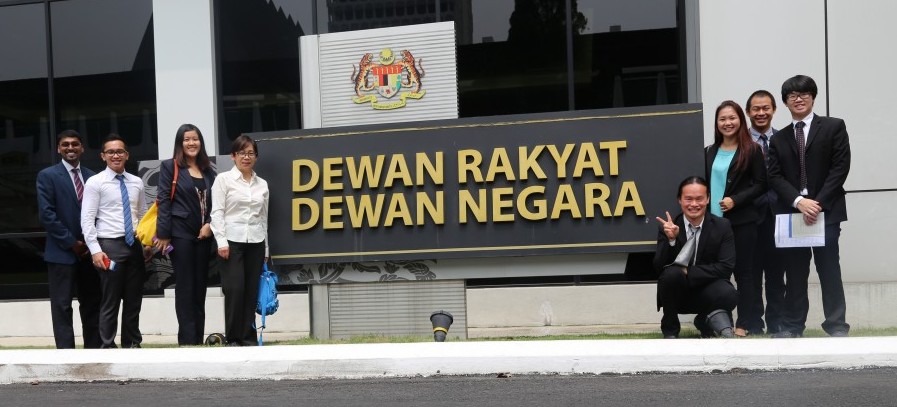
Mesyuarat Parlimen Dewan Rakyat
Semua pelawat ke Parlimen diberi taklimat mengenai peraturan asas sebelum memasuki Dewan Rakyat. Para pelawat perlu menunduk kepada Yang di-Pertua Dewan Rakyat semasa memasuki dan meninggalkan Dewan; sebagai pemerhati pelawat tidak dibenarkan menyoal ataupun mengambil bahagian dalam perbincangan dan perbahasan.
Sesi Soal Jawab Parlimen hari ini bermula pada 10 pagi sehingga 11.30pagi. Pembentangan tentang agenda yang telah dijadualkan mengambil tempat dahulu dalam bentuk soal jawab. Hanya ahli parlimen atau Member of Parliament (MP) yang terlibat dalam agenda-agenda tersebut diminta menghadiri mesyuarat. Dalam proses soal jawab, kita memerhatikan suasana parlimen agak hangat disebabkan ejekan antara MP.

Selepas itu, perbahasan tentang usul bajet 2016 dimulakan. Didapati banyak rombongan lain yang melawat parlimen pada masa yang sama. Oleh itu, setiap rombongan hanya dibenarkan untuk mengunjungi parlimen dalam giliran sepanjang 30 minit. Malangnya, rombongan kita tidak sempat memasuki parlimen sekali lagi semasa perbahasan tentang bajet kerana tempat duduk pemerhati telah dipenuhi. Selain itu, pihak media mempunyai ruang khas di luar parlimen untuk mereka menyaksi dan melapor persiaran langsung mesyuarat parlimen. Kita berpeluang menyaksikan satu persidangan media yang dianjurkan oleh pihak pembangkang.

Sesi makan dan perbualan dengan YB Ong Kian Ming
Kita bertemu dengan YB Ong Kian Ming untuk sesi perbualan. YB Ong adalah MP kawasan Serdang dan juga jurucakap alam sekitar bagi parti DAP. Beliau memberi informasi ringkas kepada kita tentang kementerian-kementerian di Malaysia yang terlibat dalam perubahan iklim and alam sekitar, iaitu Kementerian Sumber Ali dan Alam Sekitar (NRE), Kementerian Tenaga, Teknologi Hijau Dan Air (KeTTHA), Kementerian Pengangkutan, Kementerian Perdagangan Antarabangsa dan Industri (MITI), dan Kementerian Kesejahteraan, Bandar, dan kerajaan tempatan.
Sepatutnya NRE merupakan kementerian yang bertanggungjawab untuk memimpin dan meyelaraskan sebarang perbincangan tentang alam sekitar dan perubahan iklim antara semua kementerian, tetapi keadaan sebenar bukannya sedemikian. YB Ong menerangkan bahawa alam sekitar dan perubahan iklim masih bukan keutamaan dalam agenda nasional. Interaksi antara kementerian yang tidak cekap juga menyebabkan perancangan dan pelaksanaan kurang memuaskan.
Selain itu, YB Ong menyatakan pandangan beliau tentang penyerahan INDC dari kerajaan Malaysia. Oleh kerana Malaysia merupakan negara yang hampir mencapai status negara maju, kita perlu memberi komitmen yang lebih tinggi daripada negara membangun yang lain. Saya setuju pada pandangan tersebut bahawa Malaysia sepatutnya melakukan lebih banyak secara sukarela tetapi bukan bergantung semata-matanya kepada permindahan teknologi dan kewangan dari negara maju.
YB Ong menawarkan nasihat kepada MYD bahawa kita perlukan bacaan dan penyelidikan yang lebih menyeluruh terutamanya maklumat tentang konteks Malaysia. Dengan ini, kita akan jadi lebih yakin tentang soalan atau isu yang sesuai dan penting untuk dinyatakan kepada pasukan rundingan Malaysia di COP21.
Laporan disediakan oleh Emily Oi (MYD15)

by admin | Oct 25, 2015 | Knowledge, MYD2015, UNFCCC
Oleh WanJi (MYD15)
Memandangkan saya terpaksa mengikuti kursus yang berkaitrapat dengan kajian akademik pada akhir tahun ini, dukacita dimaklumkan bahawa saya tidak dapat menghadiri Persidangan Pertubuhan Bangsa-bangsa Bersatu Perubahan Iklim (COP21) di negara Perancis yang berlangsung dari 30 November sehingga 11 Disember 2015. Meskipun demikian, sebagai seorang delegasi belia negara (MYD), saya mempunyai peranan-peranan tertentu yang harus dilaksanakan. Peranan-peranan yang telah dikenalpasti adalah seperti berikut:

WanJi, kedua daripada kanan
Pertama sekali, sebagai salah seorang delegasi yang berpusat di tanah air sepanjang persidangan tersebut, saya harus membantu memastikan hubungan komunikasi yang berterusan dan stabil daripada pihak kami di ibu negara dengan rombongan wakil delegasi ke negara Perancis sepanjang berlangsungnya persidangan selama dua belas hari itu.
Cara perhubungan yang paling mudah dan berkesan dalam peringkat antarabangsa adalah melalui perkhidmatan internet terutamanya laman media sosial, e-mel dan panggilan video. Cara-cara yang dinyatakan ini bukan sahaja efektif malah percuma dan sekaligus dapat menjimatkan bajet delegasi-delegasi.
Selain itu juga, delegasi-delegasi di Malaysia harus aktif memainkan peranan dalam membuat liputan langsung tentang persidangan COP21 dan juga menyebarkan perkembangan tersebut kepada masyarakat umum. Wakil-wakil delegasi di Paris sudah tentu kepenatan dari menghadiri persidangan, ulang-alik dari tempat penginapan ke tempat persidangan dan juga kemungkinan besar menghadapi cabaran dalam menyesuaikan diri di kawasan baru yang mempunyai budaya, bahasa, cuaca, suhu dan zon masa yang berbeza.
Tambahan pula, mereka dijangka akan sibuk membina silaturahim dengan individu-individu serta persatuan-persatuan yang berpengaruh atau berserasi dalam bidang perubahan iklim dunia. Sememangnya persidangan global yang berprestij seperti COP21 merupakan peluang keemasan untuk wakil-wakil dari negara kita untuk menambah kenalan dari seluruh dunia terutamanya mereka yang berkuasa, dan berpengalaman agar dapat membina peluang untuk bekerjasama kelak.
Akhir sekali suatu peranan yang wajib dipegang oleh setiap delegasi belia termasuk saya pada setiap ketika tanpa mengira apa jua aktiviti, adalah ‘belajar’. Saya harus membuat pemerhatian terperinci dan mempelajari sebanyak yang mungkin daripada persidangan tersebut. Dengan cara ini, secara tidak langsung, saya juga dapat menimba pengalaman yang berharga dan menaiktarafkan pengetahuan diri sendiri. Ini akan memanfaatkan MYD dan diri saya juga pada masa akan dating. Moga-moga, saya akan menjadi delegasi yang lebih bersedia untuk menghadapi persidangan yang serupa pada masa akan datang.


