by admin | Oct 13, 2015 | Event, Knowledge, MYD2015, UNFCCC

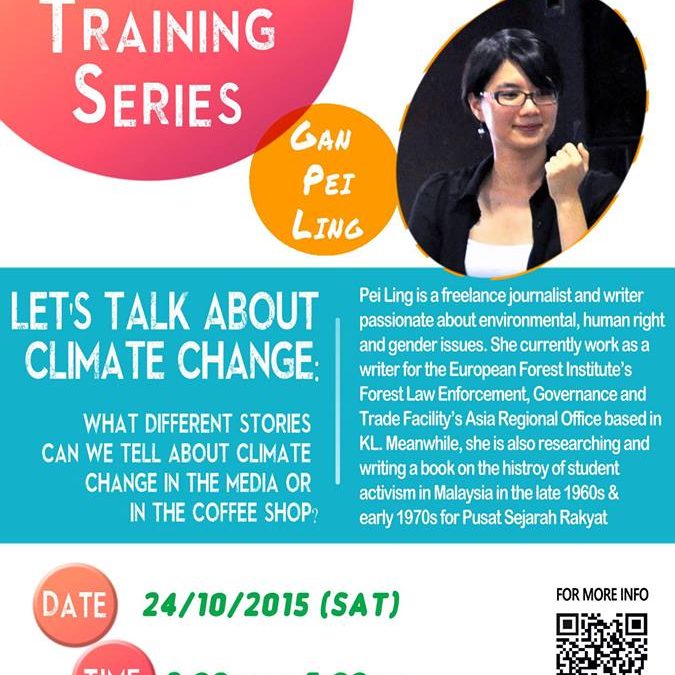
Title: Let’s talk about climate change: What different stories can we tell about climate change in the media or in the coffee shop?
Date: 24 October 2015, Saturday
Time: 3.00pm – 5.00pm
Location: BAC, PJ Campus, Block 1, 1st Floor, Room Colchester
Trainer Profile:
Pei Ling is a freelance journalist and writer passionate about environmental, human rights and gender issues. She currently works as a writer for the European Forest Institute’s Forest Law Enforcement, Governance and Trade Facility’s Asia Regional Office based in KL. Meanwhile, she is also researching and writing a book on the history of student activism in Malaysia in the late 1960s & early 1970s for Pusat Sejarah Rakyat.
As a journalist, she has written for the National Geographic News, The Nut Graph, Selangor Times and Focus Malaysia. She has an MA in Environment and Development from King’s College London and a bachelor’s degree in journalism from UTAR.
#MYD Training Series – Training on UNFCCC negotiations and media work with various climate experts, government bodies and civil society leaders, from July until Nov 2015. Each sessions will run for 2 hours and will be broadcast live on Google Hangout. Hangout will be available on YouTube for future reference. http://powershiftmalaysia.org.my/myd-training-series/
#MYD – Malaysian Youth Delegation – Malaysian youth climate movement at international United Nations climate conferences, UNFCCC, participants will be mentored and hold engagements with various climate expert bodies and dialogue with Malaysian policy makers and negotiators.http://powershiftmalaysia.org.my/category/myd2015/
by admin | Oct 6, 2015 | Knowledge, MYD2015
By WanJi (MYD15)
Perkataan “alam sekitar” mempunyai asal usal dari bahasa Perancis : “environner” yang bermaksud “untuk meliputi”. Sepanjang masa manusia mempelajari tentang alam sekitar, pelbagai pengertian untuk terma ini telah diutarakan, baik daripada pakar saintis terkemuka mahupun para sasterawan.
Pengertian yang dipilih adalah bergantung kepada penggunaannya ataupun bidang kajian yang ingin dibincangkan (MoSTE, 1998). Misalnya dalam artikel ini, alam sekitar merujuk kepada semua jenis keadaan, pengaruh, sekeliling dan organisma semulajadi yang menyelubungi populasi manusia. Oleh itu, alam sekitar boleh diklasifikasikan kepada dua aspek iaitu biotik dan abiotic (Hezri & Dovers, 2006).
Aspek biotik merangkumi spesis-spesis hidupan haiwan, tumbuhan dan microorganisma manakala aspek biotik pula termasuk suhu, cuaca, kelembapan, kadar kimia tanah dan lain-lain lagi. Alam sekitar harus dikendali dan diurus dengan baik dan bijak agar mampu membawa manfaat kepada manusia dari segi produk langsung ( balak, hasil laut, hasil tanaman, dan lain-lain) atau dalam bentuk sumbangan perkhidmatan ekologi yang menampung kehidupan semua spesis di muka bumi.
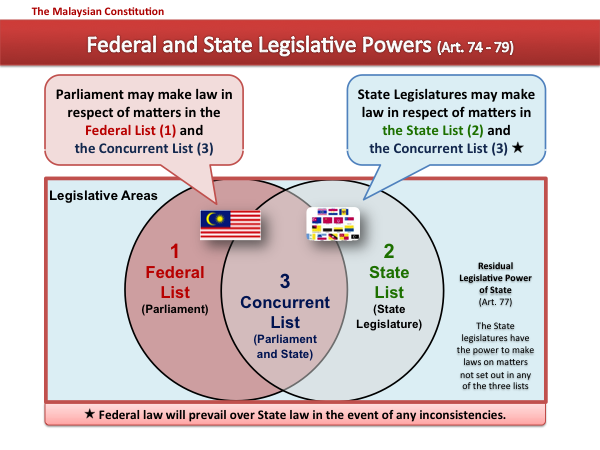
Artikel ini akan membincangkan sedikit sebanyak mengenai halangan yang sukar dielakkan dalam pengurusan alam sekitar kesan pengamalan sistem federalisme dalam pemerintahan negara di mana terdapat pemisahan kuasa di antara Kerajaan Persekutuan dan Kerajaan-kerajaan Negeri (Wee,2011). Dalam perlembagaan Malaysia, pembahagian kuasa antara kedua-dua peringkat kerajaan tersebut jelas tercatat dalam senarai persekutuan, senarai negeri dan senarai bersama (MoSTE, 1998).
Aspek-aspek pengurusan alam sekitar yang efektif melibatkan tiga aspek yang utama iaitu aspek pengurusan, perancangan dan pengawalan. Aspek-aspek ini dapat dibahagikan seperti berikut (MoSTE, 1998):
- Struktur Organisasi Kerajaan.
- Perundangan Alam Sekitar.
- Perancangan Alam Sekitar : Kaji-Selidik
- Penggubalan polisi-polisi dan strategi pengendalian alam sekitar Perancangan gunatanah dan kawalan Penilaian Kesan Persekitaran (EIA – Environmental Impact Assessment)
- Kawalan Pencemaran dan Penguatkuasaan.
- Penyertaan dan Kesedaran Awam.
Meskipun keenam-enam aspek yang dihuraikan mustahak dan harus diberi perhatian bersama, wujudnya halangan daripada pemisahan tanggungjawab oleh dua peringkat kerajaan. Ini disebabkan aspek-aspek tersebut terbahagi dibawah dua kuasa kerajaan yang berlainan peringkat (Hezri & Dovers, 2006) Hubungan Kerajaan Persekutuan dengan Kerajaan Negeri yang diikat melalui perlembagaan negara seringkali terjejas dengan keperluan kerajaan masing-masing untuk menampung kepentingan bersaing. Ini semakin rumit apabila kerajaan-kerajaan negeri ditadbir oleh parti politik yang berbeza daripada kerajaan persekutuan (Hills et al, 2013). Contohnya selepas pilihanraya awam 2008, kerajaan persekutuan membuat pembaharuan kepada sistem peruntukkan pembiayaan pembangunan yang menganak-tirikan empat buah negeri yang ditadbir oleh parti politik Pakatan Rakyat (Kedah, Kelantan, Selangor, Pulau Pinang).

Perjanjian pelbagai hala alam sekitar, kewangan, cukai, pendidikan, kaji selidik dan penyelidikan serta polisi-polisi yang berkaitan dengan alam sekitar secara umunya merupakan bidang kuasa kerajaan persekutuan, namun perkara yang berkaitan soal gunatanah untuk pertanian, pengurusan hutan, sungai, terusan, perlindungan penyu dan perikanan adalah tertakhluk di bawah bidang kuasa Kerajaan Negeri (Wee, 2011). Walaupun cara penyelesaian yang paling jelas adalah dengan usaha integrasi dari kedua-dua kerajaan namun dalam beberapa dekad ini, usaha tersebut masih kurang dilihatkan, malah badan-badan untuk menyepadukan kedua-dua kerajaan ini juga tidak kelihatan (Hills et al, 2013).
Dalam kajian kes pertama, negeri Kelantan yang ditadbir oleh Parti Islam Semalaysia (PAS) semenjak tahun 2008 menerima peruntukkan yang berkurangan daripada Kerajaan Persekutuan. Untuk meningkatkan pendapatan negeri, kerajaan negeri Kelantan telah menggandakan pengusahaan hasil hutan dan tahun 2008 menandakan pembalakkan di kawasan hutan yang dibenarkan yang paling tinggi dari segi keluasan per segi. Ini jelas mempamerkan bukti-bukti konkrit yang menyimpulkan bahawa alam sekitar mendapat impak negatif apabila kerajaan negeri yang kekurangan peruntukkan membuat keputusan untuk menjana pendapatan melalui sumber alam sekitar (Hills et al, 2013).
Dalam kajian kes yang kedua, kerajaan negeri Selangor dan kerajaan persekutuan mencetuskan konflik yang merencatkan pengurusan salah satu sumber alam kitar yang paling penting, iaitu air (Hezri & Hassan, 2004). Asset air merupakan tanggungjawab dalam senarai bersama. Di bawah Akta Industri Perkhidmatan Air 2006, agensi kerajaan persekutuan dibenarkan memperoleh segala aset yang berkaitan dengan perkhidmatan air dan aset-aset tersebut akan dipajak semula kepada operator industry air. Ini bertujuan untuk mengurangkan beban kewangan kerajaan negeri untuk membiayai pelaburan asset perkhidmatan air yang sangat tinggi nilainya (RMK-1o, 2011-2015). Namun pengendalian perkhidmatan air terencat apabila kedua-dua belah kerajaan mempunyai pelan yang berbeza dalam pengstrukturan semula perkhidmatan air sehingga terjadinya persengketaan yang membantutkan kerjasama kedua-dua kerajaa terbabit (Hezri & Hassan, 2004).
Penyertaan dan kesedaran awam merupakan aspek yang sangat kritikal dalam pengurusan alam sekitar. Ini adalah kerana alam sekitar adalah milik bersama dan setiap ahli masyarakat harus mempunyai kesedaran dan penyertaan dalam usaha memelihara dan memulihara alam sekitar. Dalam suatu kajian yang dilakukan oleh WWF-Malaysia, daripada 6090 orang responden, 3475 orang (57%) tidak mempunyai kesedaran mengenai isu-isu alam sekitar seperti banjir kilat , jerebu, dan lain-lain lagi (Hills et al, 2013). Mereka tidak mempunyai pengetahuan tentang fackor berlakunya kejadian-kejadian tersebut atau cara-cara mengatasinya. Lebih menyedihkan, kajian yang sama turut menunjukkan bahawa responden yang mempunyai kesedaran tentang alam sekitar tidak semestisnya menunjukkan sikap yang positif terhadap alam sekitar (Hills et al, 2013).
Sikap masyarakat umum yand kurang peka terhadap isu-isu alam sekitar amat memerlukan kempen kesedaran, pendidikan serta sokongan yang kuat dari pelbagai pihak. Namun peranan mendidik dan memberi kesedaran kepada masyarakat umum mengenai isu-isu dan penjagaan alam sekitar dipikul oleh badan bukan kerajaan (NGO) seperti WWF- Malaysia, Malaysia Nature Society (MNS), dan lain-lain lagi. Sebab-sebab kedua-dua kerajaan kurang memainkan peranan dalam aspek kesedaran awam dibandingkan dengan NGO tidak dapat dikenalpasti. Namun tanpa penenkanan dan penyertaan sepenuh hati dari pihak kerajaan, pendidikan mengenai alam sekitar mungkin dianggap remeh atau tidak penting oleh masyarakat setempat (Hills et al, 2013).
Kesimpulannya, dasar pemisahan pentadbiran antara kerajaan persekutuan dengan Kerajaan Negeri seringkali merumitkan pengurusan alam sekitar, lebih-lebih lagi apabila melibatkan parti politik yang berbeza. Kepentingan politik menyebabkan kedua-dua peringkat kerajaan menghadapi cabaran untuk bekerjasama. Kerajaan secara umumnya lebih cenderung kepada kegiatan ekonomi dan isu peruntukkan kewangan merupakan isu yang sensitif dan sukar diramal. Pengendalian alam sekitar pula memerlukan kos yang tinggi dan tidak memberikan pulangan dalam bentuk kewangan dalam jangka masa pendek (Hezri &Hassan,2004). Meskipun demikian, masih terdapat harapan untuk sistem pengurusan alam sekitar yang lebih telus dan efektif untuk negara ini.
Rujukan:
Hezri,A.A. and Dovers, S.R. (2006) ‘ Sustainability indicators, policy and governance: issues for ecological economics’, Ecological Economics, 60:86-99
Hezri, A.A. and Hasan M.N. (2004) ‘Management framework for sustainable development indicators in the state of Selangor, Malaysia’, Ecological Indicators, 4:287-304
Hill, H., Tham Siew Yean, and Ragayah Haji Mat Zin (2013) Malaysia’s Development Challenges: Graduating from the Middle. Routledge Publisher.
Malaysia (2010). Rancangan Malaysia Ke-sepuluh (RMK-10), 2011-2015. Kuala Lumpur: Percetakan Nasional Malaysia Berhad
MoSTE (1998). National Policy on Biological Diversity. Kuala Lumpur: Ministry of Science, Technology and Environment.
Wee, C.H. (2011). Federal-State Relations in Natural Resources Management. dlm. ISIS (pnyt.). Malaysia Policies and Issues in Economic Development, 559-576. Institute of Strategic and International Studies (ISIS).

by admin | Oct 2, 2015 | Knowledge, MYD2015, UNFCCC
In preparation for the adoption of the Paris Agreement in December 2015 Governments “in a position to do so” were to submit an “Intended Nationally Determined Contribution” (INDC).

ASEAN countries INDC for COP21
 |
Singapore – “Singapore communicates that it intends to reduce its Emissions Intensity by 36% from 2005 levels by 2030, and stabilise its emissions with the aim of peaking around 2030.” (WRI) |
 |
Indonesia – “Indonesia has committed to reduce unconditionally 26% of its greenhouse gasses against the business as usual scenario by the year 2020…Indonesia is committed to reducing emissions by 29% compared to the business as usual (BAU) scenario by 2030.”
Conditional target: “Indonesia’s target should encourage support from international cooperation, which is expected to help Indonesia to increase its contribution up to 41% reduction in emissions by 2030.” (WRI) |
 |
Thailand – Thailand intends to reduce its greenhouse gas emissions by 20% from the projected business-as-usual (BAU) level by 2030. The level of contribution could increase up to 25%, subject to adequate and enhanced access to technology development and transfer, financial resources and capacity building support through a balanced and ambitious global agreement under the United Nations Framework Convention on Climate Change (UNFCCC). |
 |
Cambodia – offered to cut its GHGs by 27% below 2010 levels by 2030, adding that it expects to receive help finance through bilateral and multilateral mechanisms. (CP) |
 |
Laos – Did not set an overall target, but listed a number of projects it would carry out on the condition it received international support, including increasing forest coverage, boosting renewables and implementing transport-focused NAMAS. The projects would cut around 1.8 million tonnes of CO2e annually. (CP) |
 |
Myanmar – “Myanmar would undertake mitigation actions in line with its sustainable development needs, conditional on availability of international support, as its contribution to global action to reduce future emissions of greenhouse gases. The document also presents planned and existing policies and strategies which will provide the policy framework to implement identified actions and prioritise future mitigation actions.” (WRI) |
 |
The Philippines – Pledging to cut by 70% its carbon emissions by the year 2030, conditional on assistance from the international community. (Rappler) |
 |
Vietnam – pledged to keep emissions 8% below BAU levels over 2020-2030, but could increase the target to 25% with appropriate funding. Reductions would be made by cutting carbon intensity and increasing forest coverage. Vietnam adopted a green growth strategy in 2012 that foresaw linking up to the international carbon market. (CP) |
 |
Brunei – “Energy sector: to reduce total energy consumption by 63% by 2035 compared to a BusinessAsUsual (BAU) scenario; and to increase the share of renewables so that 10% of the total power generation is sourced from renewable energy by 2035. Land Transport sector: to reduce carbon dioxide emissions from morning peak hour vehicle use by 40% by 2035 compared to a business as usual scenario. Forestry sector: to increase the total gazette forest reserves to 55% of total land area, compared to the current levels of 41%.” (WRI) |
 |
Malaysia – Malaysia intends to reduce its greenhouse gas (GHG) emissions intensity of GDP by 45% by 2030 relative to the emissions intensity of GDP in 2005. This consist of 35% on an unconditional basis and a further 10% is condition upon receipt of climate finance, technology transfer and capacity building from developed countries. |
|
|
|
|
by admin | Aug 14, 2015 | Knowledge, MYD2015
Wanna Stop Climate Change?
Let’s Learn about UNFCCC
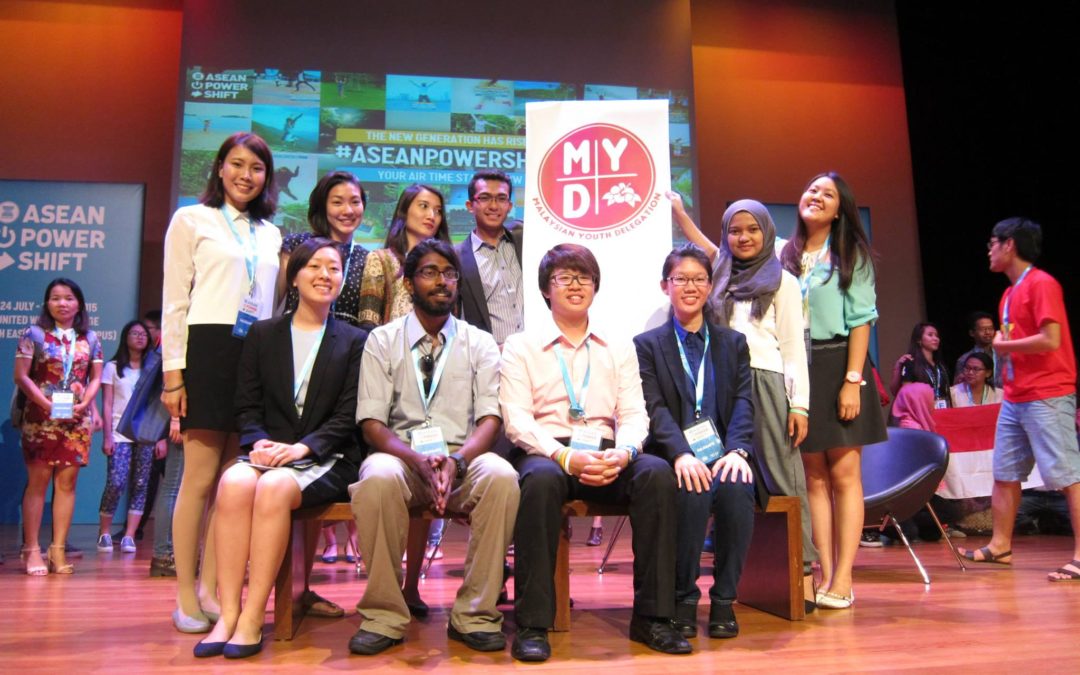
Two months ago, we have recruited and formed the ‘Malaysian Youth Delegation – MYD’ to the upcoming UNFCCC COP21 in Paris end of this year. To find out who they are, click here. #MYD15
Besides aggressively fundraising for the flight and cost, MYD is going through avigorous training regime. The delegation’s tasks include researching and producing informative articles, participating in a ‘mock’ policy negotiation and conducting series of trainings.
 One of the strategy of MYD is share the happenings during the COP21 by reporting back to Malaysia. This is done by writing articles, explaining what is happening, to our audience back home. MYD members have to produce monthly articles, part self-learning and part educating our readers. To read their artices and to learn more about UNFCCC, click here.
 Getting hands-on or learning on the job, is the best way to soak up experience. MYD have recently participated in a ‘mock’ regional policy statement drafting. After hosting the nationwide online survey, MYD negotiated on behalf of Malaysian youth, upholding our national interest while injecting ambition into the text. It was indeed a fruitful learning experience for all. Read on their journey, click here.
 Nothing beats hearing from the experts. MYD Training Series is designed to host climate experts to share on related topics with the youth delegation. The trainers line-up includes, Malaysian negotiators, IPCC scientist, Guardian’s list of top youth climate activist, NGO leaders and media specialist. This training is free and open to the public. To join or see the full list,click here.
At UNFCCC COP 21 in Paris, MYD aims are to:
- Represent the youth climate movement of Malaysia
- Hold our leaders accountable for their actions and pledges
- Pursue justice for those suffering the effects of climate change
- Act in solidarity with frontline communities in Malaysia & across the globe
- Seek solutions to one of the biggest challenges humanity has ever faced
The structure of the campaign and delegation will be in three primary tracks:
- Media: maintain our online social media presence, craft MYD newsletter during COP, write press release template, pitch delegation stories to larger media outlets, track media hits
- Mobilization: train delegates for how to plan actions in the UN Space, coordinate with other action planning hubs,
- Advocacy: tracking policy development in the UNFCCC, train delegates in advocacy aspects of the UNFCCC and the MYD support strategic policy engagements for the delegation through lobbying and other associated efforts.
Leading up to COP21 we’ll have members of the delegation, who are experienced in fundraising, support others through the process of personal fundraising. If you have more questions or concerns about the financial aspect of COP21, please feel free to reach out to us (powershiftmsia [at] gmail.com).
by admin | Aug 7, 2015 | Blog, Knowledge, MYD2015
Equipped with the knowledge and resources, humans continue to advance themselves using the help of all kinds of technology. Similarly, in the fight against climate change, we have resorted to technology in hopes to rectify this critical situation. Nonetheless, we need to remember nothing is entirely good and viceless. In other words, there are pros and cons to everything.
In this article written by Roxanne Low, she prompts us to think about the seamless BECCS that might not be so flawless,
Considering our option using BECCS
By Roxanne Low (MYD15)
All these while, humans have been using science to their advantage to develop various technologies to improve lives. Activities that were carried out in the name of development and advancement have led humans to do onto mother earth what cannot be undone. As a result, the inhabitants of the earth, including ourselves, are left to face with the adverse impacts of global warming and climate change such as increasing Earth’s average temperature, rising sea level due to the melting of permafrost and changes in amounts and patterns of precipitation. Today, the current carbon dioxide gas concentration in the atmosphere is alarmingly at 50 parts per million (ppm) more than what is considered the safety amount (at 350ppm) “to preserve a livable planet” (350.org). Fortunately for us, in our battle against climate change, scientists and researchers have made a new technology called the Bio-energy with Carbon Capture and Storage (BECCS) available to us.
What is BECCS and how does it work?
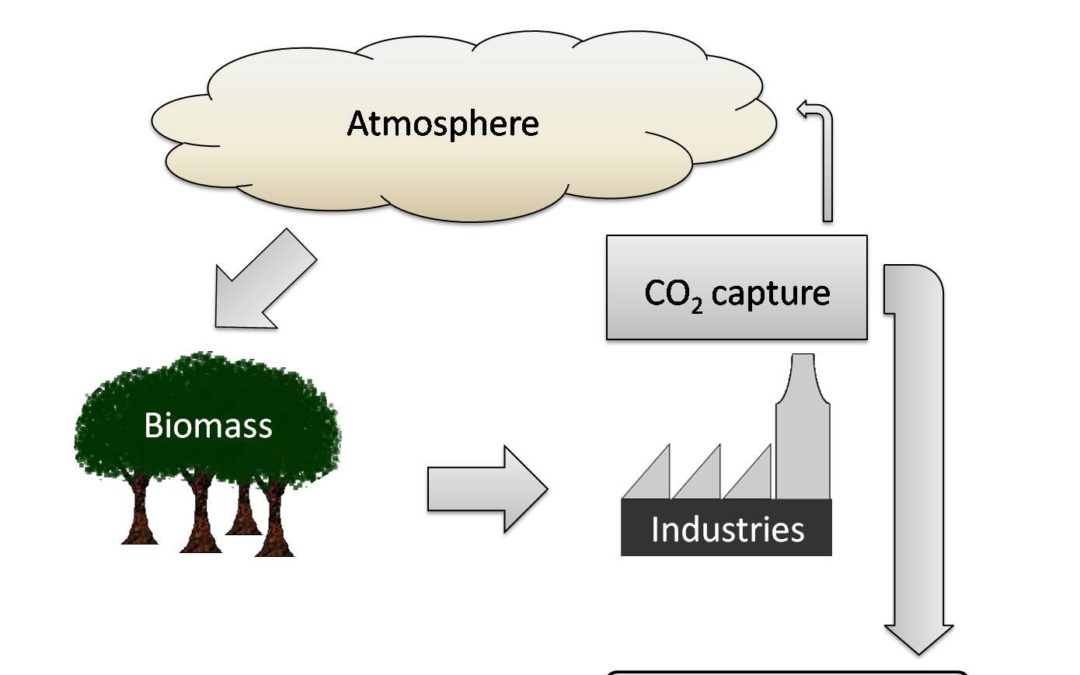
Some believe that BECCS is a brilliant technology for it would allow us to permanently remove carbon dioxide from the atmosphere. With this system, we can resolve the issue of having high CO2 ppm. According to an article published by the DailyMailUK, the logic behind BECCS is quite simple; the agricultural crops which absorb CO2 from the atmosphere will be burnt in a power station to generate energy. Then, the resulting emission from the burning of these crops will be captured by the BECCS plant and stored deep underground. Therefore, “the combination of bioenergy with carbon capture is a carbon reducing technology that can achieve net removal of carbon dioxide from the atmosphere. This is a significant advantage over other [climate change] mitigation alternatives.” (As stated in an online publishing by International Energy Agency, 2014)

Photo Credits by http://biorecro.com/?page=about_us_press
Go BECCS!
In the Intergovernmental Panel on Climate Change (IPCC) 4th Assessment Report (AR4), BECCS received much special attention because of its potential to supply energy with negative emission which in simpler terms means that greenhouse gas carbon dioxide is permanently removed from the Earth’s atmosphere. Since then, many governments have been exploring the option for BECCS as a technology that could play a role in the energy and climate policy. This can be seen through the efforts of the International Energy Agency (IEA) that organized various workshops in corporations with other institutions and experts to seek opportunities and challenges for developing BECCS in countries like Indonesia and Brazil. Furthermore, seeing that this system require a plant to store carbon emission underground, countries with gas wells and coal mines such as Britain can easily convert these into storage facilities to test out BECCS.
Today, in the faith that this newly invented super technology is the way forward as a key climate mitigation option, the governments of USA and Canada has run it on a small scale in their countries. Nevertheless, for the Carbon Capture Storage (CCS) system to be effective, it needs to happen on a large scale.
Flipping the Coin
While there seem to be great potential in the BECCS and CCS in general, there have been critics who urge that we consider both sides of the coin carefully. The the goodness of this technology can easily mask the shortcomings, but if BECCS is brought to a larger scale, the possible adverse impact would surely take a toll on our environment.
In a recent article, published by the ETC Group, it was suggested that despite what BECCS seems to be, a supreme technology, it is unlikely to save us from climate change. Few important issues that were raised by critics to dispute the concept are as follows:-
- Where would billions of tonnes of captured carbon be stored? The likely destination would be “enhanced oil recovery” techniques, increasing, not decreasing, the flow of fossil fuels that cause climate change.
- To reduce overall CO2 by 1 billion tons using BECCS would require a landmass of 218-990 million hectares of land which is 14-65 times as much land as the US uses to grow corn for ethanol. This would require landgrabbing on an enormous scale.
- BECCS proponents assume that 10 billion tonnes of wood can be harvested per year without any carbon from soil or ecosystems escaping into the atmosphere. And yet, land use change and emissions from soil are widely acknowledged as leading drivers of climate change.
- Today, the only schemes that are labelled as BECCS extract CO2 from biofuels such as ethanol, tying this scheme to their many associated problems, starting with land grabs and food price hikes.
- Would the hundreds of billions of tonnes of stored carbon leak into the atmosphere or pollute local ecosystems?
A country with geology, climate policies and skills and has also been a strong supporter of renewable energy, Germany does not fancy CCS. In fact, Jochen Flasbarth, the state secretary at Germany’s federal environmental ministry told New Scientist that buried CO2 is seen to be as bad as nuclear waste.
As a counter argument to the critical issues brought up by non-supporters of BECCS, it is that in this time of urgency, any possible solution should be given a chance to be tested. In order for us to keep the hope of keeping the increase of global temperature less than 2°C, active investigation of different technologies is greatly needed.
BECCS or No BECCS
The reason for considering various points of view is to have a more holistic judgment towards an issue. It may be justifiable that the advancement of our technology should be taken advantage of, but due underlying uncertainties that could be present in regards to “the life-cycle toxicity of some capture solvents, the operational safety and long-term integrity of CO2 storage sites, and the risks associated with CO2 transport via dedicated pipelines” (DailyMail UK, 2014), the discussion on “BECCS or no BECCS” still remains debatable.
Whether or not this ingenious technology thrives, perhaps the other approach to mitigate climate change on the grassroots level could be the awareness-raising of individual carbon footprint. The fight against climate change is not only the responsibility of large institutions and countries’ governments but every single individual’s effort to reduce carbon emission by simply a change in lifestyle. Always remember that small changes can go a long way to protect our planet Earth.
Other Resources:
- https://www.iea.org/publications/freepublications/publication/bioenergy_ccs.pdf
- http://www.tyndall.ac.uk/sites/default/files/twp147.pdf
- http://www.etcgroup.org/content/will-unicorns-save-us-climate-change-beccs-wont
by admin | Aug 5, 2015 | Blog, Knowledge, MYD2015
If you ask people, how does one increase his wealth? A logical answer you will get is to make investments and multiply your wealth. But wait, you have to be careful in what you invest in order to earn those big bucks! Not only for the sake of earning money, but also for the care of planet Earth.
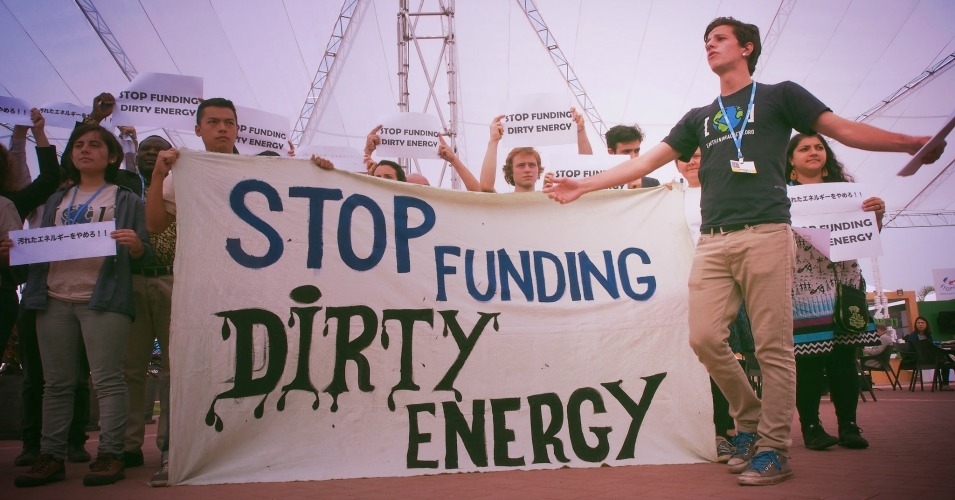
Start now, join the Divestment Movement, it is still not too late! Stop letting fossil fuel companies continue to destroy your habitat. Make intelligent investment in clean and renewable energy rather than dirty fossil fuel. Since you are investing your money, you have the power and choice to make good investments.
Presenting.. an article by Pit Yuen on joining the bright side for a better and more promising future.
Join the Divestment Movement!
By Chok Pit Yuen (MYD15)
Divestment movement is a campaign rooted in US campuses to advocate various institutions and individuals from everywhere to pull out their financial investments (in term of stocks, bonds and investment funds) from fossil energy (coal, gas and oil) related firms which deemed to be the major contributor of Carbon Dioxide (one of the greenhouse gases), in order to tackle climate change issue. Now, the movement has spread across many parts of the world especially in Europe, with a record of $50bn divested so far, according to US Fossil Free campaign. More than 220 institutions (namely universities, faith organizations, local authorities, pension funds and foundations) have now committed to divest from fossil fuels since the launch of the climate campaign in 2012 by 350.org. In this instance, Fossil Free lists 837 institutions and individuals as having committed to divesting.

Photo credits by tcktcktck.org
350.org (which included power shifts movement at local levels), led by Bill McKibben, is one of the pioneer organizations that is greatly dedicated in global climate movement. They launch online campaigns, grassroots organizing and mass public actions to boycott the assets and programmes of fossil energy related companies, implant awareness of climate change to world citizens, and create the solutions that will ensure a better future for all. They also aim to reduce the amount of carbon dioxide in the atmosphere from its current level of 400 parts per million to below 350 ppm.
Quakers and Glasgow University are among the first in Europe to commit to fossil fuel divestments, in the meantime Oxford University has ruled out direct investment in coal and tar sands, hence, this movement is considered the fastest growing divestment campaign in history. The movement correspondences including the heirs of Rockefeller in withdrawing the fossil fuel investments ($60m) in the $860m Rockefeller Brothers Fund, joined with 800 global investors pledging to divest from fossil fuels in September 2014. In April 2015, the Guardian’s parent company, Guardian Media Group said it would divest its $1bn fund from all fossil fuel.

Photo Credits by www.commondreams.org
This movement might not able to concur discernible financial pressure, as in the case of Divestment movement against Apartheid of South Africa, but non-financial impact by shaping public discourse in climate change and energy security, therefore trigger the growth of renewable energy (wind, solar, biofuels, biomass, hydro and geothermal). In a long run, the movement should make sure all those committed are accountable to their commitment and follow up actions must be implemented.
On the other hand, Divestment Movement must realize that fossil fuels still play a crucial part in 21st energy mix policy especially in various industrial sectors, being the most economical and efficient energy option. This is the main argument from Third World Countries where the standard living of huge populations are below poverty line. The other applicable approach is install CO2 catchment mechanism at the output ends, in order to reduce release of CO2 into atmosphere.the developing and least developed .The more realistic and applicable approach to achieve minimal usage of fossil fuels is Energy Mix Policy, whereby fossil fuels are crucial in industry sectors especially in logistic and machinery In logical sense, fossil fuel is one of the essential parts in 21st century energy mix policy, especially in logistic of industries and commercial sectors as well as transportation.
The latest (5th June 2015) and biggest divestment movement made by Norway’s Parliament has endorsed the move of selling off coal investments ($8bn) from its $900bn sovereign wealth fund, which will affect 122 companies across the world. Not only that, it will also set an example for other investors to follow. The magnitude of social and environmental impacts of this movement will be revealed in the future, the dilemma of pros and cons is a continuous challenge to humanity.
Reference:
1. 350.org
2. The Guardian
3. Harvard Political Reviews
