The Need for a Green Economic Recovery

To date, the COVID-19 pandemic has spread to every continent except Antarctica. More than a global health crisis, the pandemic also represents a daunting socio-economic crisis that will leave deep, long lasting social, economic and political effects in every country worldwide. Governments around the world are taking unprecedented measures to limit the spread of the virus and support their economies which have been severely disrupted by the virus. While various economic recovery packages have been introduced, only a handful of decisions took into account measures that target post-carbon economic priorities. 

ASEAN is slow to go green

ASEAN countries adopted a regional agenda in 2015, known as the ASEAN Community Vision 2025, which sets out the path for an ASEAN community that is politically cohesive, economically integrated and socially responsible and therefore has significant parallels with the United Nations 2030 Agenda for Sustainable Development. Whilst advances have been made towards some Sustainable Development Goals (SDGs) in Asia and the Pacific, the rate of progress is insufficient to meet any of the 17 SDGs by 2030. The Asian Development Bank estimates that ASEAN nations will need between USD2.8tn and USD3.1tn in infrastructure investment from 2016 to 2030, hence implying an annual average investment need of USD185bn to USD210bn. Since the launch of the ASEAN Green Bond Standards, ASEAN Social Bond Standards and ASEAN Sustainability Bond Standards in 2017 up to June 2020, a total of only USD 5.41bn in bonds have been issued under the standards from 4 member countries, with Malaysia in second in terms of bonds issued, at a total of USD1.43bn (52% Sustainability, 48% Green). The Philippines leads the pack at USD2.37bn (66% Green, 34% Sustainability) in green bonds.

The recent mobilization of fiscal and monetary measures among ASEAN Member States (AMS) to mitigate the economic impact are all national strategies in the midst of the negative effects of global trade tensions and the very real prospect of recession due to the COVID-19 pandemic. The stimulus packages introduced by the AMS entail several overarching key measures such as health systems, income support, taxes, leases, loans, and business upgrading. Despite the promising trend in fixing the economy, green stimulus packages are nowhere to be found in the region. While Malaysia’s own PENJANA package rightfully focuses on protecting jobs, FDI and SMEs, it could do with more green commitment. Scientists and researchers have been emphasizing this chance to start rebuilding the economy after COVID-19 in a greener direction. The capacity of Malaysia to deploy holistic stimulus packages portrays our capability to be the trailblazer for green packages in ASEAN.

Economic growth and green policies go together

Before getting into the details of a green economic recovery package, we must first address the elephant in the room. What about economic growth? For decades, it has been generally accepted that there is some sort of trade-off between economic growth and environmental sustainability. However, the idea that both economic growth and environmental sustainability can go hand in hand has been growing since the mid-2000s. There has been a recent study in the UK by Oxford University regarding the impact of a traditional COVID-19 economic recovery package compared to a ‘green’ economic recovery package, with results showing that a greener package can in fact be more beneficial to economic growth in regards to creating more jobs and a long term increase in cost savings. Furthermore, the discourse caused by the COVID-19 pandemic within economies of the world is the most opportune time to transition into a greener economic growth model.

Why would a greener package be better?


Firstly, let us address the misconception that green investments generate less returns. There is no clear evidence that green investments come at the expense of generating returns. In the IMF’s 2019 Global Financial Stability Report, researchers found that the performance of sustainable funds is comparable to that of conventional equity funds. The report estimates that more than 1,500 equity funds now have an “explicit sustainability mandate”, controlling nearly $600 billion in assets. However, this still only represents 2% of the total investment fund universe. Norway’s Government Pension Fund Global (GPFG), also known as the Oil Fund, was established in 1990 to invest the surplus revenues of the Norwegian petroleum sector. Owning over US$1 trillion in assets, it is the world’s largest sovereign wealth fund. In 2019, GPFG committed to divest from firms that explore for oil and gas, leading to a £130m share price drop off several UK-listed firms.

With the cost of renewables coming down, it is also becoming increasingly attractive to invest in green tech through various financial structures. In fact, the supply and prices for renewables are more stable than for oil and gas, which recently traded at negative prices. Tesla’s stock price continues to skyrocket, while 2019 saw a total of 479 green bonds issued worldwide, up by a quarter compared to the previous year. Whether through equities, bonds, ETFs, or hedge funds, the demand for ESG investing is also on the rise. 

In fact, governments now have an even stronger incentive to invest green to mitigate climate change. While private investors only seek maximum returns, governments have the responsibility to ensure the welfare of its current and future citizens. There are wide-ranging catastrophic consequences to climate change, from the sinking of capital cities to extreme weather conditions that will wreak havoc on communities all over the world. Since governments are already being forced to inject economic stimulus to sustain economies through the ongoing COVID-19 pandemic, they should be using this opportunity to target environmentally friendly policies. This will help slow the rate of climate change and lower our global carbon footprint. 

Malaysia can lead ASEAN in adopting more progressive green policies

 A common theme seen across green COVID-19 economic stimulus around the world is increased priority on renewable energy. Countries like Luxembourg, Norway, Lithuania and South Korea offered various forms of support for installations of renewable energy sources in households, industrial or public buildings. In Malaysia, ongoing initiatives and incentives in the renewable energy sector include feed-in tariff programme, extension of green investment tax allowance and green income tax exemption until 2023, Green Technology Financing Scheme 2.0 and competitive open tenders for large scale solar (LSS) plants. In fact, the ongoing fourth round of LSS bidding process – LSS@MenTARI – which offers up to 1,000 MWac represents the largest tender to date since the LSS programme commenced in 2016. The Ministry of Energy and Natural Resources (KeTSA) expects LSS@MenTARI to generate 12,000 job opportunities as 1MW of solar can create 12 jobs. While the aforementioned measures contribute towards Malaysia’s aspiration of 20% renewable energy capacity mix by 2025, more comprehensive and ambitious plans need to be implemented in order to escalate the pace of renewable energy adoption in Malaysia’s energy mix which is still reliant on fossil fuels.

Another potential industry that Malaysia could delve into is the market for hybrid and electric-vehicles (EV). This industry is gaining traction fast, with a few countries such as Germany planning to upgrade their city infrastructure with charging stations to facilitate the shift to EVs, and include incentives for EVs in their COVID-19 stimulus package.The total sales for EV in Malaysia are far cry from the volume in the advanced market due to the exorbitant price tag and limited charging stations across the country. By incorporating policies for the EV industry in the stimulus package, large investment in advanced technologies could allow Malaysia to prioritise the development and manufacturing of EV and enhance the infrastructure and support for the vehicles. This will set precedent to the region and allow a green economy to flourish through the creation of green jobs.

To conclude, green policies and investments are the way forward in moving towards a resilient economy in a post-COVID world. With the ongoing COVID-19 pandemic, this is the most opportune time to rebuild Malaysia’s economy in a green direction. We strongly urge the government to incorporate environmental considerations in Malaysia’s next stimulus package, be it in response to COVID-19 or recession, creating a sustainable future for both Malaysia, and the world.

References

ASIA AND THE PACIFIC SDG PROGRESS REPORT (2019) UNESCAP. Available at: https://www.unescap.org/sites/default/files/Executive_Summary_Asia-Pacific_SDG_Progress_Report2019.pdf.

Building back better: Green COVID-19 recovery packages will boost economic growth and stop climate change (2020) University of Oxford. Available at: http://www.ox.ac.uk/news/2020-05-05-building-back-better-green-covid-19-recovery-packages-will-boost-economic-growth-and.

Davies, R. (2019) Norway’s $1tn wealth fund to divest from oil and gas exploration, The Guardian. Available at: https://www.theguardian.com/world/2019/mar/08/norways-1tn-wealth-fund-to-divest-from-oil-and-gas-exploration.

Gek, S. K. (2020) Views on the PENJANA Stimulus Package, Deloitte. Available at: https://www2.deloitte.com/my/en/pages/tax/articles/penjana-stimulus-package.html.

Lakritz, T. (2019) These 11 sinking cities could disappear by 2100, World Economic Forum. Available at: https://www.weforum.org/agenda/2019/09/11-sinking-cities-that-could-soon-be-underwater/.

Meckling, J. and Allan, B. B. (2020) ‘The evolution of ideas in global climate policy’, Nature Climate Change, 10(5), pp. 434–438. doi: 10.1038/s41558-020-0739-7.

Meeting Asia’s Infrastructure Needs (2017) Asian Development Bank. Available at: https://www.adb.org/sites/default/files/publication/227496/special-report-infrastructure.pdf.

NST Business (2020) Malaysia can be electric car hub, New Straits Times. Available at: https://www.nst.com.my/business/2020/02/567302/malaysia-can-be-electric-car-hub.

ROADMAP FOR ASEAN SUSTAINABLE CAPITAL MARKETS (2020) ASEAN Capital Markets Forum. Available at: https://www.theacmf.org/images/downloads/pdf/ACMF_Roadmap_high.resolution.pdf.

Schulze, E. (2019) ‘Sustainable’ investors match the performance of regular investors, new IMF research finds, CNBC. Available at: https://www.cnbc.com/2019/10/10/imf-research-finds-esg-sustainable-investment-funds-dont-underperform.html.

Smith, E. (2020) The numbers suggest the green investing ‘mega trend’ is here to stay, CNBC. Available at: https://www.cnbc.com/2020/02/14/esg-investing-numbers-suggest-green-investing-mega-trend-is-here.html.

Wehrmann, B. and Wettengel, J. (2020) Germany gives energy transition mild boost with economic stimulus programme, Clean Energy Wire. Available at: https://www.cleanenergywire.org/news/germany-gives-energy-transition-some-extra-boost-economic-stimulus-programme.
Written by: Abdul Rahim Ismail, Chew Ai Hui, Justin Liew Jin Soong, Robin Goon Wooi Yeang

Applying Lessons from COVID-19 to Climate Policies

Introduction

The world is at a standstill due to the outbreak of the global COVID-19 pandemic. In Malaysia, we are seeing small victories in a slow decrease of daily cases with a relatively high recovery rate of 80% (Ministry of Health, 2020) as businesses cautiously return to operation. However, it still remains that COVID-19 continues to claim thousands of lives, push healthcare infrastructures to breaking points and debilitate the global economy. As the crisis rages on, governments around the world are under scrutiny for their lack of national priority and adequate preparation, weak policies preceding the outbreak and lacklustre responses.

Unfortunately, a parallel can be drawn between the current situation and climate change issues. In this article, we will elaborate on how the Malaysian government can improve its climate change approach by examining the lessons learned from this devastating pandemic.


Effective Leadership Requires A Clear National Priority

Currently, the national priority of every country is to act quickly and decisively on managing the COVID-19 crisis. Regardless of their respective styles of government, we are seeing a rare but not impossible exercise of political will translating directly into policy and substantive action, albeit to varying degrees of success. Here, we provide a comparative analysis of different countries to explore the governing practices and political styles that could more effectively address a crisis and can be emulated in the context of climate policy.

Despite views that a strong centralised management is preferable in dealing with a pandemic, there have been more promising results when a delicate balance is struck between central federal power and regional state power. This is because sub-national authorities are able to finetune approaches according to the specific needs of their localities, learn lessons from successful neighboring states and even ward off potentially misguided decisions made by the federal government. For example, the model in Germany yielded favourable results as Angela Merkel’s strong presence in the central government still allowed for important decisions to be made by local governments. As such, it may be advisable for countries to encourage cooperation between regional and central governments on the issue of climate change to find viable, tailored and effective solutions.

Furthermore, available data has shown that whether a government is democratic or autocratic does not determine their success in handling a crisis. This can be seen in the juxtaposition of China’s success in keeping its number of new cases down in a relatively short time period and Iran’s inability to produce similar results. In addition, there have been varying degrees of success across the democratic countries, from South Korea and Germany to the United States and Italy.

Meanwhile, bureaucratic agility and evidence-based governance have proved to be essential in managing the pandemic. This is most evident in the relatively successful Taiwanese and South Korean models, where evidence-based procedures were proactively and preemptively constructed. These procedures featured a strong emphasis on data transparency, information sharing vis-à-vis rapid implementation of contact tracing technologies and rigorous briefings by the government. Malaysia should consider applying this scientific and technology-based approach to anticipate and handle a climate crisis.

Drawing a parallel to climate change, the Paris Agreement allows its signatories across the world a large margin of flexibility when providing their Nationally Determined Contributions (NDCs) on fighting climate change. NDCs are decided by national governments based on their own capacities and priorities. Therefore, this is an opportunity for Malaysian government to prioritise and follow up the climate agenda with clear strategies and actionable solutions, just as they are doing during the COVID-19 disaster.


Preparation is Key

Generally, the countries that were prepared and equipped to provide large-scale healthcare services, with established institutions and comprehensive patient access systems, experienced a far less devastating impact of the COVID-19 outbreak and were in a better position to respond effectively to the crisis. This can be seen in countries, such as Taiwan, South Korea, Germany and Malaysia, which have sufficient national capacity to accommodate their goals of universal healthcare. As climate change may be just as devastating a crisis as COVID-19, we ask whether Malaysia is equally prepared to tackle climate change in terms of policy and institutional establishment.

Malaysia experiences a multitude of climate change impacts within the dimensions of agriculture, forestry, biodiversity, water resources, coastal and marine resources, public health, infrastructure and housing and energy. It is crucial for Malaysia to take appropriate steps to prepare for a climate crisis. To bring this point closer to home, this article will present case studies on agriculture, food security and flooding in Malaysia to illustrate that the government needs more effort to face current and future climate issues.

Agriculture and Food Security

Covid-19 affects overarching stakeholders of the food supply value chain and it covers all the processes which connect farm production to the final consumer as countries have taken proactive measures such as home confinement, lockdown and borders’ closure. Farmers working across borders or had to travel further are restricted to go to work despite agriculture being deemed essential. Farmers are facing disruptions in sudden decline of demand as people’s spending capacity in this uncertainty period owing to reduced income and job losses. For example, the Cambodian Farmer Federation Association of Agriculture Producers (CFAP) mentioned that the farmers in Cambodia are facing several hiccups to market the local produce in the absence of collectors that act as the major means of transportation (World Farmers’ Organisation, 2020).

Food insecurity has severely threatened the livelihoods of 820 million or about one in every nine people around the world even before Covid-19 (FAO, IFAD, UNICEF, WFP and WHO, 2019). In this pandemic scenario, without timely and effective policies, a slight shortage of food supply will trigger a massive impact to the vulnerable segments of population including migrants, the displaced, and those in conflict areas who are already grappling with hunger and other crises (FAO, 2020). The period between March and May is particularly fertile for various fruits and vegetables. Covid-19 has limited the amount of marketable produce and it leads to food wastage by leaving surplus perishable items dumped at farms (Food Forward, 2020).

Homogeneously, the agricultural sector in the worsened climate will jeopardize non-traditional food security. As the agricultural ecosystem heavily depends on good climate, the changes lead to the disruptions on agricultural climate elements especially on temperature, precipitation, and sunlight with further implication to the arable and hydrology sectors. In arable sectors, climate change affects the seasons, quality and shift of areas suitable for cultivation (Kim, 2014). Current literature proves that the expected reduction in crop yields because of climate change will impact the  agriculture sector significantly. Vaghefi et al.(2011) stated that RM162.53 million will be lost annually in the Malaysian rice industry with a 2°C increase in temperature. An analysis of 28 years of data shows that the increase of 1°C and 1mm in rainfall would decrease the yield of paddy between 43% and 61% (Ali and Ali, 2009). Even though Malaysia is a rapidly developing country, it has not yet reached self-sufficiency in the production of food to be able to sustain its population in the climate change worsened future (Alam, 2014).

In 2015, Malaysia’s Agriculture and Agro-Based Ministry recorded RM299 million loss in several states in the agricultural sector due to the damage of produce, infrastructure, and assets. Another post-flood study focusing on Kelantan in 2015 found agricultural losses incurred by farmers at 5% level of significance for almost all the reported crops, livestock, and agricultural assets (A. Jega, 2018).

Flooding in Malaysia

Climate change induces more severe and frequent weather events, such as monsoon rainfalls. Malaysia as a country with two monsoonal seasons might experience increasing frequency and magnitude of rain-induced flooding at river and coastal areas.. While the Integrated Shoreline Management Plan (ISMP) has been developed for coastal states to minimise flood risk and implement adaptation strategies, it has yet to be implemented throughout Malaysia(Mokhtar et al., 2019).

Malaysia’s economic activities are centred in dense areas which are vulnerable to flooding. Malaysia increasingly continues to build on vulnerable flood plains, without proper planning and flood risk assessments (Yeganeh and Sabri 2014). At this current point, the Malaysian government has to invest in building resilient communities and infrastructure. Strategies that have been recommended by scientists include the relocation of high-risk coastline cities, reducing paved areas, adding green roofs and using more absorptive pavement materials (Tan, 2020)

Furthermore, flooding is a threat to public health. A case study conducted in Malaysia also found a doubling of leptospirosis (a rare bacterial infection) cases post-flooding (Firdaus et al., 2018). With links to vector borne diseases, increased exposure to raw sewage and limited access to medical facilities, the World Health Organisation asserts that it is very likely that multiple epidemics will develop simultaneously during a flood crisis. Therefore, access to medical care systems in mitigating and adapting to floods must be considered.

In the best case scenarios of climate change impact, global access to clean water is predicted to drop to 22-24% due to flooding (Arnell and Lloyd-Hughes 2014). This will have a disproportionate impact on native and rural communities as their existing access to clean water, medical care and emergency services are already limited. As flooding events worldwide are expected to increase by 66% over the next 30 years due to climate change (Pregnolato, 2017), it is clear that the Malaysian government needs to address this impact of climate change. The National Adaptation Plan must consider risk planning, healthcare infrastructure, emergency services and resource mobilisation.


Robust Policies and Strategies Leads to Effective Crisis Response and Management 

The lack of climate policies as robust as health emergency policies in Malaysia

Reflecting on Malaysia’s experience with SARS, MERS, and H1N1, the effectiveness of our COVID-19 response must be credited to the healthcare emergency policies. The Ministry of Health devised a health emergency work plan (MySED II 2017-2021) and a Crisis Preparedness and Response Centre in 2007 to prepare and respond to pandemics like COVID-19. However, when it comes to climate change, Malaysia has yet to formulate any action plan for climate mitigation, adaptation, or disaster risk management in line with Paris Agreement guidelines.


Call for strengthening climate commitment

At the international level, Malaysia is a signatory to the Paris Agreement, SDG 2030 Agenda and Sendai Framework for Disaster Risk Reduction(SFDRR). However, we have not yet seen the same level of ambition reflected in our international and local climate commitments. Malaysia’s Nationally Determined Contributions(NDCs) to the UNFCCC was unambitious to contribute to a limited global warming of 1.5°C. Moreover, the topic of climate change and disaster risk management was only recently and vaguely mentioned as part of the 11th Malaysia Plan mid-term review.

The priority for Malaysia as a developing economy requires evidence-based mitigation and adaptation policies. Mitigation refers to the reduction or stabilisation of current levels of greenhouse gases, while adaptation refers to the reduction of  vulnerabilities and building resilience in light of current or expected climate change impacts.

Moving forward, Malaysia needs to urgently begin preparing the country to face climate change. Firstly, the government needs to draft implementable policies and specific mitigation and adaptation plans. Secondly, it needs to produce a legal framework to enforce climate change mitigation and adaptation strategies. As the Climate Change Centre has been established, this is a great opportunity for Malaysia to convene experts to address pertinent climate change issues. This is a crucial avenue for long-term planning and inter-ministerial coordination. Since 2018, the previous government had expressed commitment to draft a National Climate Change Act. We hope that the government continues on with this effort to address climate change.

Conclusion

In the long run, Malaysia will need to implement more comprehensive climate change mitigation policies to cut emission rates, increase the capacity of carbon sinks and reduce levels of greenhouse gases.

The lessons learned from the collective experience of dealing with the COVID-19 pandemic should be utilized by governments of all levels in shaping their policies to deal with the already-present symptoms of a bigger climate crisis.


References

Alam, M. M. et al. (2016) ‘Climate change and food security of the Malaysian east coast poor: a path modeling approach’, Journal of Economic Studies, 43(3), pp. 458–474. doi: 10.1108/JES-10-2014-0169.

Ali, R. & Ali, A.K. 2009. Estimating the Prospective Impacts of Global Warming on Malaysian Agriculture. Proceeding of 2nd National Conference on Agro-Environment 2009, MARDI, Malaysia, Mar 24-26.

Arnell, N.W., Lloyd-Hughes, B. The global-scale impacts of climate change on water resources and flooding under new climate and socio-economic scenarios. Climatic Change 122, 127–140 (2014). https://doi.org/10.1007/s10584-013-0948-4

COVID-19 (Latest Updates) (2020) Ministry of Health Malaysia. Available at: https://www.moh.gov.my/index.php/pages/view/2019-ncov-wuhan (Accessed: 18 May 2020).

FAO, IFAD, UNICEF, WFP and WHO. (2019). The State of Food Security and Nutrition in the World 2019. Safeguarding against economic slowdowns and downturns. Rome: FAO.

FAO. (2020). Q&A: COVID-19 Pandemic – impact on food and agriculture. (Food and Agriculture Organisation of the United Nations) Retrieved June 4, 2020, from http://www.fao.org/2019-ncov/q-and-a/impact-on-food-and-agriculture/en/

Firdaus M, Radi M, Hashim J H, Jaafar M H, Hod R, Ahmad N, Nawi A M, Baloch G M, Ismail R,  Ayub N I F (2018) Leptospirosis Outbreak After the 2014 Major Flooding Event in Kelantan, Malaysia: A Spatial-Temporal Analysis The American Journal of Tropical Medicine and Hygiene, Volume 98, Issue 5, p. 1281 – 1295

Food Forward. (2020, April 29). How Has the Covid-19 Impacted Food Waste. Retrieved May 4, 2020, from https://foodforward.org/2020/04/how-has-covid-19-affected-food-waste/

Hankla, C., Martinez-Vazquez, J. and Ponce Rodríguez, R., 2019. Local Accountability And National Coordination In Fiscal Federalism. Cheltenham, UK: Edward Elgar Publishing Limited. ISBN: 978 1 78897 217 8

Hooper, E., Chapman, L., and Quinn, A. (2014). “Investigating the impact of precipitation on vehicle speeds on UK motorways.” Meteorol. Appl., 21(2), 194–201.

Huong H T L, Pathirana A (2013) Urbanization and climate change impacts on future urban flooding in Can Tho city, Vietnam Hydrol. Earth Syst. Sci., 17:379–394

Jega, A. A. et al. (2018) ‘Assessing Agricultural Losses of 2014 / 2015 Flood Disaster in Kelantan , Malaysia’, 4(1), pp. 407–415.

Kim, C. (2014). The Impact of Climate Change on the Agricultural Sector. Seoul: Korean Rural Economic Institute.

Mokhtar, A. et al. (2020) ‘Planning the Malaysian Coastline – Integrated Shoreline Management Plan’, Apac 2019, pp. 1169–1176. doi: 10.1007/978-981-15-0291-0_160.

Pregnolato M, Ford A, Glenis V, Wilkinson S, Dawson R (2018). Impact of Climate Change on Disruption to Urban Transport Networks from Pluvial Flooding Journal of Infrastructure Systems Volume 23 Issue 4

Sutchiewcharn N, Saffioti C (2019). Understanding Flood Risk in Malaysia through Catastrophe Modeling Brink The Edge of Risk

Vaghefi, N. et al. (2011) ‘The economic impacts of climate change on the rice production in Malaysia’, International Journal of Agricultural Research. doi: 10.3923/ijar.2011.67.74.

WHO (2014) Floods and Health World Health Organisation Regional Office for Europe

World Farmers’ Organisation. (2020). Covid-19 Pandemic Outbreak: Overview of the Impact on the Agricultural Sector. Rome: WFO.

Tan, W. S. (2020). “Green rooftops and permeable pavements can help reduce risks of floods.” The star, [online] Available at: https://www.thestar.com.my/opinion/letters/2020/04/27/green-rooftops-and-permeable-pavements-can-help-reduce-risks-of-floods [Accessed 29 May 2020].

Yeganeh N, Sabri S (2014) Flood Vulnerability Assessment in Iskandar Malaysia Using Multi-criteria Evaluation and Fuzzy Logic Research Journal of Applied Sciences, Engineering and Technology 8(16): 1794-1806

Written by: Bryan Yong Bo Ou, Saef Wan, Zue Wei Leong, Robin Goon Wooi Yeang, Justin Liew Jin Soong, Tan Win Sim, Rahim Ismail

Training Series #7: Climate Action & Lobbying Policy

Training Series #7: Climate Action & Lobbying Policy

Malaysian Youth Delegation proudly presents our LAST public Training Series #7: Climate Action & Lobbying Policy.

We will discuss communication of climate change through environmental activism, give audiences insights on the history of climate action, and discus how youth agenda is pushed in a policy-based form. The public may be given insights on how they can partake in taking action into their own hands and lobby for policies that they want to see.

Date: 29th September 2019 (Sunday)
Time:
2:00pm – 5:00pm
Venue:
WORQ KL Gateway (Bangsar South, near KL Gateway-Universiti LRT)

Join us for an afternoon of insightful conversations with representatives from KUASA, MYD, and a Climate Advocate! Feel free to share this message to anyone who might be interested.

Directions to Worq

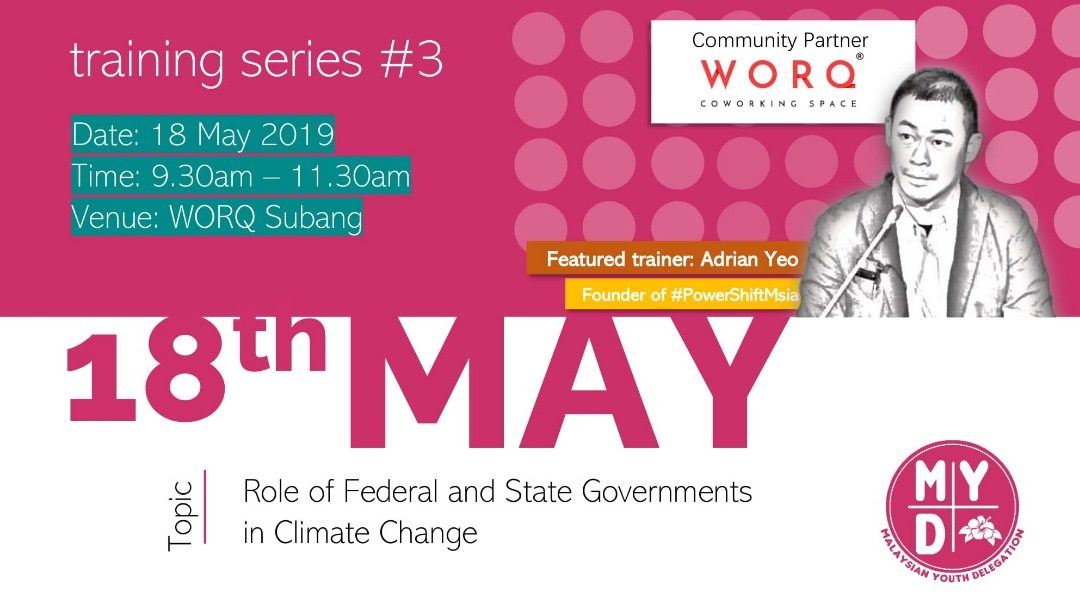
Training Series #3 – Role of Federal and State Governments in Climate Change

Training Series #3 – Role of Federal and State Governments in Climate Change

MYD Training Series #3:

Role of Federal and State Governments in Climate Change with Adrian Yeo 

Curious about climate change policies in Malaysia?

Want to know more about the United Nations Framework Convention on Climate Change or Malaysia’s governance structure and climate change plans?

This Saturday, our featured speaker, Adrian Yeo, will answer these questions and more!

The event is free of charge but there are limited spots.

Registration by clicking the button below or following the link here: 

https://docs.google.com/forms/d/e/1FAIpQLSduNnss3aMZ3WGBLhKLVanR5cANSiuxnGcnGF9UebD8IVlkqA/viewform

Event Details

Date: 18th May 2019 (Saturday)
Time: 9.30 am – 11.30am 
Venue: WORQ Subang
Speaker: Mr. Adrian Yeo, Founder of #PowerShiftMsia’

Our MYD Training Series events are open to the public. So bring your friends and family to learn more about Malaysia’s governance and involvement in climate change and the UNFCCC.

Who is Adrian Yeo?

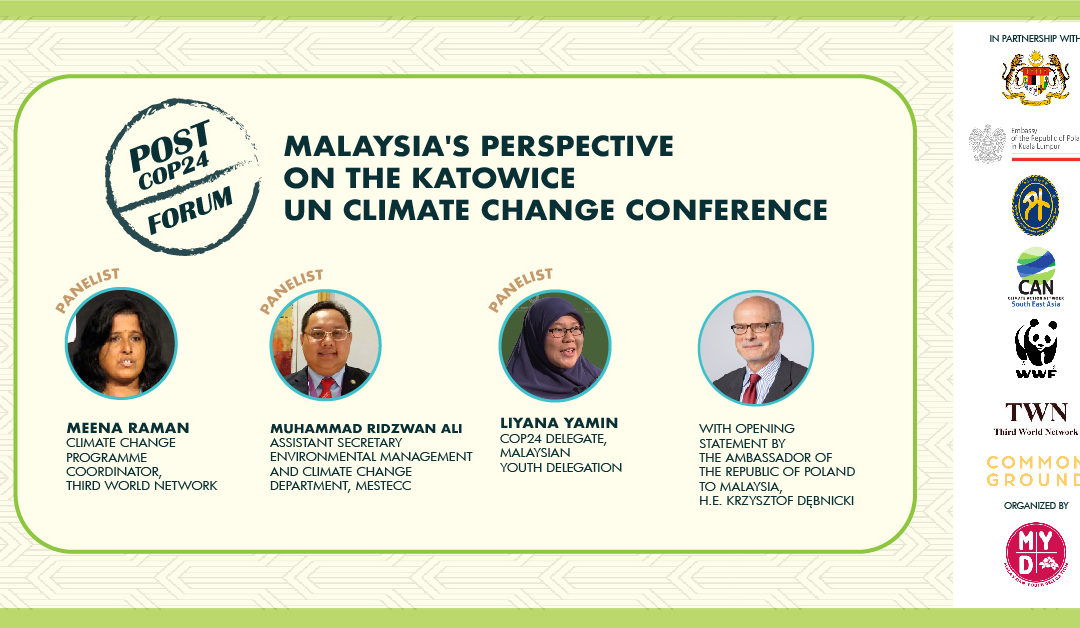
Post-COP24 Forum: Malaysia’s Perspective on the Katowice UN Climate Change Conference

Post-COP24 Forum: Malaysia’s Perspective on the Katowice UN Climate Change Conference

The United Nations Climate Change Conference, COP24, in Katowice was deemed as a turning point for the implementation of the Paris Agreement.

The Paris Agreement Rulebook, agreed on at COP24, acts as an operating manual to guide countries (or “Parties” in UNFCCC speak) to meet the ultimate goal of limiting global temperature rise to well below 2°C.

The release of the Special Report on 1.5 degrees by the Intergovernmental Panel on Climate Change in October 2018 raised concerns over the current level of ambition that Parties have committed to in the face of climate change. Calls for higher ambition at COP24 echoed the sentiments that came out of COP23. But did we get it?

The question still remains; did Parties do enough to raise ambitions? Is multilateralism still alive? Can the international community work together to avoid the worst impacts of the inevitable climate crisis?

Most importantly, where does Malaysia lie in all of this?

Join us at our Post-COP24 Forum to find out! Our distinguished panelists, consisting of Malaysians from the government, civil society, and youth organizations who attended COP24, will discuss the outcomes and how Malaysia fits into the global picture. We will have a Q&A session after the panel session, but please feel free to send us questions beforehand!

Kindly RSVP by 24th January 2019. Registration is FREE and space is LIMITED.

Drop us a message on our social media or at mydclimatechange@gmail.com if you have any questions.

Panel

  • Muhammad Ridzwan Ali, Assistant Secretary, Environmental Management and Climate Change Department, Ministry of Energy, Science, Technology, Environment and Climate Change
  • Meena Raman, Climate Change Programme Coordinator, Third World Network
  • Liyana Yamin, COP24 Delegate, Malaysian Youth Delegation

Opening address by

  • H.E. Krzysztof Dębnicki, Ambassador of the Republic of Poland to Malaysia

Agenda:

10.30 – 11.00 am: Registration and light refreshments

11.00 – 11.05 am: Welcoming Remarks by a representative from the Malaysian Youth Delegation

11.05 – 11.15 am: Opening Statement by H.E. Krzysztof Dębnicki, the Ambassador of the Republic of Poland to Malaysia

11.15 – 11.20 am: Panel introduction by Moderator

11.20 – 12.20 pm: Panel discussion

12.20 – 12.50 pm: Q&A Session

12.50 – 12.55 pm: Closing remarks and presentation of token of appreciation

12.55 – 1.00 pm: Group photo


How to get to Common Ground Bukit Bintang

    1. The nearest MRT station is Bukit Bintang. The walk from MRT Bukit Bintang Pintu D to Menara Worldwide takes about 10 mins.
    2. Parking at Menara Worldwide at RM3.50/hour.
    3. Open space parking across the street next to Shell gas station at RM8.00/entry.

      The Time I Delivered a Speech on Behalf of YOUNGO

      The Time I Delivered a Speech on Behalf of YOUNGO

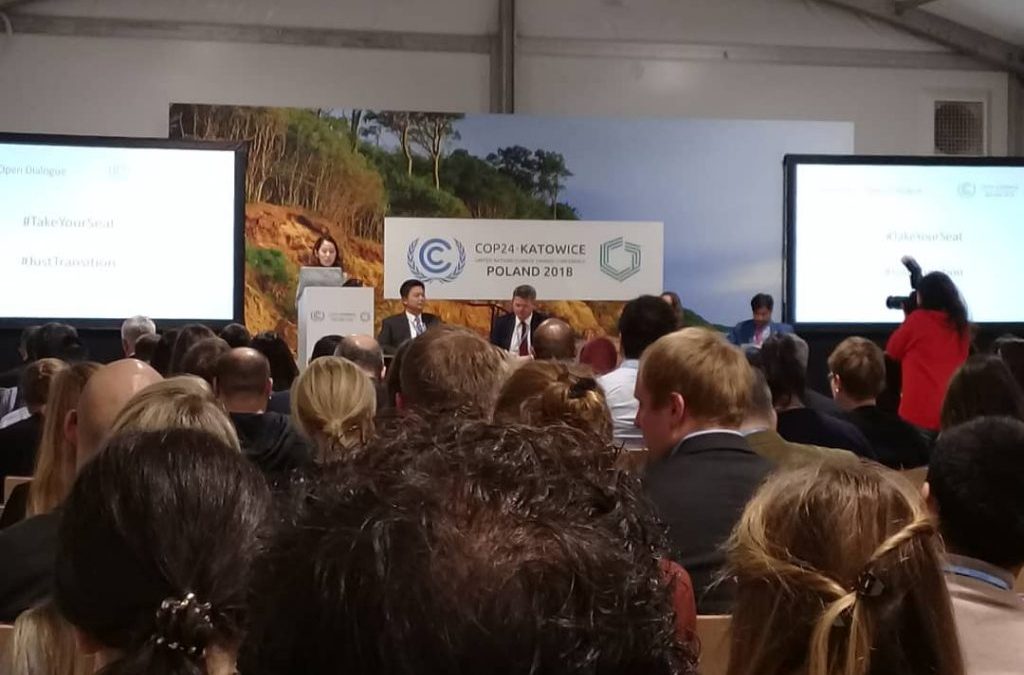
      Hi, it’s me again bringing you more content on just transition. On the 5th of December, YOUNGO was invited to participate in an Open Dialogue with the Polish presidency, centering around the theme of “just transition”. Aimed at engaging key stakeholders, the open dialogue was first initiated during COP 23. According to my YOUNGO peers, the Fijian presidency worked closely with different key constituencies to set the agenda for the dialogue session. There was no such opportunity for collaboration this time around.

      Photo taken by Syaqil.

      With all the action happening on the COP 24 floor, I joined the intervention drafting session on a whim. I was taking a breather in the computer room with some of the MYD members after a morning of informal consultation meetings. Syaqil mentioned that he would be joining the open dialogue speech planning. At the time, I was in a writing rut so I decided to come with. With fellow YOUNGO members, we started drafting the speech without a clue about the format or the layout of the session. The only guidance we received from the Secretariat was the following 5 questions:

      1)    What does Just Transition mean for different stakeholders?

      2)    How can Just transition policies contribute to the long-term goal of the Paris Agreement?

      3)    For which of the recommendations of the SR1.5 will the imperative of a just transition of the workforce be particularly relevant?

      4)    How can different stakeholders contribute to these policies?

      5)    Can we identify common areas among different constituencies and stakeholders that help to achieve a Just Transition?

      We immediately jumped into identifying what Just Transition looks like for different YOUNGO members, and had an hour-long dialogue on our concerns about the future. Although we strayed from writing the actual speech, I felt connected at the core with fellow youth representatives from around the world. The exchange kept the passion for climate action glowing in my core. It’s easy for the older generations to sit around and talk about future ramifications of inaction. But, we the youth will be the ones without sustainable jobs and experience the lack of socioeconomic mobility brought on by a transition into a low-carbon economy. Unanimously agreed that our key messages will touch upon increased ambition, to keep the youth and future generation when planning for a transition, and to involve youth in decision-making processes.

      The result of our brainstorming can be found below.

      Good afternoon everybody.

      My name is Tan Cai May from Malaysia, and I am speaking on behalf of YOUNGO.

      Formally recognized in 2009, YOUNGO serves as the official voice of young people from around the globe in the climate negotiations under the UN Climate Change. It is an independent volunteer-run structure comprising a membership of more than 200 youth-led, youth-focused NGOs, working in the field of climate change and environmental sustainability.

      YOUNGO is delighted to see that steps are being taken to continue the open dialogue platform started at COP23 – we would have appreciated this even more if the room was set up with a square table, which is more conducive for dialogue. YOUNGO played a key role in the collaborative agenda setting of last year´s dialogue at COP23 and is willing to continue such approaches towards this and future UNFCCC sessions to further strengthen the relationship we have built.

      We appreciate the Polish Presidency’s assertion that just transition holds a variety of meanings across different communities. To children and youth all over the world, just transition concerns among other challenges: healthy and clean work environment, labour rights, job opportunities, social security, and community resiliency.

      We, as young people, identify intergenerational equity as the central theme to just transition. Transition involves a change, and we, the young people want to play an even more active role in this process of change. The children & youth are the future and we want to shape our future together with you. Meaningful participation of young people in negotiations and policy-making processes is key in attaining a sustainable and just transition.

      We would like to take this opportunity to point out that ‘just transition’ is only mentioned once and in a vague manner in the Paris Agreement. We believe that it should be properly addressed in the negotiations considering that climate injustice is what’s pushing people to refuse the transition towards a green economy. Furthermore, there should be clear guidelines on how to assure just transition in the process of keeping the temperature increase below 1.5°C.

      We, as children and youth, will continue to pursue opportunities in the workforce that endeavour to create pathways towards limiting greenhouse gas emissions using available innovative and technological approaches, in order to achieve climate resilient development and meet long-term goals of the Paris Agreement. The IPCC Special Report shows that there is no time to wait. We need to raise ambitions immediately, and we need to have a transition starting today. We, as children and youth, have been taking action and will continue to do so. We are already creating change and we urge you to join us in this process.

      Thank you for your attention.

      As the presenter, I was grateful for the opportunity to speak on behalf of YOUNGOs at COP 24. However, there were great points from our discussion that did not transfer over into the speech, and I would like to highlight some of them.

      First, we would like current leaders to acknowledge that our generation will not be as well-off compared to our parents’ generations. Natural resources are depleting at a high rate, and we will have to face the accumulated climate change effects. Our discussion also highlighted the unprecedented effect of exporting externalities to developing countries, where communities are more vulnerable to climate change effects and socioeconomic externalities of modern-day consumerism. In regards to the green technology and clean energy aspect of just transitions, my peers and I agreed that outcomes from the decarbonization movement need to be accessible and affordable to all. We recognized the developed-developing divides and hope that transition issues will improve the disparity rather than exacerbate it.

      At this point, we don’t know if the outcomes of this ‘dialogue’ were documented and presented to world leaders negotiating our future. But why wait on others to do something about it.

      Written by: Cai May

      Edited by: Mike