

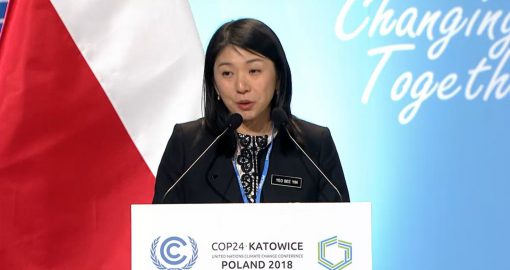

Thank you Mr. President. Mr. President, Excellencies, ladies and gentlemen, good morning. My name is Yeo Bee Yin. I’m from Malaysia, a beautiful, developing country of 30 million people in Southeast Asia. After 61 years of independence, Malaysia has just experienced the first change of government in May this year, and I have been appointed Minister of Energy, Science, Technology, Environment and Climate Change in July, which is about 5 months ago.
So, I’m really a new kid on the block. But let me share with you what I think as a new kid on the block on Paris Agreement, UNFCCC, and COP24. 3 years ago, when Paris Agreement was signed, as someone outside the system looking at it, I was impressed. It was a big feat to get more than 190 countries to finally agree on something. We all know that sometimes we also have difficulties in getting our other halves at home to agree with us, not to mention the 190 countries.
Today, I am inside the system in COP24, but I must say that I am disappointed. To note that after three years, there are still attempts to deviate from the very cornerstone of Paris Agreement, climate justice, the principle of Common But Differentiated Responsibilities, and the equity in the right to develop and to prosper among the developing countries and the least developed world.
How long more do we need to keep going back, keep going back, keep going back to what the basic principles that we have agreed three years ago. How long more before it is too late?
Worst still, I have actually had a look at the financial assistance Malaysia obtained so far, and I was very surprised to note that considerable amount of assistance that we have received so far is to produce reports for UNFCCC obligations or to build the capacity to produce the reports.
How is paperwork going to help our countries and help the world? Very ironically I have come here, I have listened [to] these words, keep on listening [to] these words – urgency, urgency, urgency. Ladies and gentlemen, transparency doesn’t necessarily mean burdensome paperwork. We must know that perfecting reports and making them even thicker will not help to change the world. Real action and aggressive actions will.
So, let me say this, I call upon more trust from the developed countries. Transparency is okay, but do not burden us with unnecessary paperwork please, because we really have no time and we really need to act.
Since we changed the government in Malaysia, Malaysia has been aggressive in our climate change action. Let me share with you a little bit of what we have done. We’ve set a new target to increase our renewable energy in electricity generation mix from 2% to 20%. This excludes large hydro above 100MW. To unlock potential of rooftop solar, we revealed net energy metering policy and introduced solar leasing policy to allow zero up-front cost of solar PV installation.
For other renewable energy, such as biogas, biomass [and] small hydro under the feed-in-tariff mechanism, we introduced e-bidding to maximise the potential of renewable energy funds. We have planned to open up our grid by 2019 to allow renewable energy trading.
We’re going big on energy efficiency too, and government is leading by example. As a matter of fact, as I am talking to you right now, my team is busy finalizing [a] energy performance contract. So, we will be able to tender out energy efficiency projects for at least 50 government buildings by Q2 next year, and we will also table the first draft of Energy Efficiency and Conservation Act by mid of next year.
In terms of financing, [the] government of Malaysia [will] continue [to] bring financing scheme that give loan guarantees and interest subsidies for green industrial players. Recognising the importance of private financing, we [have] also started drafting green financing roadmap and aim to complete them by Q3 next year.
In terms of waste management, we have developed a launch in October – a roadmap towards zero single use plastic by 2030.
In terms of transport, we aim to reduce the carbon emission, we aim to double up our public transport usage from 20% to 40% by 2030. We have recently just launched a very low flat rate unlimited ride monthly pass program to promote the use of public transport.
Excellencies, ladies and gentlemen. In [the] Chinese language, crisis is “WeiJi”. “Wei” means danger and “Ji” means opportunity. There is opportunity in every danger. Many of the initiatives I share with you here are not penalizing us economically but is making good business sense for us in Malaysia.
In the midst of climate change crisis, Malaysia wants to encourage all of us, to see this as an opportunity to develop green economy that create jobs and wealth for the world.
Excellencies, ladies and gentlemen, just now I share[d] with you many of the efforts, but all these efforts [are] done within six months and with very little help from the developed countries. Before I decided to attend COP24, I asked myself, why did I need to come here?
I have many real actions to do at home. In fact, why [does] Malaysia needs to burn so much carbon and money to send our delegation here? It is because [of] our firm belief that Malaysia can do more and can do better with the support of [the] international community. Malaysia can also help others to do better. To simply put, we are better together.
Ladies and gentlemen, we are in this fight together. Let’s fight this together. And most importantly let’s win this together. With that, I’d like to wish [for] a successful COP24, and on behalf of Malaysia, I wish every country presents here a fruitful year of fighting climate change with real action. Thank you.
Just Transition Already Lah
Day 2 of COP 24 kickstarted with much buzz around “just transitions”. Just transition has been described as a just and ethical process to shift to a low-carbon economy, keeping in mind the implications towards socioeconomic, energy and environmental systems. The need for just transition has come up primarily as an environmental justice issue in civil rights movements, before being included in climate change discussions over the past few years.

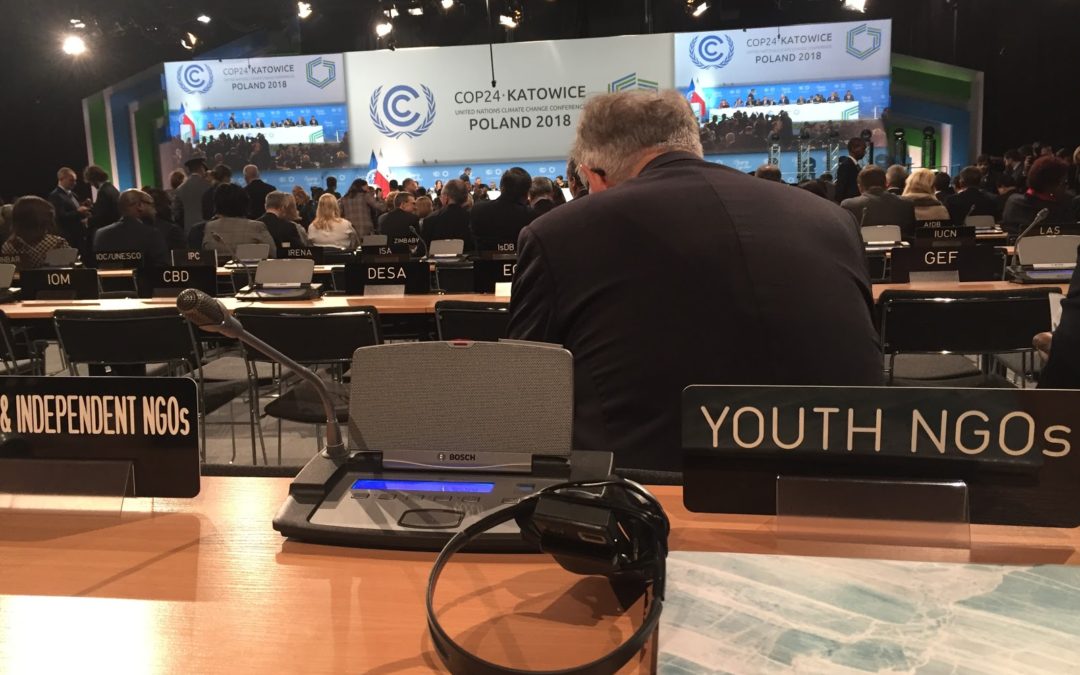
Got to take the YOUNGO seat during the official opening ceremony.
Within the just transition movement, there are groups advocating for the acceleration of low-carbon efforts, and there are groups that call for less ambitious mitigation. Communities experiencing climate change effects and suffering from distributional inequity are coming forward to call for better management of mitigation efforts as the economy undergoes changes. Thematic movements include energy democracy, food sovereignty, and sustainable job opportunities. In the other camp, we have the traditional coal miners and shale frackers who are still relying on fossil fuel extraction to put bread on the table. The tension going forward with decarbonizing the economy has been brewing all these years especially in labor union strongholds of Europe. The gilets de jaune protests are still happening in France as we speak.
The chatter on just transitions in COP 24 came from both sides of the transition story piece. In the beginning of the conference, CSOs were critical towards the Polish presidency’s message (based on my experience at that one pre-COP CAN strategy meeting I attended but still!) In the month leading up to COP 24, the Polish Presidency’s released a three-pronged strategy for the conference, one of which underscores for an ethical and fair shift in market. These key strategies were reiterated during the presidency’s opening speech on the second official day of COP.

COP 24 President Michal Kurtyka delivering the opening address. Photo by Andrzej Grygiel/EPA-EFE.
While the preceding Fijian presidency underlined just transitions for all and especially vulnerable communities that are at the frontline of experiencing climate change effects, the Polish presidency honed in on just transition matters in the coal industry. COP 24 president Michal Kurtyka gave a powerful speech on working together towards a low carbon future, tying in a message on balancing climate action and human behavior. To quote: “How do you tell a population of 5 million in 70 cities in the Silesian region to move on?” This sentiment was shared by the mayor of Katowice, Maric Krupa as he talked about the achievements of the city and how far they have come. Reigning in the message in for the third time, the Polish environment minister Henryk Kowalcyk called for more social cost consideration in decision-making concerning decarbonization. Clearly, Poland was ambiguous about their feelings on transitioning.
Before I continue, I would like to clarify that by no means I am anti-just transition. My take is but a critical lens on what the Polish presidency has to say about just transitions in the COP space because it does reflect on their intended outcomes of COP 24. But I digress. The Solidarity and Just Transition Silesian Declaration was presented by Kowalcyk during the opening ceremony and contains language that is more accommodating towards the Paris Agreement and climate action efforts than I expected. While Katowice takes pride in going from “black to green” in the Upper Silesian region known for its coal production, I think that the Polish presidency, in upholding this model city, fails to address just transition in practice. My Uber driver laid down some quick facts about Upper Silesia for me, as we drove towards the city from the airport. Apparently, there are some 20 (27 as of 2014) coal mines still in operation in the Upper Silesian coal basin, accounting for ~ 74% of coal mining activity in Poland and producing up to 330 million tonnes of coal within the 2010 – 2014 period. The model city, it seems, managed to transform because the region needed a place to grow their service sector and it just so happened to be Katowice. My driver continued to lament about the satellite cities and the collective challenge to “go green”, citing the legacy of a coal-heavy economy. “Mining runs in the family… it’s all they really know how to get an income.”

Coal at the Katowice Pavillion.
During my daily commute to Katowice, I couldn’t help but notice the power plants puffing away in the vast, open fields in between station stops at towns. How is it that countries like Poland wean off coal? To think of it, the transition will happen if you want it or not, it’s the justice aspect that you’ll have to consider. When I dropped by the Katowice pavilion, I thought the whole coal display was distasteful in contrast to the reality of the industry’s future. Soaps and coal pendants available at the nearest tourist information center is not going to get coal miners out of a dying industry, the political will to provide transitional platforms will. Until alternative industries flourish and potential employees undergo suitable training, the Upper Silesian region will only bask in the shadows of monumental “progress” in hosting COP 24 and the climate action success attributed to it. Just transition already lah…
Written by: Cai May
Edited by: Mike