Prior to COP24, I attended a strategy talk session organized by the Climate Action Network (CAN), where they gave an overview of NGO engagement strategies and expectations of negotiation items coming out of COP 24. Having followed the SBI, SBSTA, CMA and APA progress during Bangkok, I am wary that Parties will be able to finalize the Paris Rulebook. Now dubbed the Katowice Rulebook by our Polish counterparts, the rulebook is essential to the implementation of climate goals and ambitions attributed in the Paris Agreement. However, in this short blurb, I would like to shift the focus away from what we want to happen at COP and put things into what it means to Malaysia.
During the side event discussions in the Conference of Youth (COY 14) and the CAN meeting, I noticed the emphasis placed on engaging local stakeholders and policy makers. As COP 24 commences, the focus will be on implementation standards on the international stage. However, the real action will take place on the ground. Youth and civil society organizations (CSOs) voices echoed that we definitely need to be aware of the outcomes of the PAWP among other things, but more importantly, we need to make sure the promises will be implemented by individual Parties.
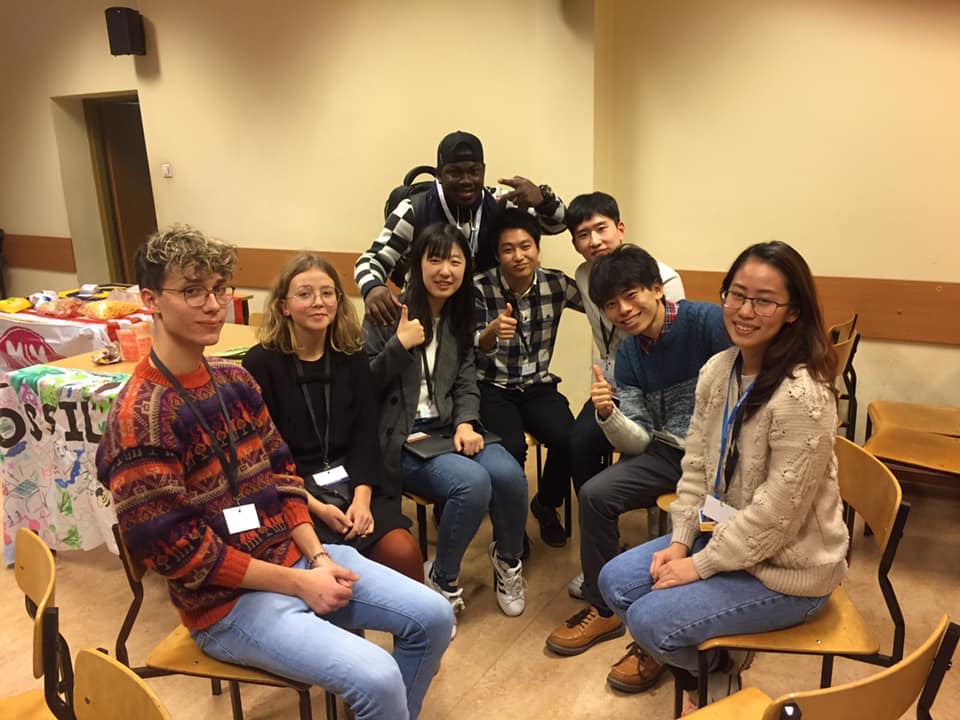
One of the groups I facilitated during COY 14 – a source of inspiration to do more.
So, how do you hold your government accountable?
Step one: You dig around for past legislation and policies relevant level governance (ie. Malaysia, Petaling Jaya, your bandar/community)
Step two: You look at what has been plated and the actions carried out under the stated objectives (ie. Sustainable Petaling Jaya 2030’s goals on a cleaner, greener sustainable city and its free city bus programs)
Step three: Identify areas of success and what could be improved (ie. You liked the bus but you want more bus frequency at the stop in front of your office)
Step four: Submit your suggestions (ie. Go to community meetings, write to them, gather support from people who share similar views as you)
Step five: Follow up!
I took the liberty of looking into Malaysia’s history of climate legislation and policies, partly because I am not well-acquainted with Malaysian law and policy. I found that within the legislative framework, the only relevant statutes have focused solely on fuel and energy supply. Additionally, climate change only popped up on the agenda in the 2010s. The earliest legislative literature is the 1990 Electricity Supply Act that provides guidance on how to regulate energy supply and the energy industry to provide fair and equal access to electricity nationwide. 2013 amendments were introduced to improve minimum energy performance standards (MEPs) for selected electrical appliances, including household utilities. 17 years later, the Malaysian legislature started to regulate biofuel blends under the Malaysia Biofuels Industry Act (2007). These Acts are important in constructing accessible, accountable and efficient energy infrastructure in Malaysia. However, the push for renewable energy took place rather recently, with the formulation of the Renewable Energy Act in 2011 and the Sustainable Energy Development Authority Act in 2011. On an executive level, Malaysia’s five-year development plans have also included strong energy focus, complementing the existing legislation. The 8th to 10th Malaysia Development Plans led to the culmination of the Renewable Energy Act and SEDA Act in 2011.
Around this period, the 6th Prime Minister of Malaysia, Najib Razak, tabled the climate change agenda under his administration. In 2009, he announced in COP 15 and 2014 UN Climate Summit that Malaysia will commit to a reduction of up to 40% of carbon emission intensity of GDP by 2020, using a baseline of 2005 conditions. Stepping up to climate action ambition, Malaysia released its National Policy on Climate Change through the then Ministry of Natural Resources and Environment. The framework emphasized on mainstreaming climate change, and strengthening institutional and implementation capacity. Even though there are 43 actions and 10 strategic thrusts listed in the policy, actions taken so far have not been substantive.
We observe a similar dynamic with implementing Malaysia Intended Nationally Determined Contributions (INDC), published in 2015 as part of Malaysia’s statement of ambition before the ratification of the Paris Agreement. Pledging to an unconditional intended reduction of 35%, the government has not moved forward in aligning Malaysia’s policies for completion before 2030. With the recent change in the Malaysian government, Pakatan Harapan in the PH Manifesto pledged 40% of carbon emissions reduction by 2020, and an increase of renewable energy from 2% to 20% by 2025. However, we have not seen significant measures to implement these administrative measures.
Our minister will be attending the second week of High Level Segment negotiations next week. Even though Malaysia has not made big splashes as a stakeholder at COPs, I would like to know clearer goals and plans she has on climate action in Malaysia. As a signatory to the Paris Agreement, Malaysia should hit the ground running moving towards goals of 2020, 2025, 2030 and beyond. YB Yeo Bee Yin, I would like to see a specific and integrated policy framework to address Malaysia’s ambitions in relation to the Paris Agreement and to Malaysia’s own part to become more sustainable.
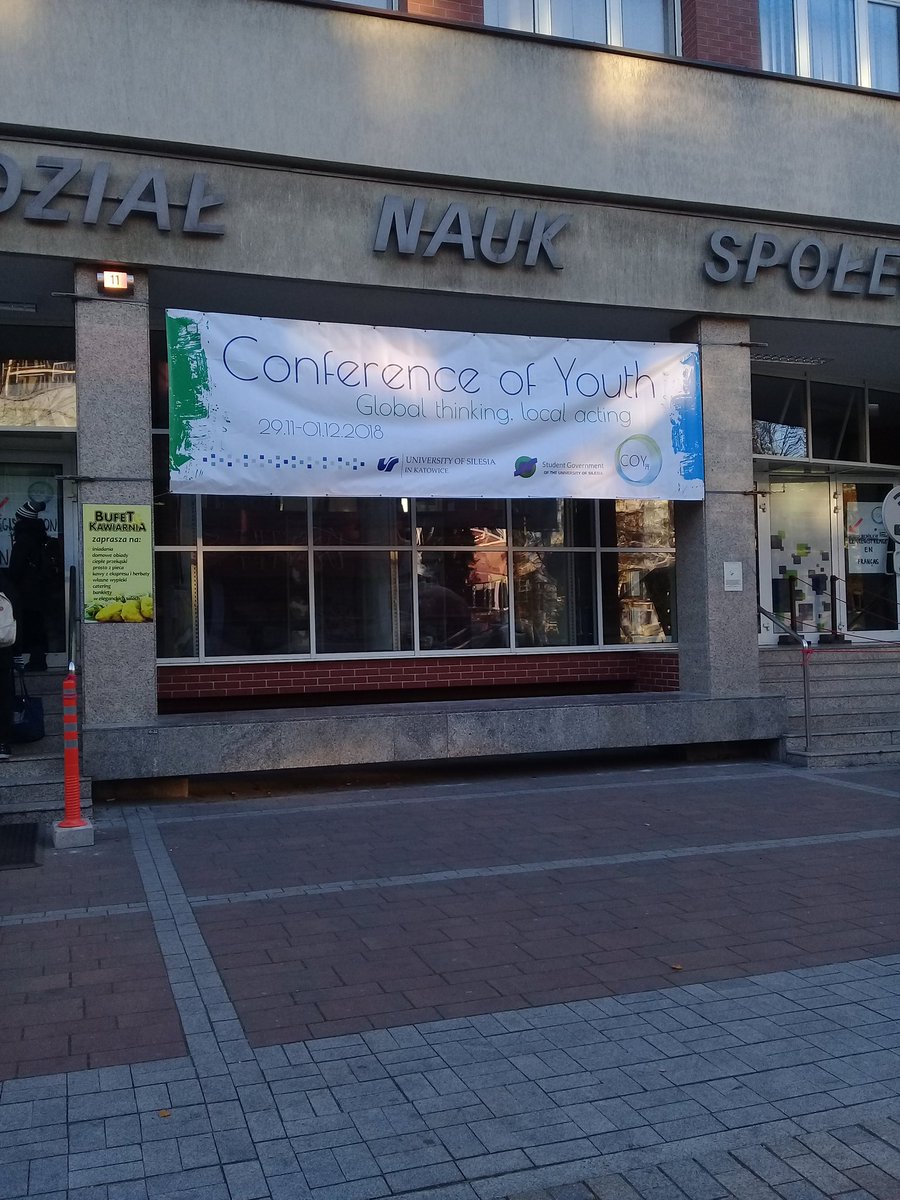
2A gathering for youth formally known as the Conference of Youth (COY) happened in the middle of University of Silesia, Poland. This would be the 14th COY and the focus of the gathering this time would be on the capacity-building process, policy operation and preparation, implementation and climate finance.
This year’s COY had a bit of a twist because they introduced the regional breakout groups before ending the day. The reason why they created the regional breakout groups is to make it easier to discuss mobilization and lobbying issues with a regional focus. These regional breakout groups include a sharing session on how each constituent country can create awareness and a course of action on a national level, as well also focus on the indicators of greenhouse gas emissions (GHG).
Action Climate Empowerment (ACE) is another primary element that was discussed among Youth Constituency (YOUNGO) members with the UNFCCC Secretariat through a bilateral capacity-building meeting. The main agenda for that meeting included enhancing the capability of ACE in terms of mobilization and education based on Article 6 of United Nations Framework Convention of Climate Change (or known as The Convention).
More than 192 NGOs from 72 countries are with YOUNGO to mobilize youth around the world to educate them on climate action and the lobbying process. More than 1,500 youths from all over the world have attended COY’s sessions and are dedicated to ensure change for future generations.
The site for COY was quite hectic and a lot of youths came in and out while participating in the various activities that were available there. There were roughly 20 different activities that covered the focus of this year’s COY. The main hall where the opening speech was held was crowded and fully-seated. The opening speeches were delivered by multiple stakeholders such as Student Government and Board members of the University of Silesia, a Board Member of the Rozdzienski Institute, and YOUNGO Focal Points Yugratna Srivastava and Clara Von Glasow. YOUNGO’s presentations were prepared by their Bottom-lining team.
By the end of the opening speech, there was a presentation on the Local Conference of Youth (LCOY), the national and sometimes regional equivalent of its global counterpart. The presentation and subsequent sharing session covered almost every continent in the world and covered the activities and outcomes of each LCOY.
The first day of the conference was packed with sessions and activities. Everyone was happy with the outcome and the input they received on the first day of the conference itself. Some of the input has been practical for the working groups in the COP Team as well. It’s only just been the first day of the conference though, and there will be another two days before ending the youth conference and the start of the 24th Conference of Parties (COP24). COP24 will take place in Międzynarodowe Centrum Kongresowe (MCK Spodek), Katowice for the next two weeks after the end of COY14..
After traveling for a total of about 48 hours, I was more than glad to settle into our quaint little apartment, lock, stock and barrel. After what seemed like an eternity of brisk walking, navigating and mad-bursts to catch buses and trains, it was pretty difficult not to lose one’s self in a hot steamy shower followed by well-deserved slumber.
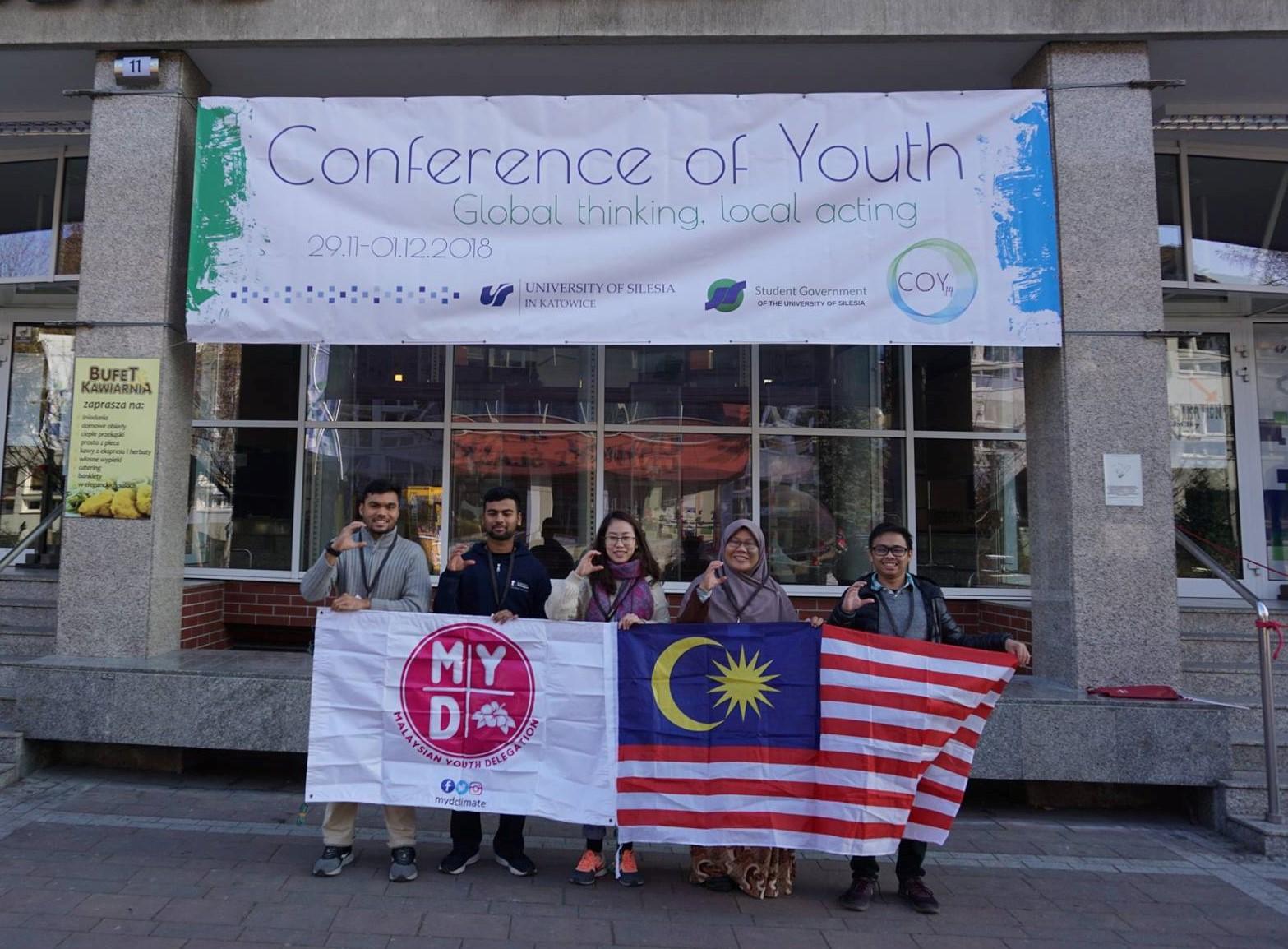
MYD’s COP24 team at COY14, from left to right: Syaqil, Varun, Cai May, Liyana and Shaqib
Ironically enough, the mad-bursts to catch trams and/or buses, on top of the occasional grab, did not stop – as evident during the first day of COY 14. Having left our Airbnb at 6.15 in the morning to catch the 7 o’clock bus to Katowice seemed straight forward, until it dawned upon us that the chance of getting lost in an unfamiliar city is too familiar a likelihood. Not only did we miss Bus 141 which was to take us to the tram station that was supposed to take us to Blonia Park – where the COP bus will be stationed – Tram 24 cynically decided to appear on the other side of the road, leaving us in a state of disbelief. Determined not to have our spirits dampened by a triviality, we decided to walk to Blonia Park, being aware that it was a straight path anyway, albeit it being the road less travelled – or so it looked that way.
After having walked for about 10 minutes whilst simultaneously looking for our elusive bus to Katowice, an unremarkably grey bus zoomed by us and to our incredulity, it bore a neon green COP24 banner. As if it were already second-nature to us, we made a beeline for our bus, though with each passing second it seemed to have shrunk more and more until it was no longer conceivable to the naked eye. No matter, we kept on marching like the proverbial troops we were, trudging towards base camp in the field of battle, where lo’ and behold, there she was like an obedient wife waiting for her husband, that unremarkably grey, beautiful miraculous bus stationed not too far off from where we thought we lost her.
The rest of the day flowed smoothly in such a sequence: I half attended a climate change education game followed by the first YOUNGO induction cum briefing session (I half attended the former as it clashed with the latter). That followed by a breakout session into respective YOUNGO working groups, where I decided to pursue my interest in renewable energy. I was a little apprehensive with regards to the renewable energy WG as there was little indication that it was going to be active prior to COP, but my concerns were banished during the YOUNGO session when it was announced that such a group does exist and that it has a predetermined agenda.
Nonetheless, it was slightly concerning that the person handling the renewable energy working group is also handling the oceans working group, albeit temporarily as he waits for his colleague to take charge as she will only be coming in late for COY. I was also slightly taken aback at the revelation that the working group facilitator had to leave for Bonn the next day as he is to speak at the Global Landscape Forum.
No matter. I take this as an opportunity for the team to take ownership of the working group and produce meaningful outcomes. During COY13, I found myself to be disconnected and detached from the spirit of the conference, feeling lost and overwhelmed (it didn’t help that I came in halfway into it either). But with COY14, I feel that I’m coming in with a bit more confidence and a sense of purpose. Just like how some say that the failure of the Copenhagen Accord was necessary for the advent of the Paris Agreement, the shortcomings I faced at COY13 and COP23 leaves me no choice but to succeed at only my second ever COY and COP.
Changes in the world’s climate has, and will continue to bring major shifts in food production. This includes the rise in temperature, increase in rainfall and coastal flooding that reduces the amount of land available for agriculture. In a nutshell, food crops and as it follows, food security, are sensitive to climate change.
After a successful SEEDS Malaysia back in 2014, it is back this year with the theme “GET REAL”.
This year’s theme could not be more timely – as the world’s population grows at an alarming rate, the increasing demand for food has put a strain on the planet’s resources to cope with feeding billions of people.
The event will be happening on 19th – 21st October 2018 at Oasis Discovery Centre (ODC), Oasis Village.
Throughout SEEDS Malaysia 2018, 2 of these events will be happening concurrently;
Together with SEEDS, Power Shift Malaysia will participate as the youth counterpart. The Youth Forum is an event organised by the youth for the youth with the objective of raising awareness about climate change and food production. Topics from food production to youth action on climate change will be discussed throughout the event.
Do you know what is LAGI BEST?! SEEDS is providing sponsorship to those who are really interested to participate in this event! T&C applies.
My name is Prattana. I work for the International Forestry Cooperation Office under the RFD (Royal Forest Department), under the Ministry of Natural Resources and Environment. I have worked for the government for 21 years, but previously I was involved with the royal forestry department and I have dealt with climate change for exactly 5 years.
Prattana Meesincharoen at the United Nations ESCAP, Bangkok
What is your role here in Bangkok?
I follow topics on
REDD+ (reducing emissions from deforestation and forest degradation in
developing countries), but unfortunately here in Bangkok they don’t negotiate,
it is not in the agenda. Therefore, I follow other topics like article 6 under
Paris Agreement, non-market mechanism, something like that. I chose article 6
because we don’t know whether or not there will be a concrete idea. Non-market
can be a mechanism for REDD+, therefore I am tracking it here in Bangkok.
What made you get involved with climate change?
I think that climate
change is an interesting topic and it is very important for the place and time.
It affects my daily life and also from my work, the forest sector, it is
important to solve climate change. In Bangkok now, we have many episodes of heavy
rains, and I think that it has never happened before. Also, there are more
flood events in Thailand and also our neighbour countries like Laos and
Myanmar. It is all due to heavy rains.
How will you explain climate change to someone
who doesn’t understand it?
It’s hot (laughs). I think that for the general people, maybe it is difficult to think about what climate change is. The first thing they think is that it is hot, but it’s way more than that. If you follow the conferences (UNFCCC) or if you read a lot, it will make you understand more about climate change, understand what is it and how it will affect our daily lives.
What is the one thing that you would want
people to know about climate change?
Climate change is
caused by everyone. Everyone has the responsibility to solve it. I think that
everyone here know what climate change is, and everyone come from a different
sector, so they have their own policy and their own ways to solve climate problems.
Article 10, paragraph 4 of the Paris Agreement has established a technology framework to provide an overarching guidance to the work of the current Technology Mechanism. The principles of this framework, which includes coherence, inclusiveness, result-oriented approach, transformational approach and transparency will provide guidance on the promotion and facilitation of technology development and transfer. This supports the implementation of the Paris Agreement, in the pursuit of its long-term vision of improving resilience to climate change as well as to reduce greenhouse gas emissions.
Purpose of the technology framework
So will the technology framework help the Technology Mechanism? What do Parties think of the framework? Here in Bangkok, I attended informal consultations regarding technology framework as well as the Technology Mechanism to find the answers.
Informal consultations in SB48-2
The informal consultations, aka negotiations on technology development and transfer were discussed in two of the subsidiary bodies to the UNFCCC, which are the Subsidiary Body for Scientific and Technological Advice (SBSTA) and Subsidiary Body for Implementation (SBI). In SB48-2, SBSTA covers matters regarding the technology framework (Agenda 5), while SBI covers matters regarding the Technology Mechanism (Agenda 14a).
In means to guide the flow of the negotiations, Parties were asked to comment on the following questions regarding the framework:-
Is the technology framework a guidance for Technology Mechanism?
Is the guidance clear enough? Does it align with the principles of the technology framework?
Is the guidance in coherence with the provisions in the technology framework? Does it repeat or overlap with other provisions?
During the first informal consultations, one Party specifically commented that tremendous progress have been made since the last meeting in Bonn, and hopes that this session in Bangkok will be as efficient as before. But has it? Well, sort of.
What do Parties think of the Technology framework?
Generally, parties had shown their positive views towards the framework. Nevertheless, the framework itself have much room left for improvement, in terms of the small scope of the entire framework, taking into account the fact that this framework is supposed to guide the already existing Technology Mechanism.
One of the major issues that was brought up during the informal consultations by developing countries was that developing countries lack financial resources for the technology framework. Although developing country Parties have all agreed that more financial resources should come from developed countries, developed country Parties did not align themselves with the idea. “I will lose my job if I align my country with said proposal.” However, without compromising, the technology framework may not be able to meet its principles of being inclusive. Another issue that has been brought up by Parties were that the structure of the framework itself does not contain elements that specifies the guidance from the framework to the Technology Mechanism.
With some of the Parties browsing through Facebook and some of the observers snoring beside me, I wonder if the sessions of informal consultation for technology development and transfer are held important at all. From my point of view, at this stage of negotiations, the technology framework may not reach its full potential in facilitating the Technology Mechanism. It is, unless developed and developing country Parties cooperate and compromise in Katowice, the framework will just be rendered pointless. Also, considering the fact the scope of the technology framework is covers only this much, will the technology framework actually complement the existing Technology Mechanism and help in improving it? We’ll know very soon.